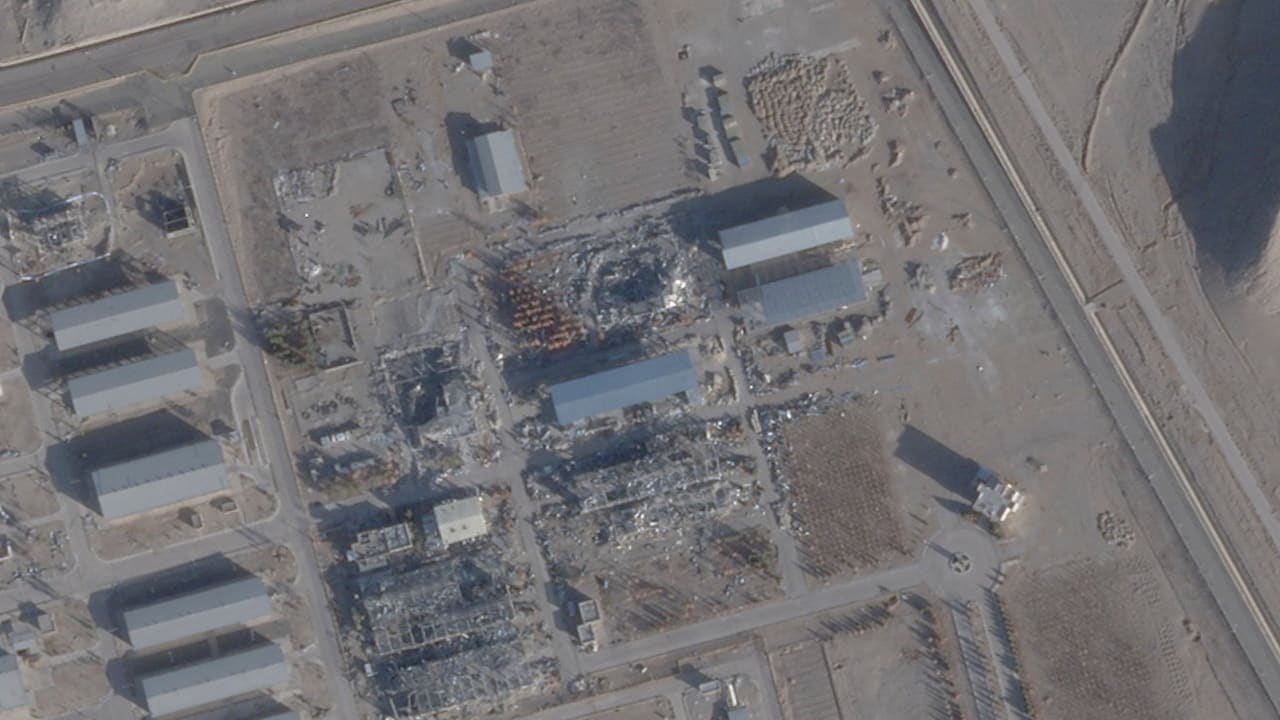
The Islamic regime is likely preparing for the possibility of a US strike, experts told The Jerusalem Post on Tuesday after reviewing high-resolution satellite images of the Isfahan nuclear complex taken Vantor on Sunday.
The images revealed the regime has covered the middle and southern entrances of the nuclear facility with soil, and the northernmost tunnel entrance, which features additional passive defense measures, is also backfilled with soil.
“Backfilling the tunnel entrances would help dampen any potential airstrike and also make ground access in a special forces raid to seize or destroy any highly enriched uranium that may be housed inside difficult,” the Institute of Science and International Security noted. “Preparations like these were last observed in the days before Operation Midnight Hammer struck facilities at Fordow, Natanz, and Isfahan.”
Jonathan Hackett, a former US Marine Corps veteran who served for 20 years specializing in counter-intelligence with attachments to the National Security Agency, Defense Intelligence Agency, and special operations units, told The Post, “The late January and early February 2026 activity around the Isfahan Nuclear Complex is likely part of a larger push to create defensive layers to the Islamic Republic’s nuclear and ballistic missile facilities in anticipation of a possible US strike.”
“While engineering units were backfilling these tunnels in Isfahan, the IRGC was similarly surging to protect ballistic missile sites,” he continued. “On January 31, 2026, specialized IRGC Ground Forces units deployed around the country to provide additional security at strategic missile facilities critical to Iran’s defense-in-depth against a US attack.”

Hackett explained that the distribution of forces is part of Iran’s two-decade-old strategy called ‘the Mosaic Doctrine,’ where “the IRGC Ground Forces and IRGC Aerospace Forces work together to secure the physical infrastructure the regime needs to transport, store, and protect short- and medium-range ballistic missiles at sites throughout the country that would be used against regional targets in the event of a US attack against Iran.”
Tehran and Washington held indirect talks last week in Tehran as tensions have mounted over the Islamic regime’s nuclear ambitions and its brutal crackdown on protests, which have seen tens of thousands murdered across Iran and widespread human rights violations.
While some Iranian officials have said that Iran could agree to dilute its stockpile of 60% enriched uranium in exchange for the lifting of all sanctions imposed against its nuclear program, Iranian Foreign Minister Abbas Araghchi previously insisted that a complete halt to uranium enrichment is absolutely unacceptable to Iran.
“The discussions should focus on scenarios in which uranium enrichment continues, alongside assurances that the enrichment is solely for peaceful purposes,” he said.
Dr. Lynette Nusbacher, a former British Army intelligence officer and one of the architects behind two of the UK’s National Security Strategies as part of Britain’s National Security Secretariat, told The Post that the movement around the Isfahan site was likely a message connected to the latest talks.
“Iran is protecting these facilities in ways that are observable from satellites, as this open source reporting shows,” Nusbacher explained. “It is certainly easier to get a couple of bulldozers to clear the entrances than it is to rebuild the place after a Tomahawk or a Massive Ordnance Pentetrator turns these facilities into craters.”
“I think that Iran’s national security people have clearly assessed, perhaps in light of last week’s face-to-face discussions between Iran’s foreign minister and the American envoys, that they are being told either to give up their nuclear programme or have it destroyed by American force of arms,” Nusbacher continued.
The only solution to Iran’s nuclear ambitions is for its people to establish a new government
At the same time that Tehran is sending this message, Nusbacher said that Washington is “in the process of rather theatrically demonstrating a readiness and even an eagerness to attack Iran, including regime targets. This buildup is, in my view, designed to shape Iran’s participation in talks with President Trump’s envoys on the future of their nuclear programme; but it is also a signal that the United States might be ready to make a far more committed set of attacks against Iranian nuclear targets than they did last year. This is particularly so because last year’s attacks, whatever their intent, appear not to have had a decisive effect.”
Noting that Tehran has previously agreed not to pursue nuclear weapons, and denied the existence of its ambitions while continuing to enrich Uranium, Nusbacher stressed the “only long-term solution to the Iranian nuclear programme is for the Iranian people to find themselves a government that is more interested in the needs of the Iranian people than in seeking to dominate the region.”
Sharing similar thoughts, Dr Efrat Sopher, an Iranian-Israeli security analyst and chair of the Board of Advisors at the Ezri Center for Iran and Gulf States Research at the University of Haifa, also commented, “One wonders what the Iranians are hiding in Isfahan. They also seem to be expecting some sort of kinetic engagement. This is puzzling as one would assume that in the event of an attack on the complex in Esfahan, it would be bombed from the air.”