
European Union leaders have agreed on the need for reforms to revive Europe’s struggling economy but left an EU summit with diverging views on the role of public funding.
German Chancellor Friedrich Merz reiterated his opposition to financing reforms through joint debt instruments such as eurobonds at the close of the gathering on Thursday.
“I made it very clear that, even if there are other opinions on the matter, I cannot agree to financing European Union projects through eurobonds,” Merz said after the meeting at Alden Biesen Castle in Belgium.
He noted that Germany’s Federal Constitutional Court has set clear limits on joint borrowing and stressed: “We have to make do with the money we have.”
The summit was convened to find common ground on how to respond to growing global competition from the United States and China and to address internal challenges such as high energy prices, excessive bureaucracy and complex rules that hamper growth in the 27-member bloc.
French President Emmanuel Macron and Italian Prime Minister Giorgia Meloni expressed support for taking on joint debt.
“Innovation requires more financing, matter of fact. You can like it or not, but it’s a matter of fact,” Macron said.
He urged fellow leaders to calmly consider raising money on capital markets for shared priorities.
Merz said that financing would be discussed in the coming weeks and months, calling it “a very difficult undertaking.”
Reducing barriers and boosting investment
Despite disagreements over funding, EU leaders agreed to push for reducing persistent trade barriers within the bloc to improve the investment environment and foster growth.
Experts say the fragmentation of national rules costs the EU more than external tariffs.
But efforts to streamline national rules for businesses and financial markets have proven difficult.
As a result, the bloc is considering introducing an additional set of EU-wide corporate rules for companies operating across multiple member states.
A proposal is expected before the next leaders’ meeting in March and aims to allow companies to operate seamlessly across the EU with a single set of rules, European Council President António Costa said.
Leaders also agreed to accelerate work on harmonizing capital markets across the EU to attract private investment.
“Europe needs a single and efficient financial system which can better turn European savings into investments,” Costa said.
The European Commission has proposed creating a so-called savings and investment union, although harmonizing financial rules has been challenging in the past.
Other ideas discussed include giving preference to European companies in certain sectors to channel more funds into domestic economies.
Costa highlighted defence, space, clean technologies, quantum technologies, artificial intelligence and payment systems as strategic areas.
Energy prices, carbon pricing and reform pressure
Europe’s industry continues to struggle with comparatively high energy prices.
European Commission President Ursula von der Leyen pledged to advance efforts to reduce dependence on fossil fuel imports, integrate energy markets and improve grid infrastructure.
High energy costs have also fuelled resistance to the EU’s carbon pricing system, particularly in countries that rely heavily on fossil fuels for electricity and heating.
Under the EU Emissions Trading System (ETS), businesses in sectors such as electricity generation, industrial manufacturing and aviation must buy allowances for their greenhouse gas emissions.
The system currently covers around 40% of total EU emissions.
Von der Leyen said the Commission would present a long-planned assessment of the ETS in the coming months.
Leaders pledged to accelerate reforms, although Europe’s economic challenges have persisted for years.
Industry representatives expressed frustration over the slow pace of change, urging leaders to move from plans to concrete results.
“We urge you to move from diagnosis to delivery, and from plans to results, with a single objective: Save our industry. Not next year, not next week, but today,” a joint statement by leading European companies said.

German Chancellor Friedrich Merz and French President Emmanuel Macron arrive to the EU leader’s informal meeting in Bilzen. FREDERIC SIERAKOWSKI/European Council/dpa
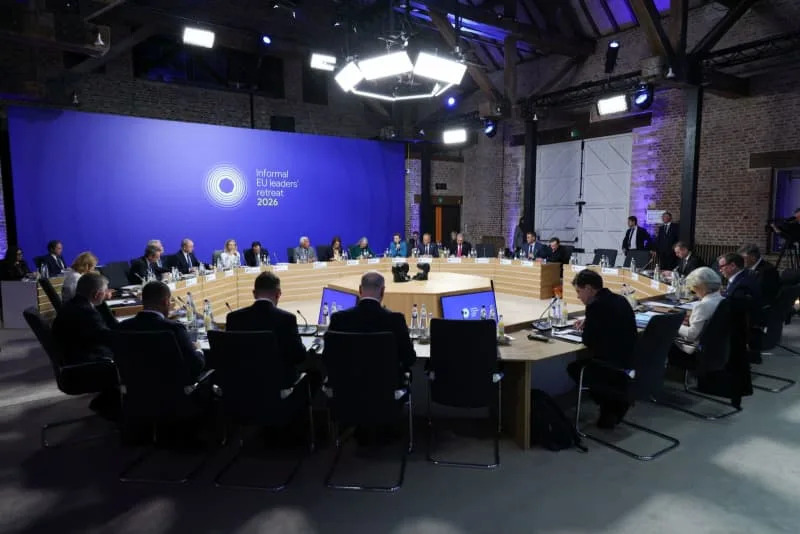
General view of EU leaders during their informal meeting in Bilzen. Alexandros MICHAILIDIS/European Council/dpa