
At a moment when the United States is again turning inward on climate policy, California is looking outward.
On a gray winter morning in Munich, Gov. Gavin Newsom stepped onto the stage of the Munich Security Conference, a forum more commonly associated with war, NATO strategy and geopolitical brinkmanship than with carbon pricing or zero-emission vehicles. The panel was titled “Playing With Fire: The Need for Decisive Climate Action,” and its framing was deliberate: climate change not as an environmental sideline, but as a security threat.
As President Donald Trump renews efforts to withdraw the United States from the Paris Agreement and recalibrate traditional alliances, Newsom arrived in Germany with a different message. California, he said, intends to remain engaged.
“While Donald Trump continues to demonstrate that he is unstable and unreliable, California is leaning in on the partnerships that make California stronger, Americans safer, and our planet healthier,” Newsom said. “Growth and security depend on democratic values, credibility, and climate action. California delivers all three.”
The Munich Security Conference has long been the world’s premier gathering for debating international security policy. That a U.S. governor — rather than a federal official — would seek to occupy that space illustrates a shift that has been unfolding for nearly a decade: in the absence of consistent federal leadership on climate, subnational governments have begun to conduct their own version of diplomacy.
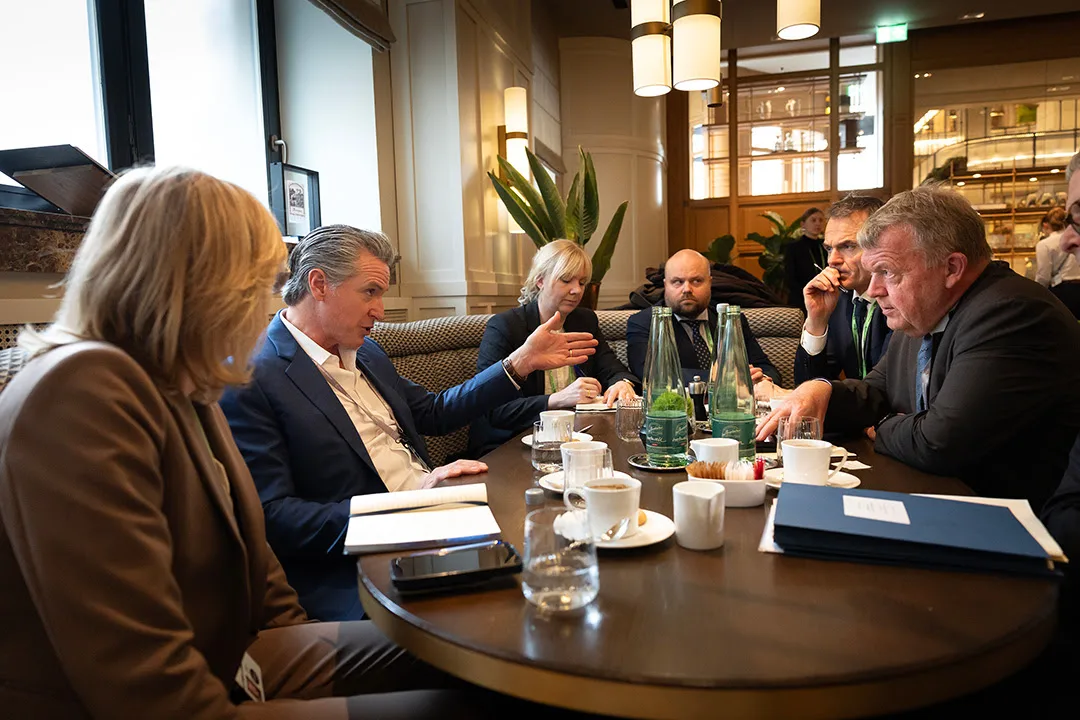
Newsom’s day in Munich was structured less like a ceremonial visit and more like a trade mission layered with geopolitical symbolism. He met with Lars Løkke Rasmussen, Denmark’s foreign minister and former prime minister, to expand on a 2025 memorandum of understanding between California and Denmark focused on the green economy, digital safety and innovation.
He then sat down with Carsten Schneider, Germany’s federal minister for the environment, climate action, nature conservation and nuclear safety, to discuss renewable technologies and economic growth.
Later, he met Wopke Hoekstra, the European commissioner for climate, net zero and clean growth, to talk about zero-emission vehicles and California’s Cap-and-Invest carbon pricing system.
The choreography was unmistakable. As Washington signals retreat, Sacramento seeks relevance.
On the conference’s main stage, Newsom joined Ralph Regenvanu of Vanuatu, Lídia Pereira of the European Parliament and Andrew Forrest, the executive chairman of Fortescue, in a conversation moderated by Bloomberg’s Francine Lacqua. The topic was climate finance, geopolitical instability and whether subnational actors can preserve international cooperation when national governments falter.
California officials argue that they can. The state cannot formally bind itself to the Paris Agreement — that authority rests with the federal government — but it can pursue policies aligned with the agreement’s temperature goals and build networks that function in parallel to federal diplomacy.
When Trump first withdrew from Paris in 2017, California co-founded the U.S. Climate Alliance, a coalition that now includes 24 governors representing roughly 60 percent of the American economy. Newsom now co-chairs the group. The alliance’s premise is that states can continue to meet emission targets regardless of federal participation.
Beyond domestic alliances, California has quietly built what it describes as the largest network of subnational climate cooperation in the world. It is a co-founder of the Under2 Coalition, a group of more than 270 governments committed to limiting global temperature rise to under 2 degrees Celsius.
It joined the Beyond Oil & Gas Alliance in 2021, signaling support for a gradual transition away from fossil fuel production. At COP28 in Dubai, California launched the Subnational Methane Action Coalition to curb methane emissions, a powerful greenhouse gas responsible for nearly a third of current warming.
The agreements stretch across continents: Brazil, Denmark and Kenya in 2025; Noord-Holland in the Netherlands in 2024; Australia and British Columbia in 2023; and multiple Chinese provinces and municipalities. California also maintains partnerships with Baja California and Sonora in Mexico, focusing on zero-emission freight corridors and clean manufacturing.
These are memorandums of understanding, not treaties. They lack the binding force of federal agreements. Yet they carry practical consequences, shaping regulatory standards, aligning markets and signaling long-term policy stability to investors.
California’s argument for credibility rests partly on its numbers. Since 2000, state greenhouse gas emissions have fallen 21 percent, even as gross domestic product has risen 81 percent.
In 2023, two-thirds of California’s electricity came from clean sources, the state says, making it the largest economy in the world to reach that threshold. Battery storage capacity has expanded more than twentyfold under Newsom, reaching nearly 17,000 megawatts.
For foreign officials wary of the oscillation of American federal policy, those metrics are meant to offer reassurance.
Still, California’s climate diplomacy exists within constitutional limits. States cannot negotiate trade deals or bind the nation to international accords. And critics argue that the symbolism can outpace the substance — that memorandums may overpromise while implementation depends on domestic politics and funding.
In Munich, though, the symbolism mattered. The conference has historically served as a barometer of Western cohesion. This year, with transatlantic tensions simmering and global climate negotiations fragile, the presence of a U.S. governor attempting to fill a perceived vacuum carried its own message.
It suggested that in a fractured era, American influence may flow not only from Washington, but from state capitals — and that climate policy, once treated as a niche portfolio, has become inseparable from economic strategy and national security.
For Newsom, who has increasingly positioned himself on the global stage, the trip also reinforces a broader narrative: that California is both laboratory and ambassador, projecting a model of economic growth decoupled from rising emissions.
Whether that model can withstand the political turbulence at home remains an open question. But in Munich, as presidents and prime ministers debated security and sovereignty, California made the case that climate — and credibility — are now part of the same conversation.
Follow the Vanguard on Social Media – X, Instagram and Facebook. Subscribe the Vanguard News letters. To make a tax-deductible donation, please visit davisvanguard.org/donate or give directly through ActBlue. Your support will ensure that the vital work of the Vanguard continues.
Categories: Breaking News Environment State of California Tags: California California CLimate Policy Climate Action Gavin Newsom Gov. Gavin Newsom Munich Security Conference Paris Agreement President Donald Trump Trump Administration