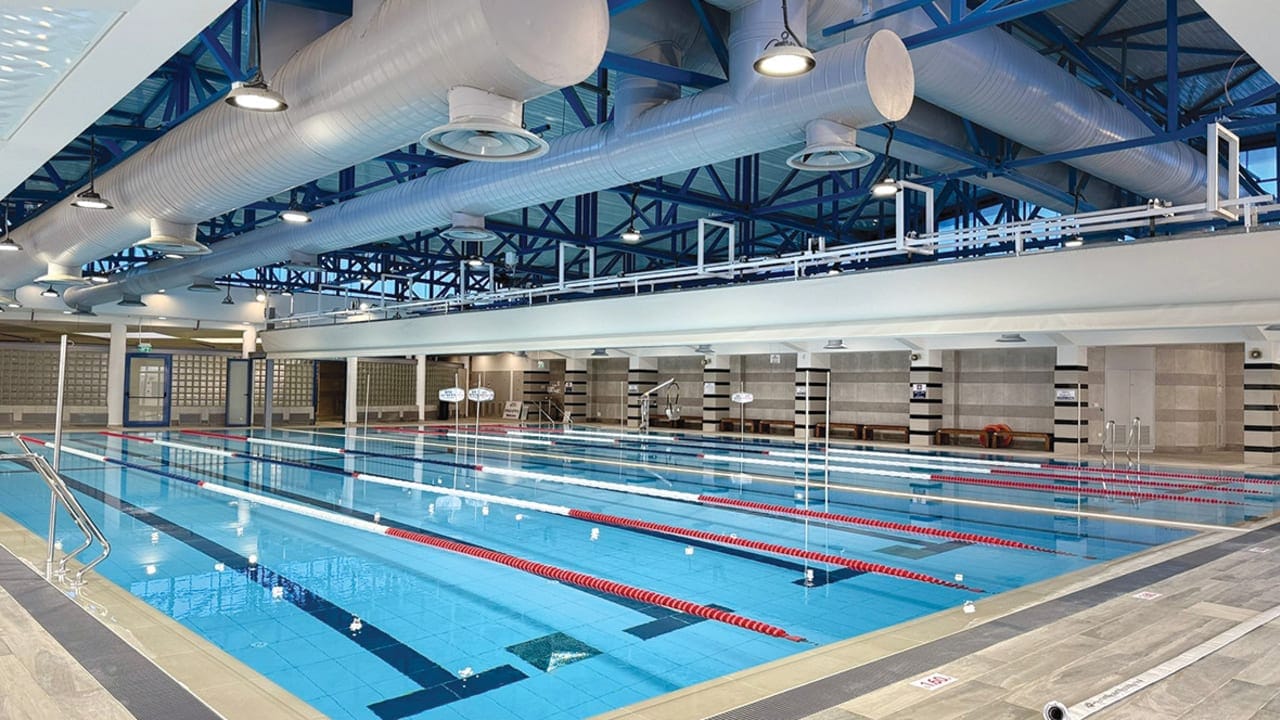
Until recently, there was a longstanding joke in Efrat about whether the proposed swimming pool or the Messiah would come first. Now, the community, located in the Judean Hills just south of Jerusalem, has something that does not exist anywhere else in the world – a community pool with a mechitza: a mechanical wall that divides the pool in half.
A significant percentage of Orthodox Jews avoid swimming in mixed-gender settings. To meet their religious requirements, they need separate swimming hours or entirely separate swimming facilities for men and women.
Existing pools in Israeli communities generally operate on one of two models. Either they serve a religiously diverse population and are available for mixed swimming all the time, or they operate on a schedule that alternates among hours for men, women, and families.
Efrat’s founding rabbi, Shlomo Riskin, a serious swimmer, had a different vision. In keeping with the city’s hallmark outlook of balancing Jewish law and modernity, Riskin envisioned something so revolutionary that there was no precedent for it. Now Efrat has an eight-lane pool with a middle divider that opens and closes, enabling men and women to swim separately – at the same time.

The idea of building a pool in Efrat dates back decades. The actual construction of the project took 10 years – and NIS 40 million ($13m). According to Ryan Levin, executive director of the Efrat Development Foundation, also known as Keren Efrat, about 25% of the funding was provided by Mifal HaPais (the Israeli lottery) and other government allocations. Efrat’s municipality provided another 55%, and the Kleinberg Family Foundation, a philanthropy with family connections to the community, provided the remaining 20% through Keren Efrat.
Levin said that Riskin’s idea of creating a pool with a built-in divider that could be raised and lowered “seemed like fantastical thinking – and we made it practical.” Any pool construction must comply with specified requirements; Riskin’s vision went way beyond that.
“The mechitza has to go up and down: That’s a different problem. How do we, in a wet environment, have something safe and sturdy? It took a lot of testing to get it right,” Levin explained. “Part of why it took longer than expected was a lot of trial and error. The technical team worked very hard trying to figure it out.”
Levin said that “Outside of Israel, there are very few pools exclusively for the Jewish community. It makes sense that this [innovation] happened in Israel – and in a community that is both Orthodox and modern.”

Reactions to the pool design among Efrat residents tend to fall into two camps. To those for whom separate swimming is a religious priority, the pool with a mechitza offers “a real, meaningful, actual solution for those who require it,” Levin noted.
Shira Schreier, a grandmother of 13, has been living in Efrat since 1989. She joined the pool as soon as it opened and swims almost every day. “The pool is a dream come true for me. I love to swim! I love the water aerobics classes!” she enthused. “The presence of the mechitza is genius as far as I’m concerned. There are four lanes for men and four lanes for women – and each [gender] goes out to their respective locker rooms.
“The design of the pool and the schedule are both perfect for me! The pool manager, receptionists, and lifeguards are all friendly and professional. The pool is new, clean, and beautiful, and it has greatly enhanced my physical and emotional health,” Schreier said.
“I love the new Efrat pool, and I am extremely grateful every day. I feel like I should make a blessing every time I go swimming.”
Leah Bernstein of Efrat is another satisfied user. “I think the mechitza is a wonderful solution to allow many hours a day of separate swimming.” She pointed out that there are no transparent windows on the women’s side, “to prevent people from looking in. I appreciate the time and effort put into planning the pool.”
Not a good match for others
For those critical of the setup, it’s generally not so much about the mechitza itself as it is about the pool’s design and scheduling policies that don’t meet their family’s needs.
Along with her husband and four children, ages seven to 11, Shaina Warshay has lived in Efrat since 2020. After visiting the pool once, the Warshays concluded that it wasn’t a good match for them.
“The layout of the pool precludes our family from fully enjoying it,” she said. “The family wading pool is in a separate room from the full-sized pool, so unless both my husband and I come, the kids have to choose one or the other. My kids did not enjoy the family time. The small area allocated to families was loud and crowded,” which makes lap swimming impossible. And if her children who genuinely want to swim want to go when it’s not family time, they can’t go with the parent of the opposite gender.
“I understand the desire for some to have separate swim hours for men and women,” Warshay elaborated. “I think the city did not take into account that there may be residents who don’t care if there are separate swimmers all the time.” She also made the point that the current configuration doesn’t allow any opportunity for adults “who may want to swim as a couple without the noise and crowding of young families present.”
Not so family-friendly
Wendy Erdheim-Poch, her husband, and two young boys have been living in Efrat for almost 10 years. A member of the pool for a few months, she indicated that, while separate swimming is not her priority, the mechitza, which has extended hours for adult swimming, “at least allows me the opportunity to swim at times that work for me – in theory.”
The issue, she said, “is that the schedule shows very little understanding of family and school realities.” She mentioned, as an example, that most of the hours on Fridays are reserved for separate swimming, even though children are not in school then.
“This was presented as a family pool, with family time at its core, but that is not how it feels in practice,” she asserted. “It often feels like a choice between separate swimming or a crowded situation where not everyone can realistically use the pool. If there is family time, it should be the entire pool. Separate swimming should happen at the same time on both sides. It should be one or the other, not a mix that leaves everyone frustrated. More true family time would make a big difference.”
Erdheim-Poch also expressed concern about the fact that when she brings her young sons to family swim, they are required to enter through separate entrances.
“My boys are capable and responsible, but they are still children. Things can happen very quickly around water – and pools, while enjoyable, can also be dangerous. Any system that physically separates a parent from their young children before they are reunited in the pool needs to be reconsidered. Family-oriented planning must account for safety, not just ideology or technical rules.”
From her perspective, “This is not just about a physical divider: It is about how policies, scheduling, and enforcement affect the overall atmosphere. Even people who are willing to compromise need a system that feels thoughtful, fair, and respectful of families, not one that creates tension and resentment.”
She would like to see the pool open much later on Fridays to relieve the overcrowding, and building “an outdoor pool for the summer and designating it as a true family pool. That would allow families to swim together without constant conflict over separation, while still preserving indoor options for those who prefer separate swimming.”
Balancing contradictory demands
Levin acknowledged the challenges. “The mechitza itself creates a challenge more than a single pool [does]. The challenge is the delivery of equity. We do our best, but it’s challenging to please everybody equally. Ultimately, balance is in the eye of the beholder; this is the compromise of a shared community.”
Addressing the fact that the kiddie pool is in a different room than the adult pool, he remarked that since both fathers and mothers take equal responsibility for their children, situating the kiddie pool on one side or the other would have created additional problems. Parents are expected to dress appropriately in the shared kiddie pool area.
With some notable exceptions, Levin said that the divided schedule “has been well received. Pools with separate hours also have limited family hours. The real novelty, aside from these family hours, is that men and women have equal access concurrently.” Levin called the Efrat model “absolutely duplicatable” by other communities.
Reflecting on the relative success of the Efrat pool in balancing contradictory demands, he concluded, “Often, as observant Jews, there’s emphasis on restriction and inconvenience. I think the message that Efrat is communicating broadly is that it is possible to square modern-day life with halachic [Jewish legal] sensibility in a way that doesn’t compromise on Halacha, religious sensitivities, and requirements.
“Creative thinking and willpower reveal solutions,” he said. “That’s exciting.”
The writer is a freelance journalist and expert on the non-Jewish awakening to Torah happening in our day. She is the editor of three books on the topic: Ten from the Nations, Lighting Up the Nations, and Adrift among the Nations.