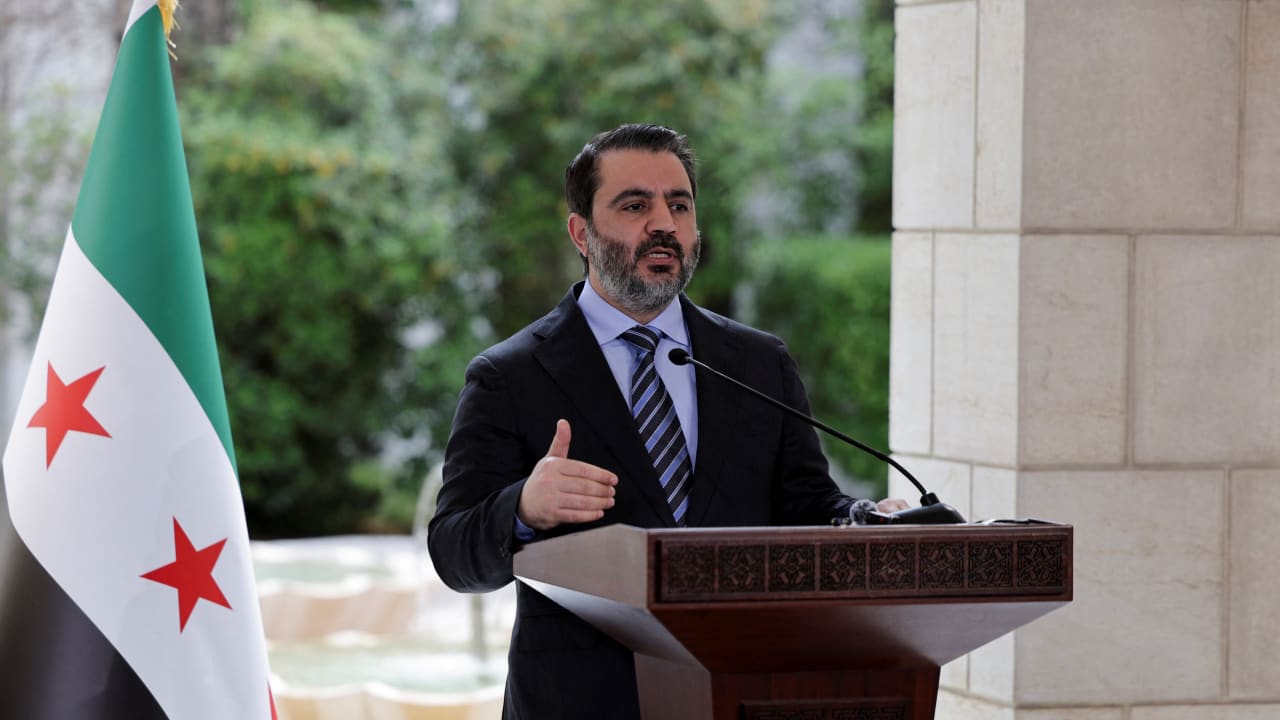
Syria’s Foreign Minister Asaad al-Shaibani has recently been more outspoken about Israel than in the past years, as Syria has increasingly been focused on improving relations with other countries and has tended to downplay tensions with Israel over the past year.
Now, Damascus may feel the time is right to be more open about its policies regarding Israel. According to a report in Al-Arabiya, which cited AFP, Syria’s foreign minister said on Saturday that “negotiations on a security deal with Israel were focused on areas Israel has recently occupied and excluded the broader issue of the Golan Heights.”
This matters for several reasons. It means Syria tends to think that arguing over the Golan is a lost cause. It shows Damascus is being very pragmatic and not interested in wasting time. The new Syrian government is willing to shift course from that taken by the previous Assad regime.
This illustrates flexibility and thinking outside the box. The Syrian government enjoys support from the United States as well as Saudi Arabia, Turkey, and other countries. Syria’s foreign minister is hinting that Damascus and Jerusalem may be able to reach further arrangements in the future, in the wake of talks held in Paris in January.
Israel has chosen to be skeptical and often hostile to the new government in Damascus. The skepticism initially was that the new government would fall apart and be replaced by warring factions. Over time, this was replaced by hostility to Damascus, asserting that it was “jihadist” even though Damascus opposed enemies of Israel, such as Iran and Hezbollah.

When the new government in Syria came to power, the IDF was ordered to carry out wide-ranging airstrikes on Syria, destroying the former Assad regime’s military assets. The IDF also took over the peak of the Hermon and areas in a buffer zone along the border.
Over the last year, the IDF has continued to operate in Syrian villages along the buffer zone. It has also been ordered to carry out airstrikes on Damascus.
Jerusalem says it is supporting the Druze in Syria. However, the US and other countries have appeared nonplussed by Israel’s aggressive actions.
Why ruin relations with a new government in Damascus and try to make it hostile to Israel? Over the last year, Israeli politicians have suggested targeting Syria’s new leader, Ahmed al-Shara’a, and routinely refer to him as a “jihadist.” The language against Shara’a is more extreme than the language against the Assad regime, which has led to questions about whether some in Jerusalem preferred Assad as a weak leader to a new Syria.
Syria’s leadership has taken this all in stride. They have adopted a wait-and-see approach.
Since the December 8, 2024, overthrow of Syria’s longtime ruler, Bashar al-Assad, Israel has sent troops into a United Nations-patrolled buffer zone that separated Israeli and Syrian forces on the Golan Heights.
Al-Arabiya noted how winds of change may be on the horizon. ”Israel and Syria’s new authorities have held several rounds of direct talks in recent months, and after negotiations in January – and under US pressure – they agreed to establish an intelligence-sharing mechanism as they edged towards a security agreement.”
Syria’s foreign minister says the current talks focus on Israel’s extended control of the buffer zone on the Golan. Syria wants the new areas Israel has occupied to be returned to Syria. To reach a security deal, Israel should “respect the security of Syria and withdraw from these territories” recently occupied, the report noted.
“These negotiations will certainly not lead to forcing an acceptance of the fait accompli imposed by Israel in southern Syria,” the Syrian top diplomat said. “The end of these negotiations will be the withdrawal of Israel from the areas where it advanced.” Syria also wants the threat of Israeli air strikes to stop.
Israel, US, Syria meeting changed tone of relationships
Ever since a trilateral meeting between Israel, the US, and Syria in January in Paris, there has been a change in tone. Syria has now worked with the Syrian Democratic Forces in eastern Syria to extend Syrian control over northeast Syria.
This has changed Syria and means that talks with Israel may now enable accommodation with the Druze in Sweidaor a way to get through other hurdles. Reports on social media that Syria may be more interested in opposing Hezbollah in Lebanon could be linked to Damascus’s new policy.
The reports regarding Syria’s position on Israel have been highlighted in the pro-Iran Al-Akhbar media in Lebanon. This shows that Hezbollah may be concerned. If Syria-Israel tensions ease, more focus might shift to Hezbollah. Iran would prefer to see Syria and Israel at odds. Now, cooler heads may be prevailing.
Meanwhile, US Secretary of State Marco Rubio also met with Syria’s foreign minister and the head of the Syrian Democratic Forces (SDF), Mazloum Abdi.
The US Department of State said, “Secretary of State Marco Rubio met with Syrian Foreign Minister Asaad al-Shaibani and Commander-in-Chief of Syrian Democratic Forces Mazloum Abdi at the Munich Security Conference.
The Secretary affirmed the United States’ support for a Syria that is stable, at peace with its neighbors, and that protects the rights of all its ethnic and religious minority groups. Secretary Rubio welcomed the Syrian government’s commitment to fully cooperate with the United States and the Global Coalition to Defeat ISIS. Rubio emphasized the importance of implementing the permanent ceasefire and integration agreement in northeast Syria, and ensuring full respect and safety for the rights of all Syrians.”