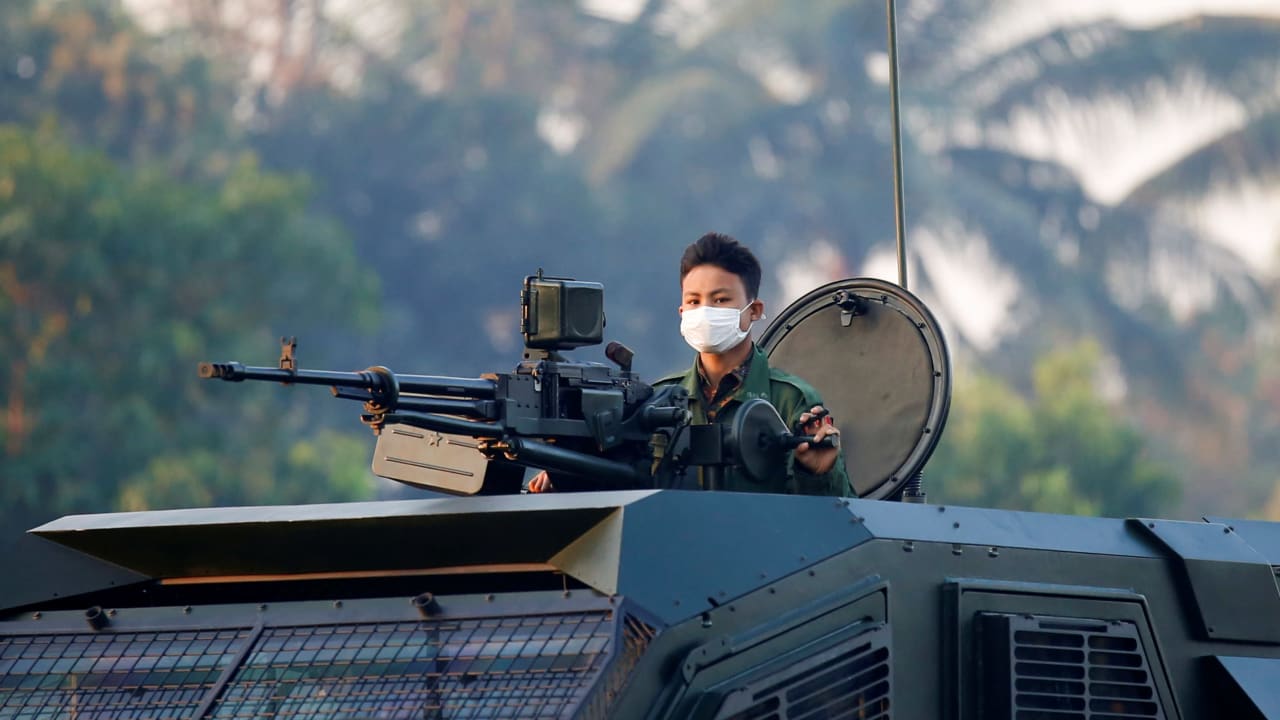
Myanmar is unraveling at a pace that should shock even those familiar with state collapse. What began as a tentative step toward democracy has spiraled into a brutal conflict between a humiliated military junta and a determined population.
The generals of the Tatmadaw once believed that sheer force and total control could erase an election and reclaim their lost power. But the people have refused to bow. The world, for the most part, has turned its back. This mix is fueling a collapse so swift and severe that anyone concerned with global stability should take notice.
The 2021 coup detonated every unresolved issue within Myanmar. Ethnic conflicts that simmered quietly have exploded into coordinated uprisings. Thousands of civilians, many young, have taken up arms. Regions once held by shaky truces are now in open revolt.
World is silent on Myanmar
The National Unity Government has become the political heart of resistance, while the People’s Defense Force embodies the collective rage on the ground. They fight alongside ethnic armies like the Kachin Independence Army, Karen National Liberation Army, and Arakan Army, groups that once fought only for their own people. The junta is hemorrhaging control, losing territory, manpower, and influence at a pace that would destabilize any country.
We have seen this up close in Myanmar. We’ve walked through villages where families offer what little they have to strangers, where children greet visitors with trust, still hoping kindness can hold back violence. These are some of the kindest people we have ever met, but their innocence is being crushed by a conflict they never chose. They are caught between a desperate military, increasingly skilled insurgents, and an international community that treats their suffering as a regional problem, not a global crisis. Their decency is their weakness, and that weakness is Myanmar’s tragedy.
The scale of the collapse should sound alarms everywhere. The state is losing ground on multiple fronts. Military outposts that once stood as symbols of junta power are falling quickly. Desertions are rising, the economy is breaking apart, and millions are displaced, overwhelming humanitarian efforts. The global response? Mostly words and symbolic sanctions that change nothing on the ground. The world acts as if Myanmar’s crisis lacks strategic weight, despite it ticking all the boxes of the most dangerous outcomes in fragile states – when legitimacy vanishes, and force alone rules.

Into this power vacuum step the big players. China pulls strings on multiple fronts, prioritizing its pipelines, border security, and strategic foothold over Myanmar’s civilians. Russia arms the junta to secure clients and allies in Asia. India hedges its bets, wary of instability spilling into its border regions. The United States condemns but wields little influence.
None of these powers prioritize the people’s welfare. Instead, they fan the flames of fragmentation. Myanmar is becoming a textbook example of how a mid-sized state can become a geopolitical no-man’s-land when competing powers accept chaos as collateral damage.
Israel’s role in Myanmar often pops up in global discussions, usually blown out of proportion or stripped of context. Jerusalem once maintained limited security ties with Myanmar, including some past arms sales, but these were frozen under international pressure. Compared to the vast influence of China and Russia, Israel’s involvement is minor.
Yet critics conveniently inflate the Jewish state’s role, turning it into a symbolic villain in a narrative that ignores the real drivers of violence: the generals, the local conflicts, and the regional giants. Israel is not the main story here – Myanmar’s collapse is.
Fragile states can collapse instantly
Still, the way Israel is used as a scapegoat reveals a troubling pattern. It distracts from the true causes and lets the bigger players off the hook. Jerusalem’s limited engagement should be scrutinized but not exaggerated. The real focus must be on how the military’s ambition, the people’s fury, and the geopolitical chess game are destroying the large Southeast Asian country.
Myanmar is a stark warning about how fragile states can crumble in an age of instant mobilization, cheap weapons, and exhausted societies. When legitimacy shatters and governments rely solely on force, collapse can accelerate overnight. This is not a slow unraveling over decades: it’s a rapid descent fueled by arrogance at the top and desperation below.
The lesson is brutal and clear: When leaders ignore their own people’s anger, when global powers treat instability as a nuisance rather than a crisis, and when the world looks away out of fatigue or indifference, collapse becomes unstoppable. Myanmar has already hit that point – and the next country to follow may not be in Southeast Asia. It could be anywhere, even places we believe are stable – until the moment they’re not.
Dr. Michael J. Salamon is a psychologist specializing in trauma and abuse and director of ADC Psychological Services in Netanya and Hewlett, NY.
Louis Libin is an expert in military strategies, wireless innovation, emergency communications, and cybersecurity.