
Representatives of the state and the Jerusalem municipality traded blame over the delay in implementing a mandated upgrade to the egalitarian prayer section at the Western Wall and restoring its direct access to the wall itself during a High Court of Justice hearing on Tuesday.
The hearing marked the first time in three years that the court discussed petitions on the status of religious rights at the holy site, although the first of those petitions was presented in 2013. The main petitioners include the Conservative Movement-affiliated Masorti Israel, the Reform Movement in Israel, and Women of the Wall. Still, over the years, additional groups and individuals have petitioned the court on the topic, including Orthodox groups seeking to prevent more liberal forms of prayer services.
As expected, no decision was issued at the end of the hearing, which was presided over by a panel led by High Court President Yitzhak Amit of seven justices instead of the usual three, emphasizing the sensitivity of the questions debated.
At the most recent hearing on the topic in February 2023, the government told the High Court that it was working to fix and improve the egalitarian section and still planned to implement the 2017 decision to “build and formalize” it.
In opening the hearing, Amit stressed that almost 10 years after a directive by Prime Minister Benjamin Netanyahu regarding the egalitarian plaza, also known as “Ezrat Israel,” and three years after the state was instructed to move forward with the project, the situation remains frozen.
Get The Times of Israel’s Daily Edition
by email and never miss our top stories
By signing up, you agree to the terms
“What we will do today is receive practical updates and gain an understanding of the barriers to implementing the guidelines, and why, in fact, these matters have not yet been resolved,” Amit said, instructing the attorneys representing the state and the Jerusalem municipality to clarify the current state of affairs at the start of the proceedings.
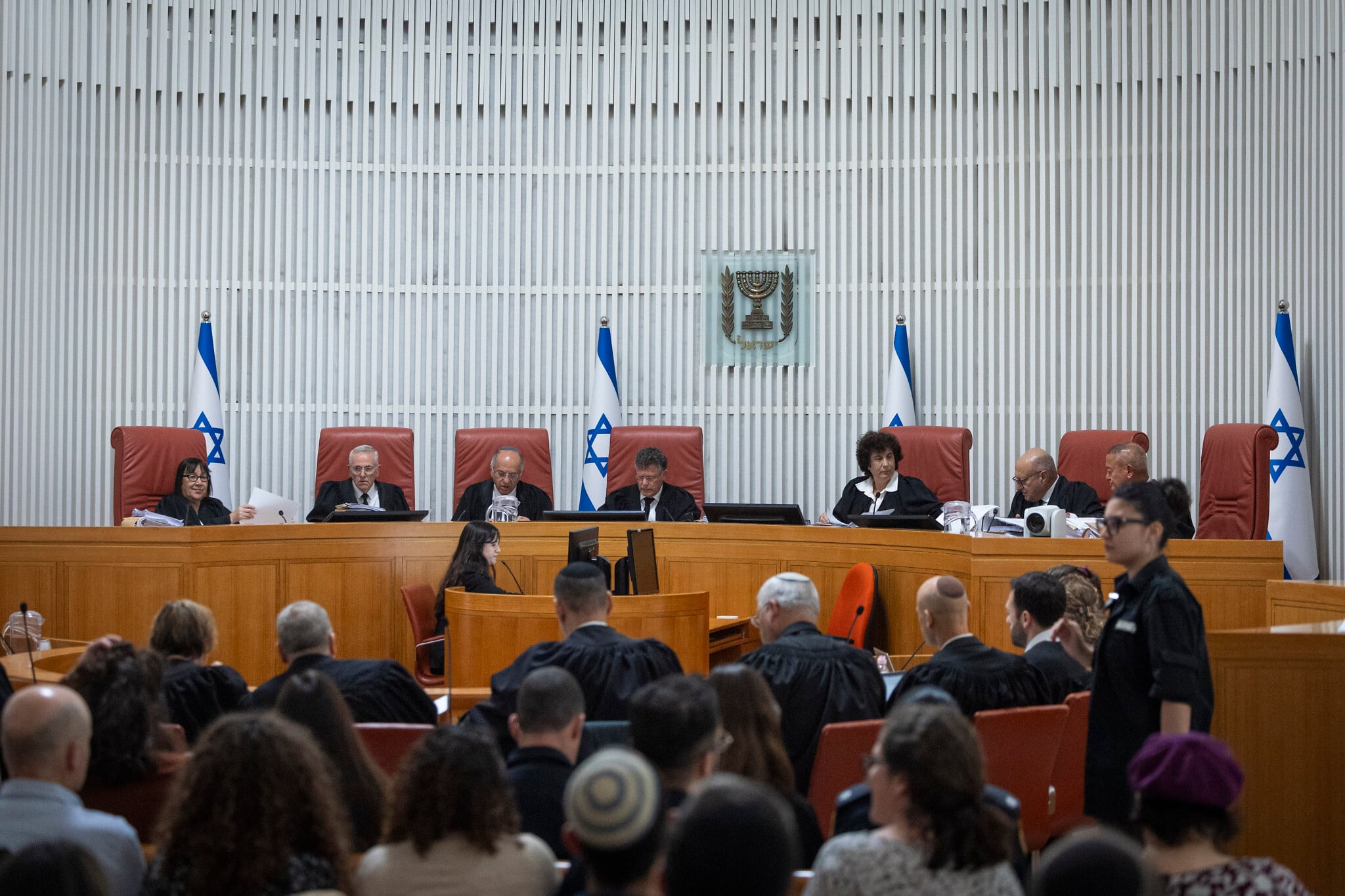
High Court of Justice President Yitzhak Amit and other justices hold a hearing on petitions regarding egalitarian prayer at the Western Wall, on February 17, 2026. (Chaim Goldberg/Flash90)
In detailing the various developments of the past three years, State Attorney Sharon Rotshanker often cited difficulties raised by the Jerusalem municipality in allowing the refurbishment work to restore the small wooden platform that, until 2018, allowed worshipers in the southern plaza to touch the Western Wall.
In 2018, some stones fell on the platform, which has since been closed, although the Israel Antiquities Authority declared the area safe in 2020 and again in 2021.
“There is a [municipal] injunction — at least as far as we know — that prevents repairs,” Rotshanker said. “The Jerusalem municipality can expand on this.”
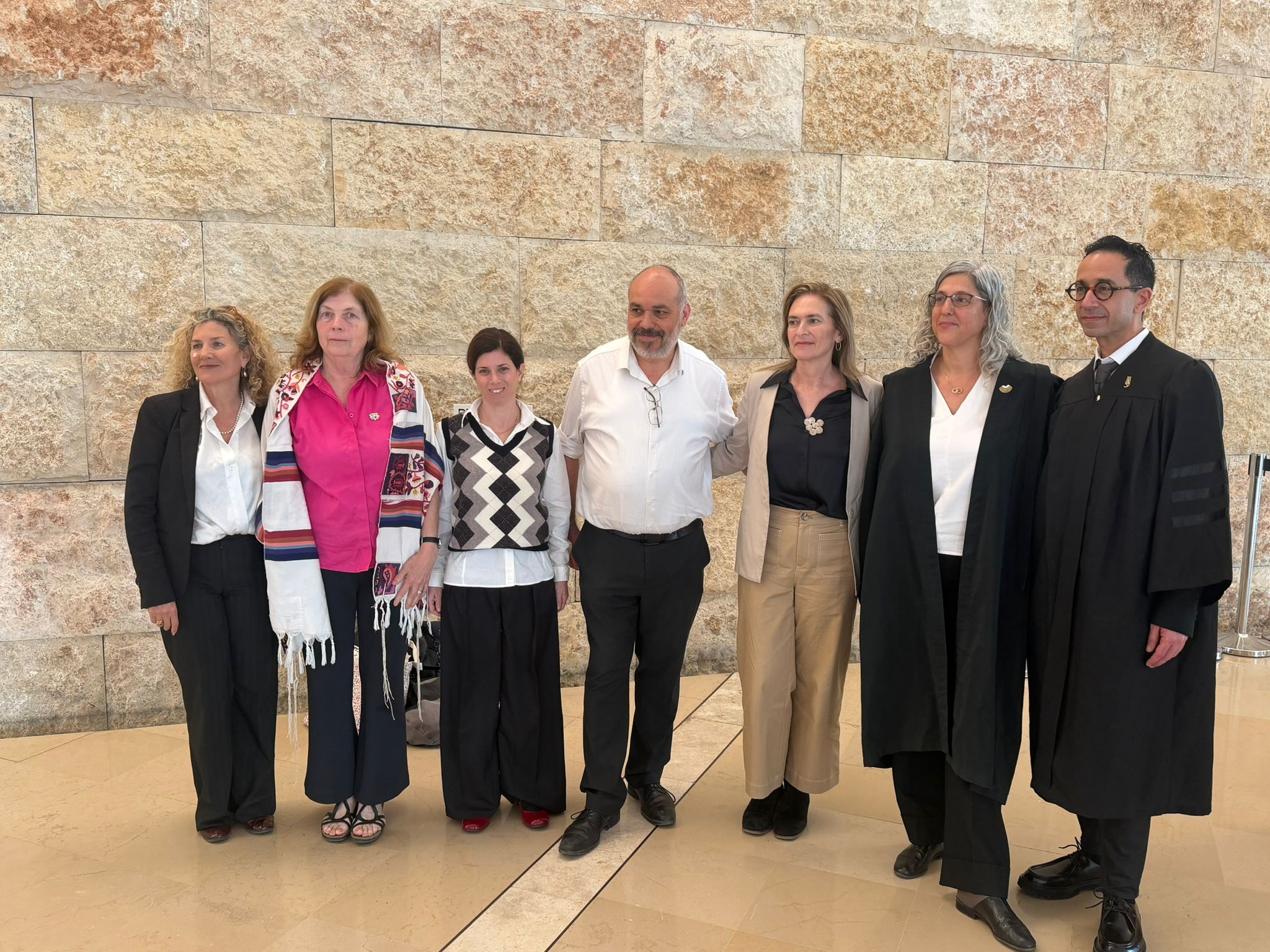
Some of the petitioners in a hearing regarding religious rights at the Western Wall at the High Court of Justice in Jerusalem on February 17, 2026. (Women of the Wall)
The lawyer also said that the state attempted to submit requests in 2023 for two permits for the necessary construction work, but to no avail, as the municipality required updated cabinet approval to accept the requests.
“We are talking about the most sensitive and explosive place in the Middle East,” Jerusalem municipality attorney David Halper said. “Therefore, [our] position, on which there is a consensus, is that a cabinet approval is required if there is a gap between the [original] permit and the current request.”
On his part, Amit criticized the lack of communication between the state and the municipality and cast doubt on the need for an updated cabinet approval, given a previous cabinet approval on the matter from 2016.
Years of delay
The main Western Wall plaza is under the purview of the Western Wall Heritage Foundation, which operates the site under the auspices of the Prime Minister’s Office and the Government Companies Authority. The religious authority responsible for the site is the Western Wall Rabbinate, a branch of the Chief Rabbinate, an Orthodox institution that adheres to the strictest interpretation of Jewish law.
Under its rules, men and women can access the wall only in separate sections; women are barred from reading from a Torah scroll (or even bringing one into their area), leading prayers, or being considered for a prayer quorum, including in all-female services in the women’s section, something that is considered permissible by at least some Orthodox authorities.
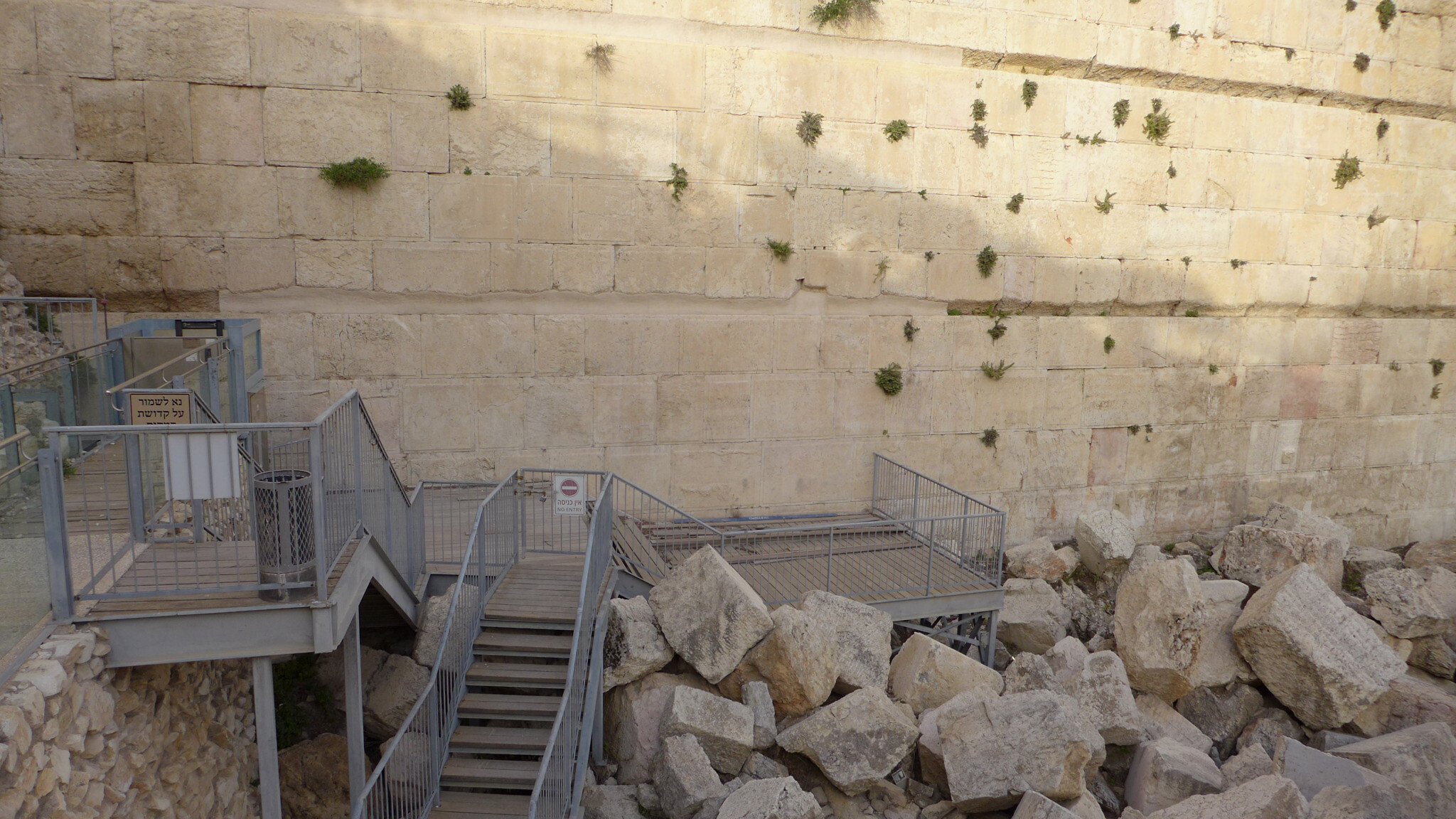
A fence bearing a no-entry sign, pictured here on May 22, 2023, prevents access to the Western
Wall through the balcony of the Ezrat Israel egalitarian plaza in the Old City of Jerusalem, Israel. (Canaan Lidor/The Times of Israel)
For decades, the inability to hold egalitarian services at the wall has been a point of contention with liberal Jews in Israel and the Diaspora, in part because in the United States, which holds the largest Jewish community in the world outside of Israel, the vast majority of Jews are not Orthodox.
In 2013, former prime minister Naftali Bennett, who at the time served as the religious services minister, promoted the construction of Ezrat Israel as a compromise to ensure liberal Jews could pray according to their custom without altering the status quo of the site’s most recognizable part. Direct access to the wall was guaranteed by a smaller platform next to the main egalitarian section.
The development, however, did not ease the tensions.
In 2016, a compromise to ensure an official status for the egalitarian plaza and access to it from the main plaza was approved by the cabinet, but the following year, when it was due to be implemented, Netanyahu caved to ultra-Orthodox pressure and issued the decision to put the agreement on hold indefinitely, while committing to improve the infrastructure at the site.
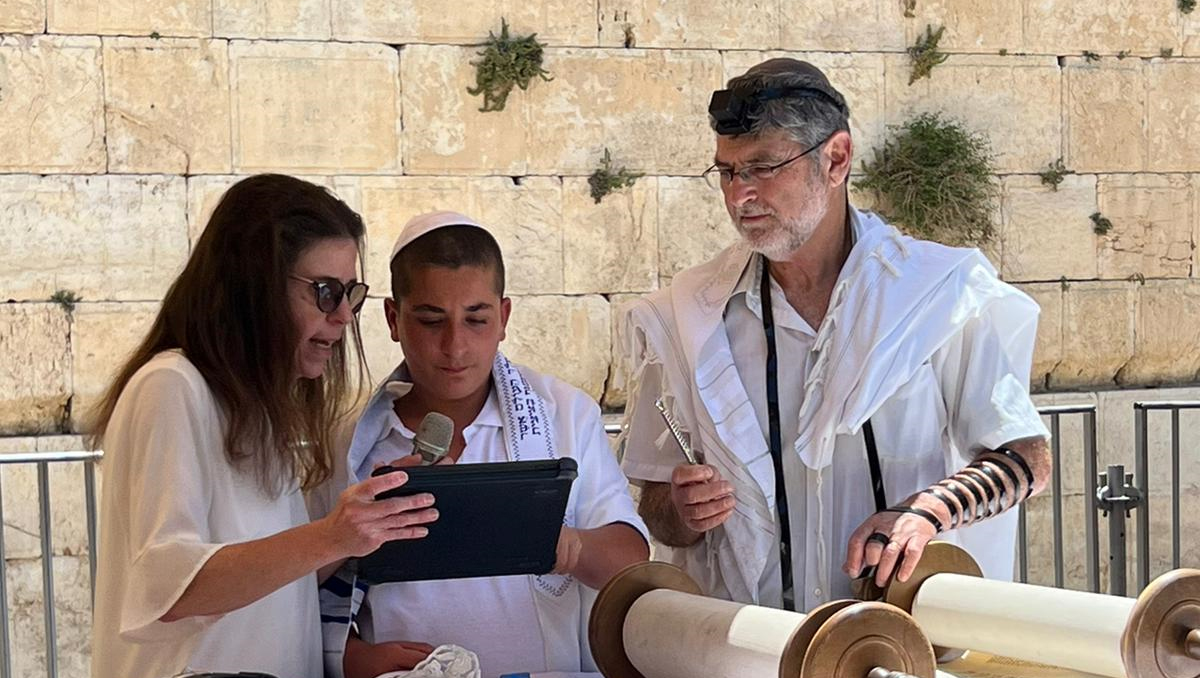
A boy celebrates his bar mitzvah on the egalitarian Ezrat Israel plaza near the Western Wall in Jerusalem, Israel on June 19, 2023. (Courtesy of the Masorti Movement in Israel)
Since 2018, the smaller platform has been closed. The main Ezrat Israel currently exists in a legal gray zone, technically under the authority of the ultra-Orthodox chief rabbi of the Western Wall, but permitted to operate as an egalitarian prayer space by a prime ministerial order.
Egalitarian services are held there regularly, especially for bar and bat mitzvahs, but the liberal movements have lamented the lack of proper infrastructure and recognition, as well as the impossibility of praying while touching the stones of the Western Wall, which is traditionally considered an important part of the experience.
“The conditions at the Southern Plaza are sub-standard,” said attorney Ori Nerov, speaking during Tuesday’s hearing on behalf of the Jewish liberal groups.
In addition to the impossibility of touching the wall, Nerov pointed to difficulties for people with disabilities to reach the space, the lack of restrooms, and the fact that the entrance of the egalitarian section is very difficult to find. He also reminded the court that in the Ezrat Israel section, liberal movements have to pay out of pocket for cleaning, prayer books and other needs that, in the main Western Wall Plaza, are funded by the state.
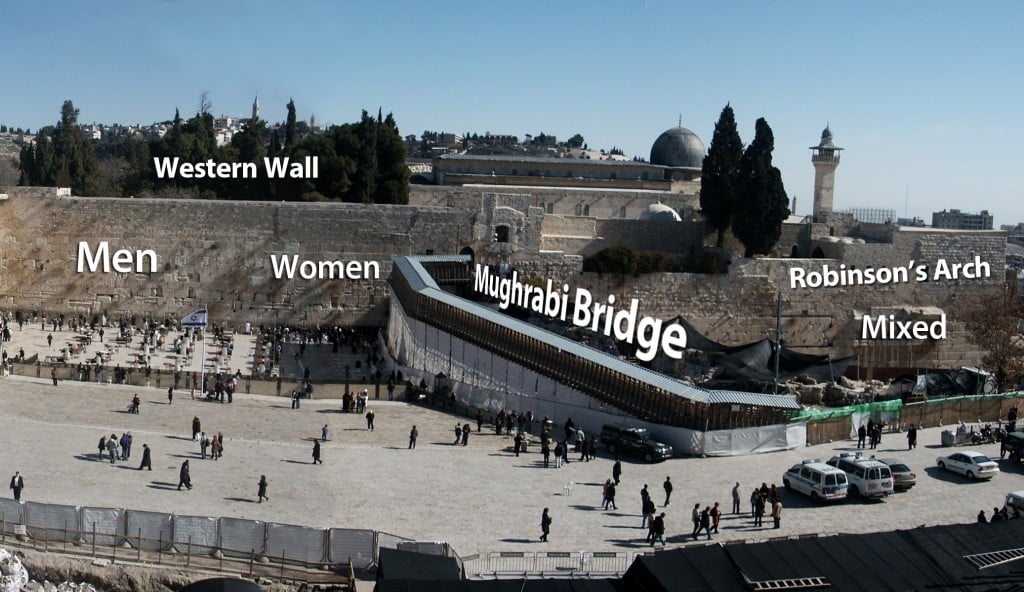
An illustration of Natan Sharansky’s proposal for the ‘Kotel Agreement’ to expand the Western Wall and create a permanent egalitarian space in the Robinson’s Arch area. (photo credit: Creative Commons/Graphics by Uri Fintzy/JTA)
“[The egalitarian section] has nothing official, respectful, or accessible,” he said.
During the hearing, several attorneys representing the Chief Rabbinate and other Orthodox groups rejected the notion that the High Court had jurisdiction over the case, as the court is not supposed to rule on matters of prayer and Jewish law.
At the same time, attorney Yifat Solel, deputy director of the religious rights group Hiddush, spoke on behalf of a group of women, mostly Orthodox, whose request, she explained, was not to use the egalitarian platform but rather to organize all-female prayer services in the main Western Wall women’s section with the ability to read from a Torah scroll.
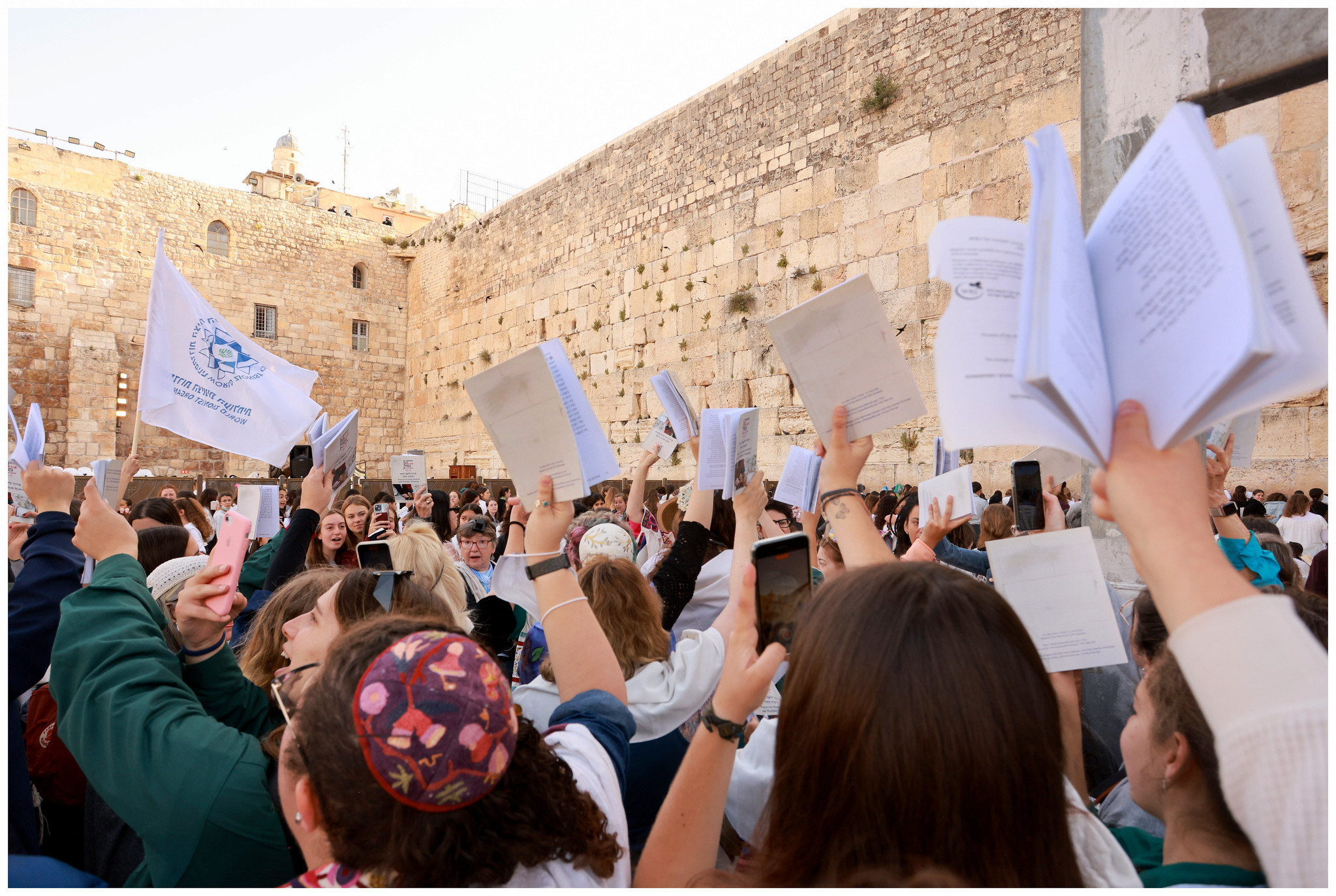
Women hold a prayer service at the Western Wall as demonstrators protest against them on May 2, 2022. (Women of the Wall)
Asked by a justice whether they could hold such services in the egalitarian section, Solel answered that it would not be suitable.
“We are talking about women who are mostly Orthodox and traditional, and they want to pray in the women’s section that they see as their place,” she said. “They have the right to do it.”
After the hearing, Masorti Israel, the Reform Movement in Israel, and Women of the Wall issued a statement expressing hope that the court will instruct the state and all the relevant actors to stop dragging their feet.
“We expect the High Court of Justice to instruct the state to swiftly rectify the current situation, in which the rights of anyone who does not align with the Rabbinate are being violated — in order to create a truly equal and respectful alternative at the Western Wall for those who represent the majority of contemporary Jewry,” they declared.