
A major shock inside Iran, whether triggered by leadership succession turmoil, economic crisis, popular unrest, or external escalation, would not remain an Iranian story. It would ripple across the Middle East and reach the central battlefield of Europe: Ukraine. For Washington and its allies, the point is not to cheer for collapse. It is to recognize that Iran is a key node in an informal authoritarian support network, and that sudden instability in Tehran could weaken that network in ways that matter for Moscow’s war.
Iran is often discussed in US debates through familiar lenses: nuclear thresholds, sanctions, and proxy violence. Those factors are real. But another dimension deserves more attention: the psychological effect authoritarian systems fear. The more a regime portrays itself as permanent and invulnerable, the more damaging it can be when cracks appear. If Iran’s ruling establishment suddenly looked fragile, allies and adversaries alike would revise their expectations. That shift can change behavior across the region.
JOIN US ON TELEGRAM
Follow our coverage of the war on the @Kyivpost_official.
The strategic implications begin inside Iran. A leadership crisis in a multi-ethnic state rarely produces a tidy regime change sequence. It more often yields elite bargaining, competing centers of authority, and security fragmentation. In such conditions, neighboring governments worry about spillover: refugee flows, cross-border militant activity, criminal networks, and the risk that local grievances ignite. Borderlands are sensitive. States with co-ethnic populations across frontiers may feel pressure to protect kin communities or secure adjacent areas through intelligence activity, humanitarian corridors, and limited security deployments.
Other Topics of Interest
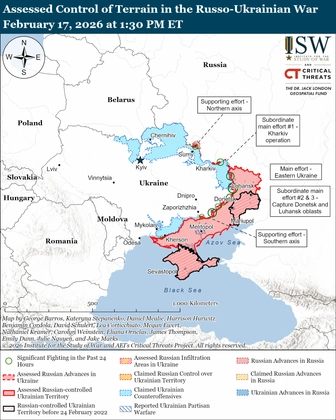
ISW Russian Offensive Campaign Assessment, February 17, 2026
Latest from the Institute for the Study of War.
For the United States, the core question would not be whether an Iranian crisis is deserved. It would be how to prevent instability from producing a wider war, while also recognizing that a regime focused on internal survival may have less capacity to project power abroad. Those realities can coexist.
This matters because Iran is not isolated. Authoritarian governments facing Western pressure increasingly learn from one another. They trade sanctions-evasion techniques, build alternative financial channels, share internal security know-how, and sometimes exchange military technology. Iran’s regional partnerships, Russia’s wartime dependencies, and China’s economic reach form a loose but consequential set of relationships. It is not a treaty alliance like NATO, but it functions as a network of mutual lifelines.
A visible crisis in Tehran could amplify anxieties inside Moscow about its own long-term stability.
A Tehran crisis could stress those lifelines in three ways.
First, it could disrupt practical cooperation. When a regime is fighting to stabilize itself, attention and resources move inward. Security services focus on domestic control. Leadership becomes divided or risk-averse. Personnel changes accelerate. In that context, outward projection, including support for partners and the maintenance of clandestine supply channels, can become harder to sustain. Even modest disruption can matter in long contests of production, morale, and political endurance.
Second, it could alter the diplomatic geometry among Russia, China, and Iran. Beijing generally prefers predictability: stable trade routes, manageable risk, and incremental expansion of influence. Moscow has embraced volatility, yet it also depends on external relationships to offset growing constraints. If Iran slid into prolonged instability, China would face a dilemma. It could invest more to protect its interests and shape outcomes, or keep distance and risk losing influence. Russia, already strained, would have fewer resources and less credibility to shape events.
Third, and most overlooked, an Iranian shock would have psychological consequences for other authoritarian systems. The Russo-Ukrainian War is a war of attrition not only in ammunition and manpower but in confidence and narrative control. Ukraine must sustain national unity and Western support. Russia must maintain elite cohesion and public acquiescence as costs rise and promises fade. A visible crisis in Tehran could amplify anxieties inside Moscow about its own long-term stability. It would not decide the war by itself, but it could shift the psychological balance.
A sober American response should start with contingency planning rather than wishful thinking: Treat Iranian instability as a regional security problem, not an occasion for gloating. Prioritize crisis deconfliction and coordination with allies to reduce miscalculation. Keep Ukraine in focus; turbulence in Iran is not a substitute for sustained backing of Kyiv. Understand China’s incentives; Beijing will act less out of ideology than out of risk management and influence.
The central point is not that Iran’s system will collapse, or that any external actor can engineer outcomes at will. It is that the Middle East and Eastern Europe are not separate chessboards. A Tehran shock would force recalculations in Moscow and Beijing, and those recalculations would intersect with Ukraine’s fight for survival. If Tehran shakes, Moscow may feel it. The job for the United States is to be prepared, without confusing preparation with provocation, and without mistaking another society’s upheaval for a policy instrument.
The views expressed in this opinion article are the author’s and not necessarily those of Kyiv Post.