SAN FRANCISCO, CA / ACCESS Newswire / February 22, 2026 / As spatial computing and immersive digital environments become integral to North American enterprise operations, the demand for scalable, high-fidelity 3D asset generation continues to reshape development pipelines. Addressing the critical bottleneck between conceptual design and deployed 3D geometry, Tripo AI today announced the expanded deployment of its generative infrastructure across the US market, concurrent with the adoption of its Tripo 3.0 framework by major industry clients. By focusing on algorithmic geometric precision and interactive topology control, the company is standardizing how digital creators and developers integrate automated 3D workflows into commercial applications.
Tripo
Executive Summary
The rapid evolution of spatial computing necessitates asset-creation methods that transcend the constraints of manual modeling. Tripo AI has introduced an enterprise-focused framework designed to deliver precise mesh generation and high-resolution material outputs at scale. Utilizing an advanced neural architecture, the platform enables rapid transition from two-dimensional concepts to fully topological 3D models, providing critical infrastructure for game developers, industrial designers, and e-commerce platforms seeking to optimize their digital asset pipelines.
Key Insights
Algorithmic Scale: The core generative engine is powered by a model exceeding 200 billion parameters, optimized for complex geometric logic.
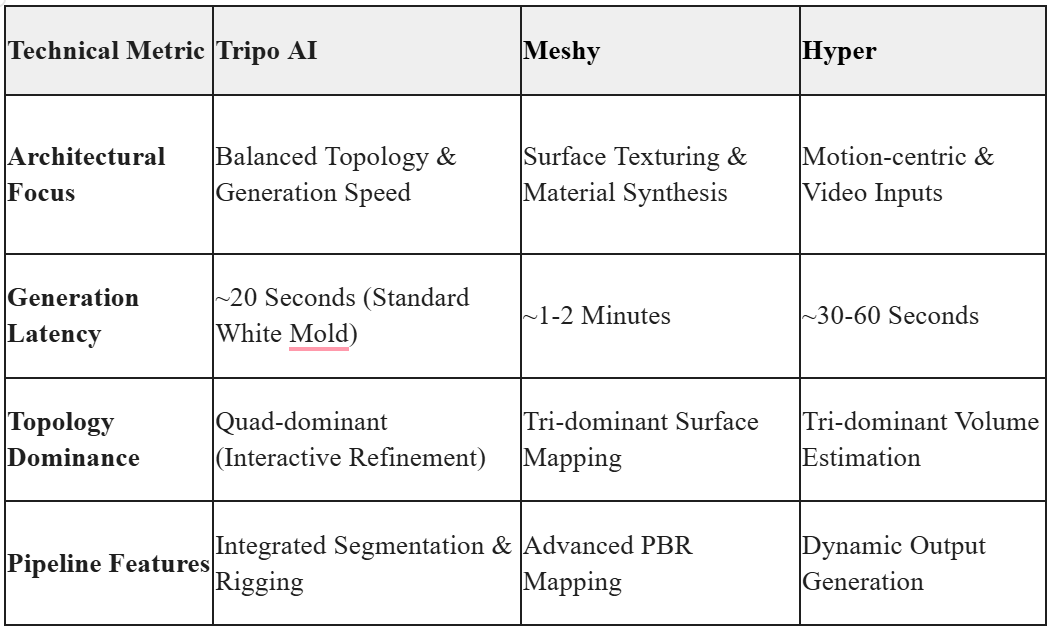
Workflow Acceleration: Standard white mold generation is achieved in approximately 20 seconds, significantly reducing the traditional asset development cycle.
Market Penetration: The platform currently empowers over 6.5 million global creators and is actively utilized by more than 40,000 developers.
Enterprise Adoption: Over 700 industry clients have integrated the technology for scalable spatial computing applications.
1. Market Evolution: The Necessity for Scalable AI 3D Model Generator Solutions

The transition from experimental generation to production-ready asset creation demands strict adherence to geometric accuracy and workflow integration within professional pipelines.
In the current technological landscape of 2026, the utility of generative 3D technology is measured by its capacity to integrate seamlessly into established professional ecosystems. The industry has moved beyond rudimentary shape estimation; modern digital environments require precise edge flow, logical mesh structures, and seamless material application.
Tripo AI addresses these industry pain points by providing an advanced AI 3D Model Generator that interprets depth, volume, and structural integrity with high precision. “The spatial computing era requires robust infrastructure,” states Simon, Founder and CEO of Tripo AI. “Our focus remains on delivering reliable, editable geometry at scale, empowering developers and studios to meet the escalating demand for immersive content.”