
As the Trump administration explores how to “restructure” the National Center for Atmospheric Research, including inviting proposals for new ownership of NCAR’s Mesa Laboratory in Boulder, it risks hitting an unexpected obstacle: a 65-year-old city ordinance that could cut off city water to the building if it changes hands.
In 1959, Boulder residents voted overwhelmingly not to provide city water services above the “Blue Line,” a 5,750-foot contour line to the west of the city.
NCAR was created a year later as a federally funded research center, and Boulder was selected for its university ties and emerging scientific hub. But the proposed Mesa Lab site sat above the city’s Blue Line, where voters had barred water service.
In 1961, a measure was placed on Boulder’s ballot to make an exception to the rule and extend city water to NCAR’s Mesa Lab – and only NCAR. It passed with nearly 80% of the vote.
The measure amended the city charter to extend city water to specific tracts of land, on the condition the land was “used to carry out the purposes and functions of the University Corporation for Atmospheric Research [UCAR], the National Center for Atmospheric Research [NCAR] or the National Science Foundation [NSF].” Construction began in 1964, and the building was dedicated in 1967.
NCAR describes the vote, which passed by a more than 3-to-1 margin, as a “resounding endorsement of the organization.”
NCAR is an international leader in Earth system science and provides research tools and modeling capacity to universities and governments worldwide. Its work plays a critical role in allowing the government to prepare for climate disasters and severe weather events, and support for the lab remains strong within the local community.
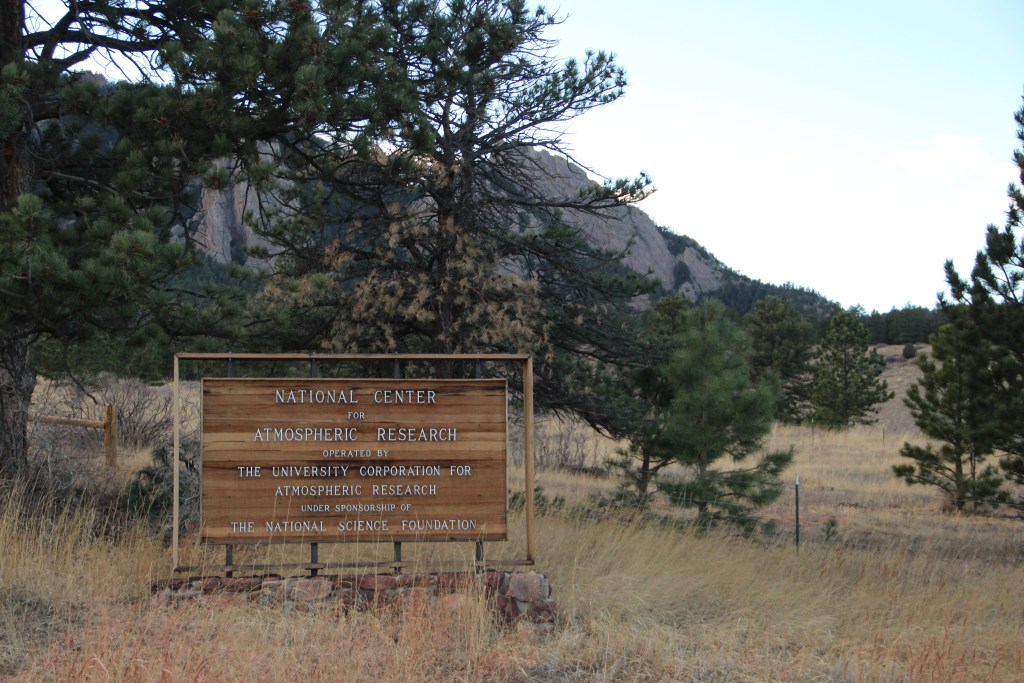 The Trump administration is pushing to close the Boulder headquarters of the National Center for Atmospheric Research (NCAR). Credit: Brooke Stephenson
Currently, NCAR is funded by the National Science Foundation and managed by UCAR, a nonprofit consortium of more than 130 universities. If the NSF, under the Trump administration, sells the Mesa Lab to a private owner or another government entity outside of UCAR or NSF, the building would be ineligible for city water services under Boulder’s city charter.
That possibility has drawn attention after a recent NSF memo called for ideas to restructure NCAR, including inviting proposals for new ownership of key facilities, including the Mesa Lab. The January letter came after a December X post from Russell Vought, director of the Office of Management and Budget, saying that the administration intends to “break up” NCAR, calling it “one of the largest sources of climate alarmism in the country.” The push to dismantle the institution followed a dispute between Trump and Gov. Jared Polis, and Colorado’s Democratic lawmakers described it as retaliatory.
City staff told Boulder Reporting Lab that they are “still evaluating the implications of the ordinance” on any potential changes for the NCAR property.
“The City of Boulder is currently focused on joining with partners to advocate for NCAR to remain the incredible asset it is,” said Sarah Huntley, a city spokesperson. “Having said that, the city is well aware that voters agreed to conditional water supply above the Blue Line.”
Since 1961, voters have approved several other exceptions to the Blue Line: the Canon Park Subdivision, Nuzum’s Nursery, the Silver Saddle Motel, the Flagstaff Apartment Property, the Flagstaff House Restaurant and water for firefighting, according to the city charter.
The NSF is still soliciting feedback on potentially dismantling NCAR until March 13. Feedback can be sent to NSF_NCAR@nsf.gov. On Feb. 12, NSF announced plans to shift management of a NCAR property that was “considered separately,” the NCAR-Wyoming Supercomputing Center, to a third-party operator, raising more concern about plans for NCAR in Boulder.
The move has drawn swift pushback from Colorado’s congressional delegation, with Rep. Joe Neguse organizing a bipartisan response and Sens. John Hickenlooper and Michael Bennet attempting — unsuccessfully so far — to add protections for NCAR in federal funding legislation.
Meanwhile, Historic Boulder, which works to preserve local legacy buildings, is attempting to help protect the Mesa Lab by applying to get it National Historic Landmark status, a two- to five-year process.
“The Mesa Lab is probably the most important building architecturally in Boulder, and perhaps even in the entire state,” Tim Plass, board president of Historic Boulder, said. “It has importance in the modernist movement that’s international.”
Related