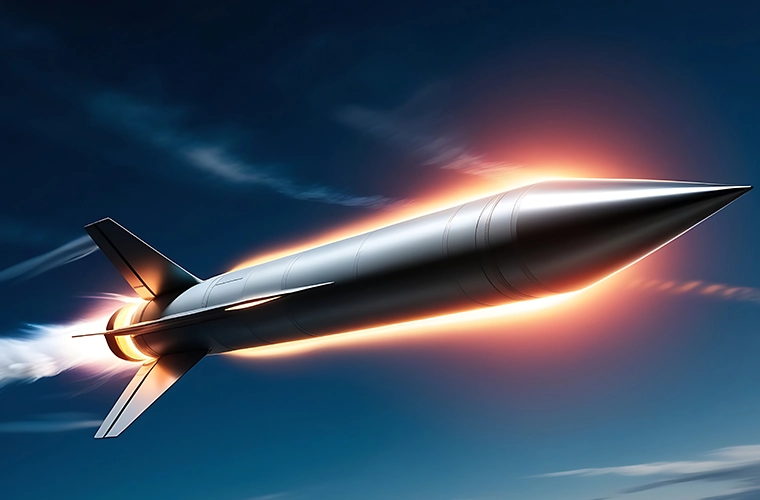
In a plasma wind tunnel in Italy, researchers blasted two tiny ceramic “nose tips” with a stream of superheated air meant to mimic the kind of brutal heating a vehicle faces at hypersonic speeds—or during a fiery plunge back through Earth’s atmosphere.
Within seconds, superheated gas screaming at several times the speed of sound slammed into its surface. Surface temperatures climbed to about 2,700 Kelvin—far beyond the melting point of steel.
The experimental ceramics survived the exposure. However, the extreme heating triggered severe oxidation and structural changes, causing their surfaces to bubble and shed, and later partially detach during handling.
The research, set to be published in the July edition of Journal of the European Ceramic Society, offers rare experimental insight into how advanced materials behave under conditions similar to atmospheric re-entry and sustained hypersonic flight.
The findings underscore a crucial reality in modern aerospace competition: mastering hypersonic flight isn’t just about propulsion. It also depends on materials capable of surviving the inferno created at Mach 5 and beyond.
The fact that the research was sponsored by NATO and the U.S. Air Force Office of Scientific Research underscores how seriously the United States and its allies are pursuing the materials needed to enable practical hypersonic flight—and to secure their future role in aerospace.
“Atmospheric re-entry and hypersonic flights expose spacecrafts to some of the most extreme combinations of aero-thermo-chemical loads, including ultra-high temperatures, severe shear stresses, and chemical aggressions in dissociated species-rich environments,” researchers write. “These conditions require robust Thermal Protection Systems (TPS) to safeguard the spacecraft’s external structure, maintaining internal temperatures within acceptable limits.”
Why Hypersonic Flight Pushes Materials to Their Limits
Hypersonic vehicles—includingadvanced missiles and reusable spacecraft—must endure punishing conditions during flight. When objects travel faster than five times the speed of sound, over 3,800 mph, air molecules compress and heat dramatically, generating intense thermal and chemical stress.
Under these conditions, conventional materials can melt, crack, or chemically degrade. Protecting the vehicle requires specialized thermal protection systems capable of withstanding both extreme heat and corrosive atmospheric interactions.
For decades, engineers have relied on reinforced carbon–carbon composites and ablative heat shields to protect vehicles from extreme aerodynamic heating. Reinforced carbon composites—famously used on the Space Shuttle’s nose and wing leading edges—can survive hypersonic re-entry, but they come with significant limitations. They slowly oxidize in air, require protective coatings, and must be carefully inspected, repaired, or refurbished after each flight.
Ablative heat shields, meanwhile, solve the heat problem by design. They char, melt, and erode away, carrying heat with them. While effective, that process consumes the material, making ablative heat shields impractical for vehicles expected to fly repeatedly with minimal turnaround time.
Future hypersonic aircraft—especially reusable systems designed for frequent operations—will need materials that can endure repeated exposure to these punishing environments without being consumed or requiring extensive refurbishment. That’s where ultra-high-temperature ceramics come in.
Engineered to remain stable at temperatures exceeding 2,000 Kelvin, these materials offer the possibility of thermal protection systems capable of surviving the hypersonic inferno again and again, potentially enabling a new generation of reusable high-speed vehicles.
Simulating Hypersonic Flight in a Plasma Wind Tunnel
In recent experiments, researchers from the University of Naples Federico II tested two versions of a next-generation “ultra-high-temperature” ceramic designed for extreme flight.
Both were based on the same core recipe, but one included a small amount of niobium carbide and the other a small amount of vanadium carbide. In essence, this was a controlled head-to-head comparison: the same basic material, with slightly different chemistry, to see which one stays steadier under harsher conditions.
The ceramic specimens, shaped like small hemispheres, were then placed in an arc-jet plasma wind tunnel known as the Small Planetary Entry Simulator (SPES). The facility uses electrically heated plasma to replicate the searing aerodynamic heating encountered during hypersonic flight.
In the tests, the materials were subjected to two progressively harsh environments.
First, they endured hypersonic conditions equivalent to Mach 6, reaching temperatures of roughly 1,700-1,800 K. Then, the same samples were subjected to even more severe supersonic flow conditions, which pushed surface temperatures to 2,700 K.
These experiments allowed researchers not only to observe whether the materials survived but also to examine, at microscopic scales, how they degraded—or resisted degradation.
How Advanced Ceramics Protect Themselves From Destruction
One of the key discoveries involved how the ceramic materials formed protective oxide layers when exposed to intense heat.
At hypersonic temperatures, silicon carbide within the material oxidizes, forming a glass-like silica layer. This coating acted as a barrier, slowing further oxidation and helping preserve the material underneath.
“In hypersonic conditions … SiC exhibited passive oxidation with formation of a SiO₂ layer that acted as a barrier to oxygen diffusion,” researchers report. This protective layer helped both tested ceramics survive conditions comparable to atmospheric re-entry.
However, during the more extreme tests, when temperatures rose above 2,200 K, this protective mechanism began to break down. The silica layer destabilized, oxidation accelerated, and the ceramic surfaces experienced dramatic changes—including bubbling, oxide formation, and surface restructuring.
Despite the intense heating, the damage was mostly confined to the ceramics’ outer surface. The extreme temperatures caused the outer layer to oxidize and, in some places, even break off, but much of the underlying material remained in place.
The ceramics’ unusual mix of elements played a key role in their response. As temperatures rose, different ingredients reacted with oxygen at different stages, forming a complex, layered oxide shell on the surface.
This evolving protective layer didn’t prevent damage entirely, but it helped slow its progression and allowed the materials to withstand multiple exposures to hypersonic-like heating without failing completely.
Insights Into the Future of Hypersonic Flight
Beyond demonstrating the survivability of ultra-high-temperature ceramics, the findings also revealed critical physical mechanisms that could guide future hypersonic material design.

Researchers found that zirconium oxide ultimately dominated the protective layer at extreme temperatures. This oxide has relatively low thermal conductivity, which helps reduce heat transfer deeper into the material and protects the underlying structure.
At the same time, the presence of niobium and vanadium altered oxidation behavior, influencing how the protective layers formed and evolved.
Overall, the materials exhibited remarkable endurance despite exposure to conditions that replicate the most severe hypersonic environments.
“Tests conducted at the Small Planetary Entry Simulator (SPES) showed that these materials can withstand multiple high enthalpy cycles, with surface temperatures ranging from 1700 K to 2700 K with microstructural changes in the outermost 500 μm upon dynamic oxidation processes,” researchers write.
Strategic Importance in the Hypersonic Arms Race
Although the work is rooted in materials science, its implications reach well beyond the lab. Hypersonic weapons have become a centerpiece of global military competition, with the United States, China, and Russia all investing heavily in systems designed to fly at extreme speeds.
It’s easy to frame hypersonics as a story about velocity. In practice, the more unforgiving challenge is keeping a vehicle intact. At Mach 5 and beyond, a nose cone or leading edge isn’t just heated—it’s battered by a chemically aggressive flow where air itself can react with the surface, accelerating erosion and material breakdown.
This study doesn’t claim to have “solved” that problem. But it does offer something unusually valuable: high-enthalpy test data that tracks how advanced ceramic composites respond as temperatures climb into a regime where protective oxide layers can bubble, destabilize, and even detach. For designers of thermal protection systems, that kind of detail can help separate promising concepts from materials that fail in real-world conditions.
If ultra-high-temperature ceramics can be refined to better control oxidation and prevent scale failure, they could enable protection systems that last longer and require less refurbishment than current approaches.
That, in turn, could broaden what’s practical—from more resilient defense platforms to reusable high-speed aerospace vehicles that cut turnaround time and cost, opening the door to faster global reach and more responsive access to space.
Ultimately, in the race to make hypersonic travel practical, materials are arguably more decisive than engines—and this new generation of ceramics suggests there’s still room to push the frontier.
“Both ceramics successfully endured representative conditions of a vehicle re-entering the atmosphere,” researchers conclude. “These findings provide solid foundations for the optimization of new materials intended for thermal protection systems and propulsion, particularly relevant for applications in atmospheric re-entry vehicles and long-duration hypersonic flights.”
Tim McMillan is a retired law enforcement executive, investigative reporter and co-founder of The Debrief. His writing typically focuses on defense, national security, the Intelligence Community and topics related to psychology. You can follow Tim on Twitter: @LtTimMcMillan. Tim can be reached by email: tim@thedebrief.org or through encrypted email: LtTimMcMillan@protonmail.com