

Not one of my regular morning posts, but something I’ve been thinking about. Many readers may want to disregard it.
Regular readers know that I have a longstanding interest in comparisons between the U.S. and European economies — largely because that comparison is important for geopolitics and economic policy, but also because it’s intellectually interesting. The conventional wisdom among elites on both sides of the Atlantic is that Europe is falling far behind. But I’m a skeptic. And I have some new thoughts about the issue.
So I thought I’d do a wonkish post, aimed primarily at economists, to explain what I think is going on.
This post was inspired in large part by an extremely informative post by Seth Ackerman that has generated a lot of discussion in the circle of economists who worry about such matters. My take is a bit different from his, although not contradictory. I’m basically enlarging on a point I made a couple of months ago, although I hope this version is clearer.
Ackerman points us to a seeming contradiction between widely cited comparisons of the US and EU economies. I’d summarize this issue as a tale of three charts. In each case I’ll compare 2007 — the year before the global financial crisis, and a useful baseline — with 2024.
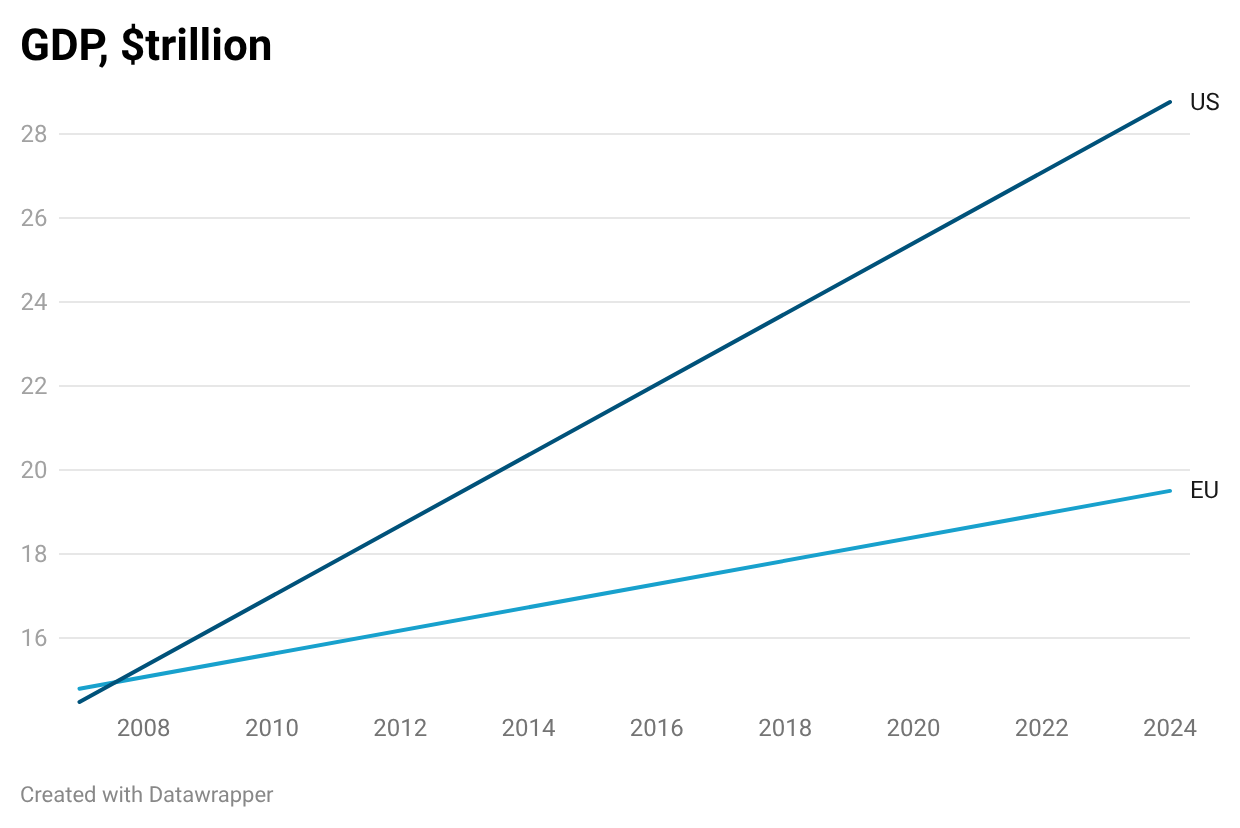
First, look at EU and US gross domestic product, measured in dollars at current prices.
Source: World Bank
In 2007 the EU economy was slightly larger by this measure. Now the US economy is about 50% bigger. Wow!
Or maybe not. A lot of this reflects a decline in the euro against the dollar, rather than differences in real economic growth. So this is a really bad measure to use.
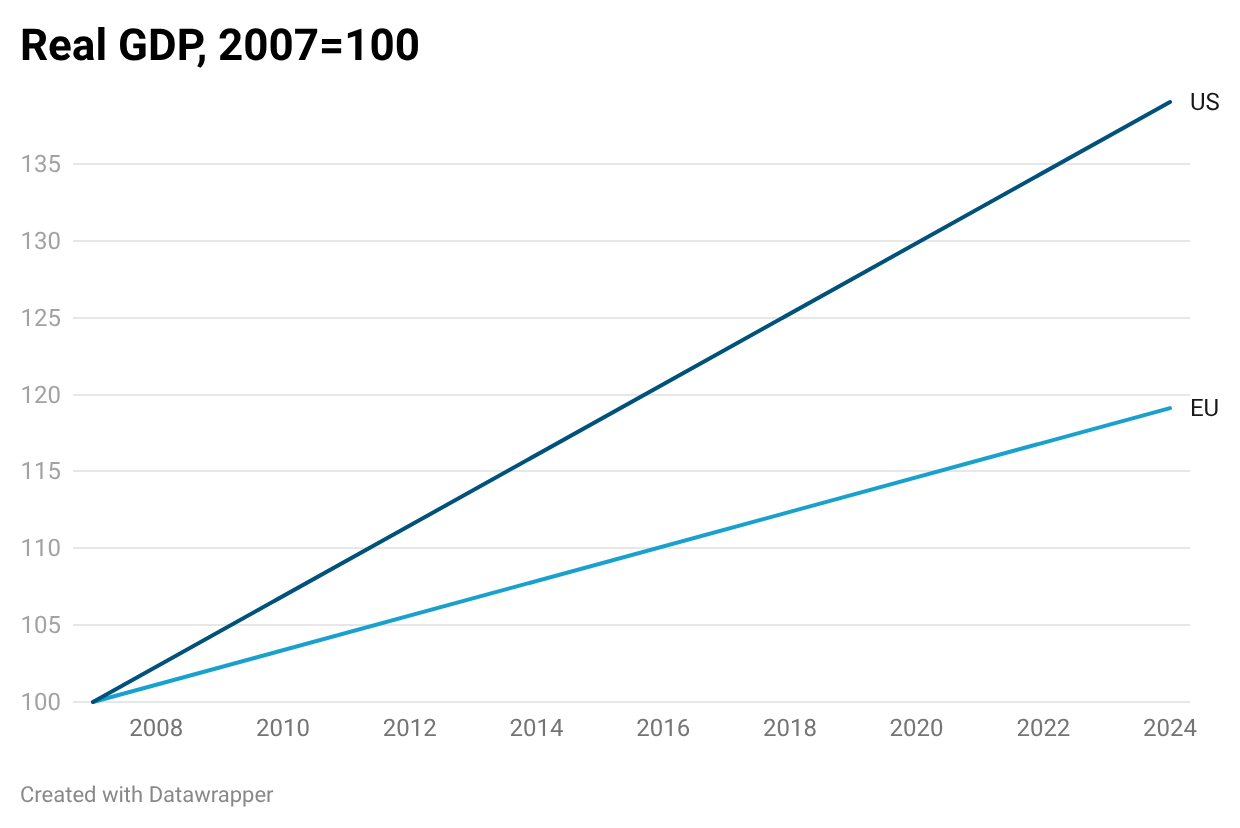
An alternative is to look at growth in real GDP — GDP at constant prices (in this case 2015 dollars). This measure shows the U.S. growing substantially more than the EU, although not 50 percent more:
Source: World Bank
So US economic growth is outpacing growth in Europe, and Europe needs to address its lag. Right?
Not so fast.
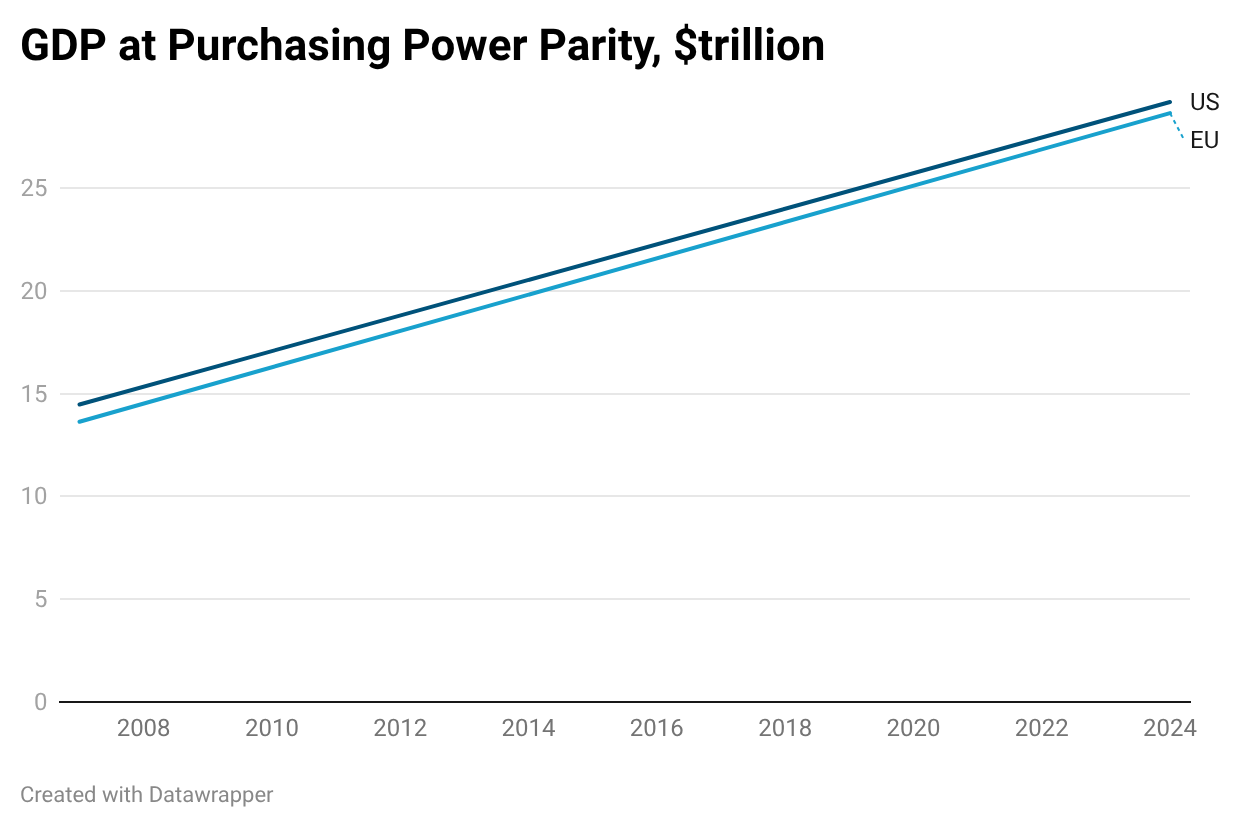
Look at a third comparison: GDP at purchasing power parity, that is, using the same prices for goods in the EU and the US, in effect adjusting for differences in the overall price level. Here’s what that comparison looked like in 2007 and 2024:
Source: World Bank
By this measure, in 2007 the EU economy was slightly, but only slightly, smaller than the U.S. economy. By 2024 the EU economy was … still slightly smaller than the U.S. economy. Indeed, the gap was a bit less in percentage terms.
The second and third charts look contradictory. One says that in real terms the US economy has grown much faster than the EU economy. The other says that in real terms the two economies have stayed roughly equal in size. Those statements can’t both be true, can they?
Actually, they can.
Ackerman emphasizes data problems: Differences in the way national statistical agencies calculate growth. I don’t want to minimize those issues. But even with comparable data, the fact is that the EU and US economies produce different mixes of goods, with the US dominating information technology industries, which have also seen much faster productivity growth than other industries. And this difference in industrial mix causes differences in real GDP growth that aren’t reflected in different trends in living standards.
I find that the easiest way to make this point is with a stylized, exaggerated numerical Ricardian example.
Imagine, then, that there are two countries, the US and the EU. In each country, labor is the only factor of production, and each country has 100 workers. (Examples like this are thought experiments and are not supposed to be realistic.) There are two goods, tech (T) and non-tech (N). The US has a comparative advantage in T, so that all global T production is concentrated there.
An aside about the real world: In practice, the US tech advantage has a lot to do with local industrial clusters, but the source of the advantage doesn’t matter for current purposes.
Productivity in the two countries is the same in N; we can choose units so that 1 worker produces 1 unit of N.
I assume that half the US work force, 50 workers, is employed producing T. For the really nerdy, this is what you would get if preferences are Cobb-Douglas with a T share of 0.25. The rest of you can pretend you didn’t read that.
Since both countries produce N, and they have the same productivity in that sector, wages in the two countries will be the same.
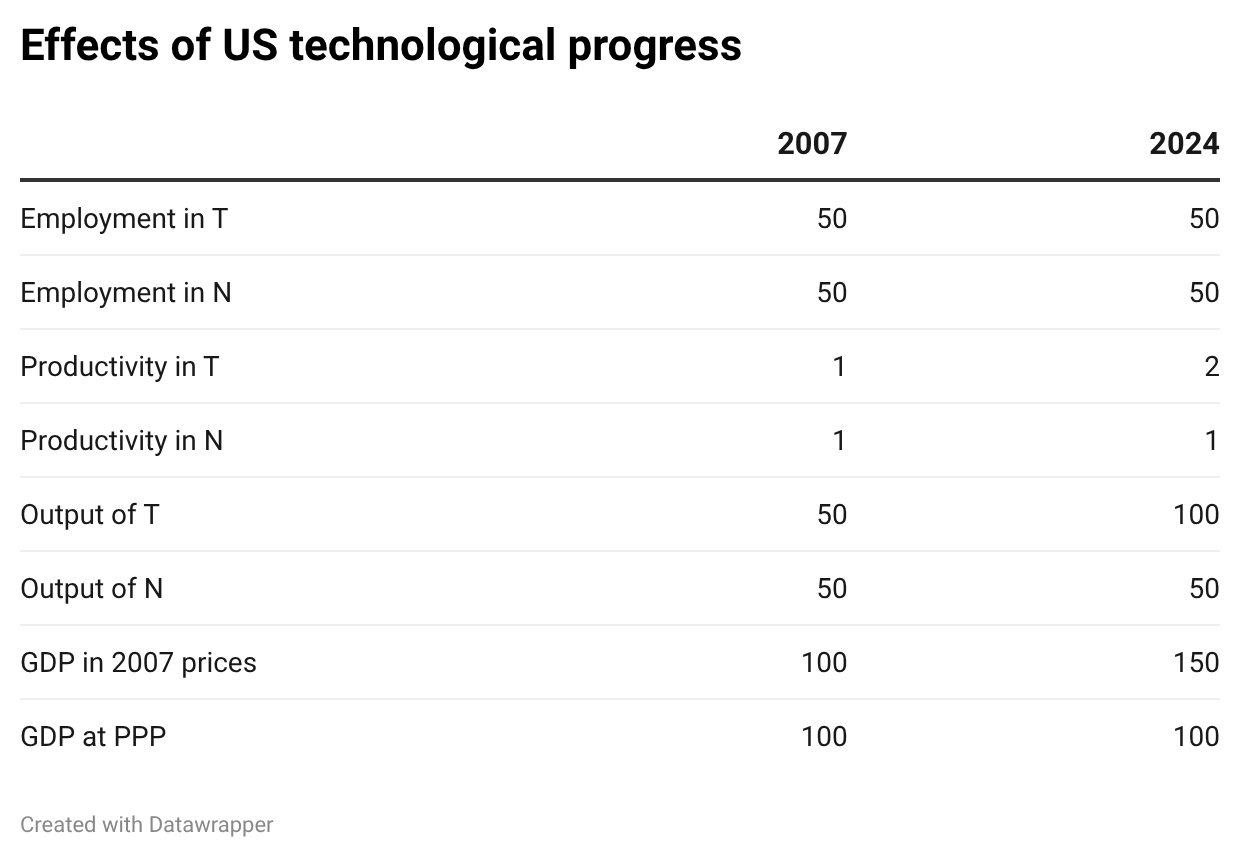
Now assume that productivity in tech doubles. Since the EU doesn’t produce T, none of the numbers for the EU change. But numbers for the US economy do. Specifically, we would expect output of T to double, while the price of T relative to N falls in half.
The table below shows the effects on US GDP. Because output of T, which is half the economy in this example, doubles, GDP in 2007 prices rises 50 percent. However, because the price of T relative to N falls in half, GDP measured in terms of N doesn’t change.
Not shown: nothing happens in the EU, which doesn’t produce any T. And because the EU’s GDP — which consists only of N — doesn’t change, US GDP relative to EU GDP measured at current purchasing power also doesn’t change.
Source: Author’s imagination
In short, a situation in which the US dominates the sector with rapid technological progress, but this progress is passed on to everyone in the form of lower prices, will look just like what we see for the US/EU comparison in practice. America has faster growth measured in base-year prices, but the relative size of the economies measured at PPP doesn’t change.
If this feels like a contradiction, it’s because the concept of real GDP is often misunderstood. Calculations of real GDP involve using market prices to add up apples and oranges, a useful exercise for many purposes. We often like to think about economic growth as if the economy produces a single, homogeneous good. But that’s just a metaphor, and one needs to be careful not to use that metaphor when it can lead you astray. And it can very much lead you astray when you’re comparing nations that produce different mixes of goods because they have staked out different positions in the global economy.
One more real-world aside: Should Europe envy the United States for its tech sector? No. Aside from the fact that Europeans are living well, tech generates a big negative externality, because among other things it generates tech-bro billionaires, who are corrupting our politics.
Back to economics: When comparing the US and the EU, uncritical use of real GDP numbers can lead to the conclusion that Europe is getting poorer relative to America. But it isn’t.