
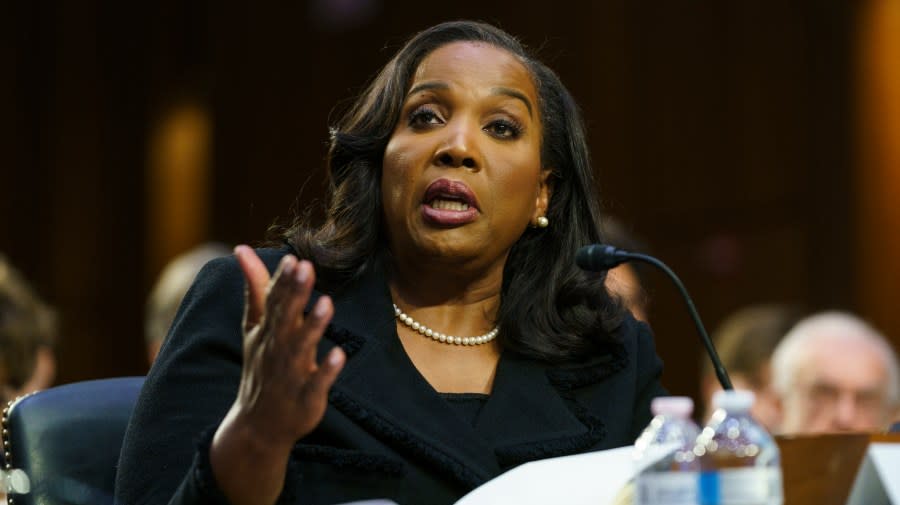
Federal Reserve governor Lisa Cook on Tuesday warned of the dangers created by artificial intelligence emerging in the labor sector.
Cook said the use of AI could cause “job displacement” while preceding “job creation” and causing unemployment rates to rise as the labor force declines.
“This outcome could cause hardship for many workers and their families,” the Federal Reserve governor said during opening remarks at the 42nd annual National Association for Business Economics (NABE) Economic Policy Conference in Washington, D.C.
“Evidence that the transition has commenced has emerged, even if it is too soon to see the effects in the aggregate. Demand for labor in certain occupations has declined—most notably for coders, a field where AI has made significant strides,” she added, noting the unemployment rate for recent college grads has increased while the rate of unemployment overall remains at a steady 4.3 percent.
Cook highlighted AI’s positive impact on society while raising concerns with its continued progression.
She described AI as the latest example of the creative destruction economist Joseph Schumpeter described almost a century ago, and noted the concept of a neutral interest rate that neither stimulates nor cuts back on an economy that is stable and not losing jobs. Schumpeter’s theory ties capitalism’s gains to its pains, as some are hurt or left behind by new creations or developments.
“To recall, the neutral rate is a long-run concept that articulates the equilibrium level of interest rates that is noninflationary and consistent with maximum employment. The AI investment context compels us to understand what is happening in the short run. In anticipation of future productivity gains, we already see soaring AI-related business investment in data centers and chips, despite interest rates broadly being elevated relative to levels over the past 20 years,” Cook said.
“With investment contributing to strong aggregate demand, it is possible that the current neutral rate is higher than before the pandemic. This could reverse when the AI productivity gains are more fully realized or if the labor market transition leads to a rise in income inequality, such that well-off consumers receive a larger share of income, which could lower the neutral rate, all else equal,” she added.
U.S.-based employers show January was the worst month for job cuts since 2009. However, Federal Reserve Gov. Chris Waller said unemployment rates fell last year.
“Accounting for those upcoming revisions, it seems clear that payroll employment in the United States probably fell in 2025, only the third year that has happened, unrelated to a recession, since 1945,” he said on Monday at the NABE conference.
“There is no doubt that the decline in net immigration last year has significantly lowered labor force growth and thus the number of new jobs that are needed to reflect a healthy labor market. However, last year the labor force grew by 2.9 million while payroll gains were much less,” Waller said.
“There has been much discussion of the current low-hire, low-fire labor market. A relatively low level of layoffs means that slow hiring is not as bad as it looks. Even so, I continue to believe that close to zero net job creation over 2025 indicates a weak, and fragile job market, and this is some important context for the data we received in January.”
Copyright 2026 Nexstar Media, Inc. All rights reserved. This material may not be published, broadcast, rewritten, or redistributed.
For the latest news, weather, sports, and streaming video, head to The Hill.