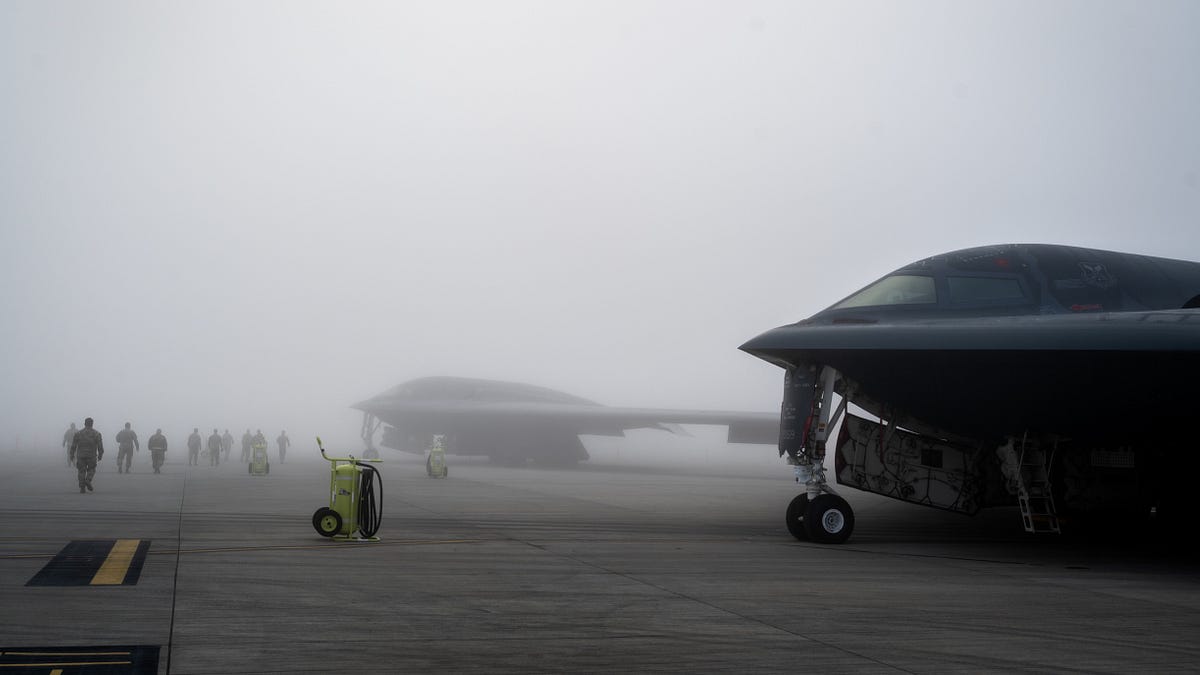
 Image: U.S. Air Force image library
Will America attack Iran this weekend? Or next week?
Will this be a quick intervention or the start of something more protracted?
These are important questions for a couple of reasons. First, the amount of military force that has been deployed into the region around Iran cannot be sustained there forever. Their peak readiness will decline over time. Second, the purpose of such an attack remains unclear, with little strategic communication from the White House about why such an attack is necessary, and why now is the right time. Finally, and perhaps more importantly, might an attack on Iran result in a more extensive and prolonged conflict than expected?
The Trump administration has thus far demonstrated a preference for avoiding the important and tough international challenges – China and Russia – and opting for small-scale, less vital interventions – Venezuela, Greenland, and Iran. In the case of Iran, there is yet to be a clear rationale provided from the Trump administration. After the Midnight Hammer operation that, according to the administration, obliterated Iran’s nuclear capability, the Iranians have apparently been able to unobliterate (is that a real word?) it in a couple of months.
Let me state up front: getting rid of the repulsive, murderous mullahs in Tehran would be a massive benefit to humanity. They have done nothing but suppress their people, and export terrorism and murderous ideology for decades. But is removing them – or destroying their weapons – the highest priority right now given the much larger challenges of Russia and China?
The key issue with Iran is one of purpose. What is the strategic objective or objectives of attacking Iran with the significant naval and air power arrayed across eastern Europe and the Middle East? Below is the possible answer (or answers) to this question:
Re-obliterate Iran’s nuclear program. This is the most likely, one that both Trump and Vance have raised in recent speeches and interviews.
Regime change.
Regime assassination. This is different to regime change because it is focused on removing a few senior leaders and then seeing what happens (essentially FAFO).
Protect Israel.
Destroy Iran’s long range strike capability, particularly missiles, mobile missile launchers and its missile R&D/production capacity.
Distraction from domestic challenges and record low approval ratings.
It would feel good to get rid of the mullahs in Tehran.
To be honest, given the paucity of communication from the Trump administration about why attacking Iran might be necessary, and why now, means that you can probably pick any of the above (or a combination) and have a chance of being right. As Max Boot recently wrote:
So now America is sleepwalking into war with Iran for reasons that remain opaque, in pursuit of objectives that remain mysterious. The only certainty is that, whatever happens, Trump will claim the biggest win ever.
Understanding strategic purpose matters because there are serious consequences that arise from the endeavour that the Trump administration is currently engaged in.
First, it may risk the lives of many American military personnel for purposes that are at best unclear, and at worst, counterproductive to U.S. national interests.
Second, it is providing data to both Russian and Chinese political leadership about the current decision calculus of the United States government and educating Putin and Xi about how they can manipulate American strategic decision making.
Third, with a huge proportion of American combat power (and expensive, strategically managed precision munitions) dedicated to this operation so far, far more important strategic concerns in the Pacific (deter Chinese aggression) and Ukraine / Eastern Europe (deter Russian aggression) are getting fewer resources than their missions demand. Thus, deterrence against China and Russia is degraded.
Fourth, might an attack on Iran – designed as another ‘one and done’ – see America dragged into a long war that it had no inclination to engage in? It would not be the first time. No American expected the Civil War to last four years, the wars of the 20th century in the Pacific and Vietnam, or the more recent Afghanistan and Iraq conflicts, to last as long as they did.
I would like to explore this particular scenario a further below.
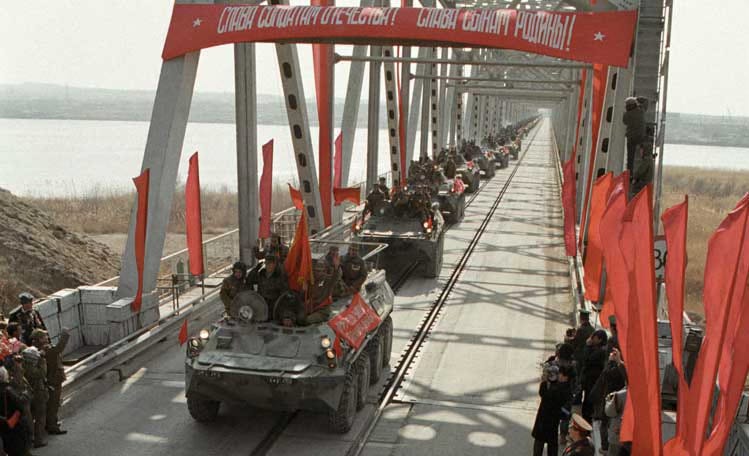 Soviet troops withdraw from Afghanistan. Image: History Today
One modern example of politicians beginning short interventions that end up in long wars is the Soviet invasion of Afghanistan in 1979. The leaders of the Soviet Union, after initially rejecting an armed intervention, expected a quick stabilization operation, with a duration of perhaps a few months. Instead, it expanded into a larger and longer war that lasted nearly a decade and has become widely credited with accelerating the collapse of the USSR. As Rodric Braithwaite writes in Afgantsy:
In December 1979 Soviet troops poured into Afghanistan. Soviet special forces seized key objectives in Kabul, stormed Amin’s palace, and killed him. The intentions of the Soviet government were modest: they aimed to secure the main towns and the roads, stabilise the government, train up the Afghan army and police, and withdraw within six months or a year. Instead, they found themselves in a bloody war from which it took them nine years and fifty-two days to extricate themselves.
Since the dawn of the 21st century, the United States and its partners have also engaged in two short wars which eventually became long wars. Both Iraq and Afghanistan were intended to be wars which could be executed with the standing, professional forces available at the time, with limited supplementation by reserves and national guard units. They were not designed to last a decade or more and require expansion of the military and massive additional spending.