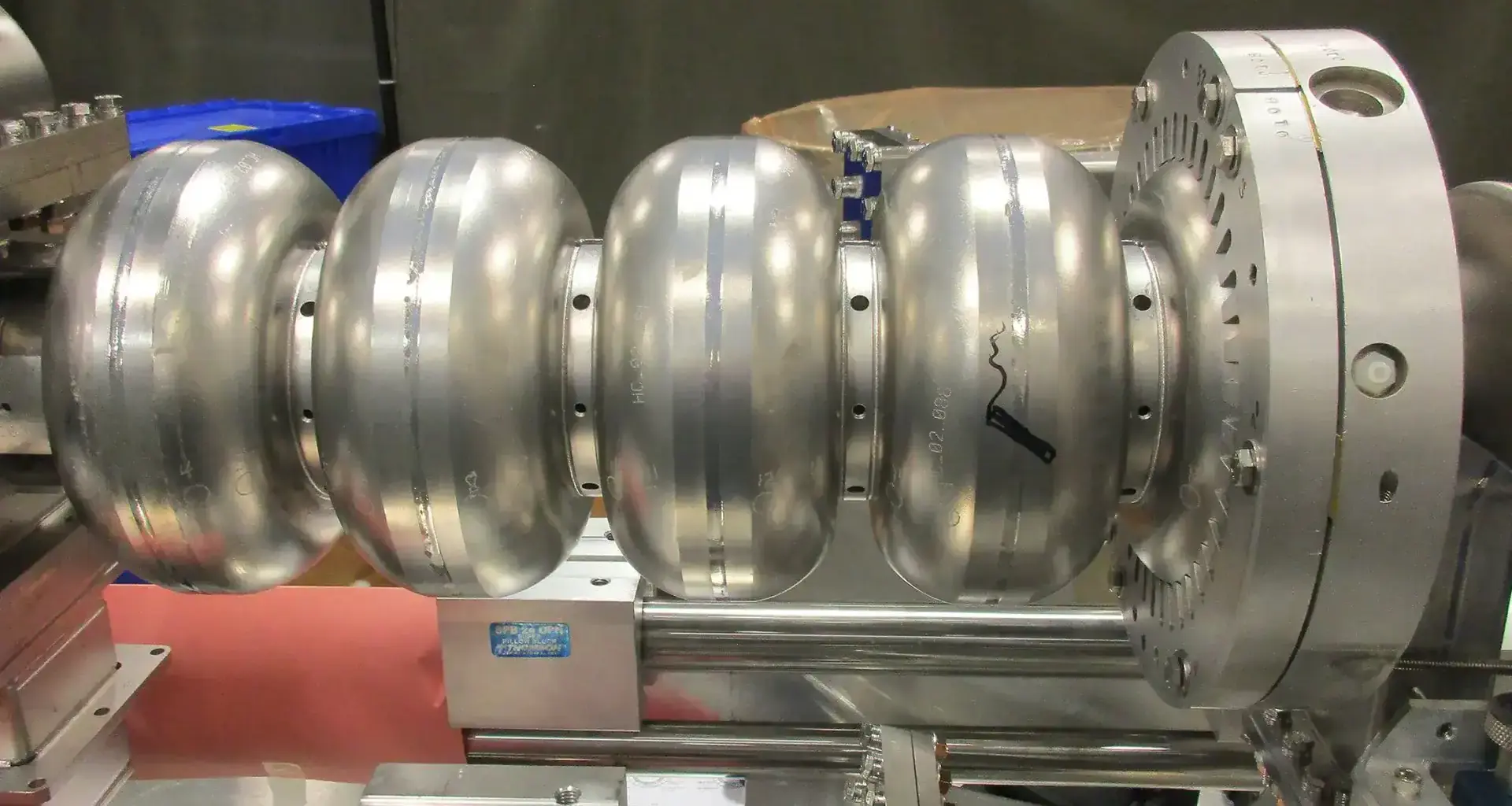
 Particle accelerators are being optimized to both transmute nuclear waste into safer forms and harness it for electricity. Credit: Jefferson Lab
Used nuclear fuel is one of the most persistent challenges facing nuclear energy. Long after a reactor stops using it, the material remains intensely radioactive, requiring cumbersome and expensive storage for tens of thousands to hundreds of thousands of years.
Researchers are now exploring whether advanced physics tools could drastically shorten that timeline by transforming some of nuclear waste’s most hazardous components into materials that decay much faster.
The idea is to pair a particle accelerator with a subcritical nuclear reactor.
Standard nuclear reactors leave behind isotopes like Plutonium-239 or Americium-241. These are “transuranic” elements that stay radioactive for tens of thousands of years. Conventional reactors struggle to “burn” these effectively because they can make the chain reaction unstable.
In a traditional reactor, you need a self-sustaining chain reaction (criticality). In an accelerator-driven system, the reactor is subcritical, meaning it doesn’t have enough fuel to keep the fire going on its own. It needs an external “spark” to stay lit, which is where the high-power particle accelerator comes in.
The U.S. Department of Energy’s Advanced Research Projects Agency–Energy (ARPA-E) has awarded $8.17 million to the Thomas Jefferson National Accelerator Facility to lead two projects aimed at doing exactly that. The funding comes through the Nuclear Energy Waste Transmutation Optimized Now program (NEWTON), which is investigating technologies that could both reduce the longevity of nuclear waste and extract additional power from it.
“Based on our own success in developing cutting-edge accelerator technologies to enable scientific discoveries, we believe that there is a contribution we can make with the experience we have gained over the last few decades,” said Rongli Geng, a principal investigator on both projects, in a Jefferson Lab press release.
Waste Into Resource
Unprocessed spent nuclear fuel remains dangerous for extremely long periods. While most heat and radioactivity drop after a few hundred years, some components remain hazardous for up to 100,000 years or more. According to ARPA-E, separating and recycling the most troublesome elements could shrink that timescale dramatically, to around 300 years. That’s still a long, long time, but your great-great-great-great….–great-grandkids will thank you.
Accelerator-driven systems fire high-energy protons into a heavy target such as liquid mercury. The impact releases a burst of neutrons through a process called spallation. Those neutrons then strike the long-lived isotopes in nuclear waste, transforming them into different, shorter-lived materials.
“These neutrons will interact with these unwanted isotopes and convert them into more manageable isotopes that you can either try out for some beneficial use or bury underground,” Geng said. “Instead of having a lifetime of 100,000 years in storage, for example, you can shorten the storage years down to 300.”
The reactions also produce heat. That heat can potentially generate electricity, turning part of the waste problem into an energy source.
Accessible Accelerators
The idea of using particle accelerators to deal with nuclear waste has been around for years. The obstacle has always been cost: the machines are expensive to build and run.
Most large accelerators rely on superconducting cavities made from niobium. The metal only works under extremely cold conditions, which means facilities need complex cryogenic plants that add major costs.
Researchers at Jefferson Lab are testing a simpler approach. By coating niobium cavities with a thin layer of tin to form a superconducting niobium-tin surface, the devices can operate at higher temperatures. That change could allow the use of standard commercial cooling equipment instead of specialized systems.
“Those are based on the mature Spallation Neutron Source cavity design, but we will add the new tin material on this existing design,” Geng said. “So that will be tested together with our partners at Oak Ridge National Lab.”
The team is also developing a different cavity geometry known as a spoke cavity, which could further improve efficiency.
A second project focuses on the power source for the accelerator. These systems require enormous amounts of energy to drive the particle beam. Researchers are investigating advanced magnetrons—the same operating principle used in microwave ovens—to deliver that power. The challenge is matching their output precisely to the accelerator’s operating frequency of 805 megahertz.
Industry partners, including Stellant Systems, General Atomics, RadiaBeam and Oak Ridge National Laboratory, are involved from the start to help move the technology beyond the lab.
“The challenge is to really translate the accelerator science from where we are right now in terms of technology readiness to where the technology needs to be for this application,” Geng said.