
Prime Minister Benjamin Netanyahu said early Tuesday that an attack against Iran was urgently necessary because Iran was building new underground sites to shield its missile and nuclear programs from attacks.
“The reason that we had to act now is because after we hit their nuclear sites and their ballistic missile program [in June 2025]… they started building new sites… underground bunkers that would make their ballistic missile program and their atomic bomb program immune within months,” the premier said in an interview with Fox News.
“If no action was taken now, no action could be taken in the future,” he said.
Netanyahu’s comments came less than nine months after he declared, at the end of the June war, that Israel had “achieved a historic victory” over Iran that would “abide for generations.”
In his Fox interview, the prime minister denied that the US and Israel were engaging in an “endless war” against Iran, insisting that the operation would end quickly.
“I hear people are telling you that you’re going to have an endless war here — You’re not going to have an endless war because… this terror regime in Iran is at its weakest point” since its founding, Netanyahu said.
“This is going to be a quick and decisive action,” he asserted.
Netanyahu said that the US and Israeli strikes would create the conditions for regime change in Iran.
US officials have offered mixed messages regarding whether regime change is the goal. Defense Secretary Pete Hegseth and Secretary of State Marco Rubio said earlier Monday that it wasn’t, and that neutralizing the Iranian missile, navy and nuclear threats is. US President Donald Trump has vacillated on the matter.
Netanyahu said that “95%” of the problems in the Middle East are generated by Iran, and that the fall of the regime would lead to a flood of peace deals between Israel and its Arab and Muslim neighbors.
He maintained that the joint US-Israeli operations would “usher in an era of peace that we haven’t even dreamed of.”
Earlier, Rubio said that the US had launched Operation Epic Fury in part because Israel was going to carry out a preemptive strike against Iran, and US intelligence indicated that Tehran would respond by targeting American assets in the region.
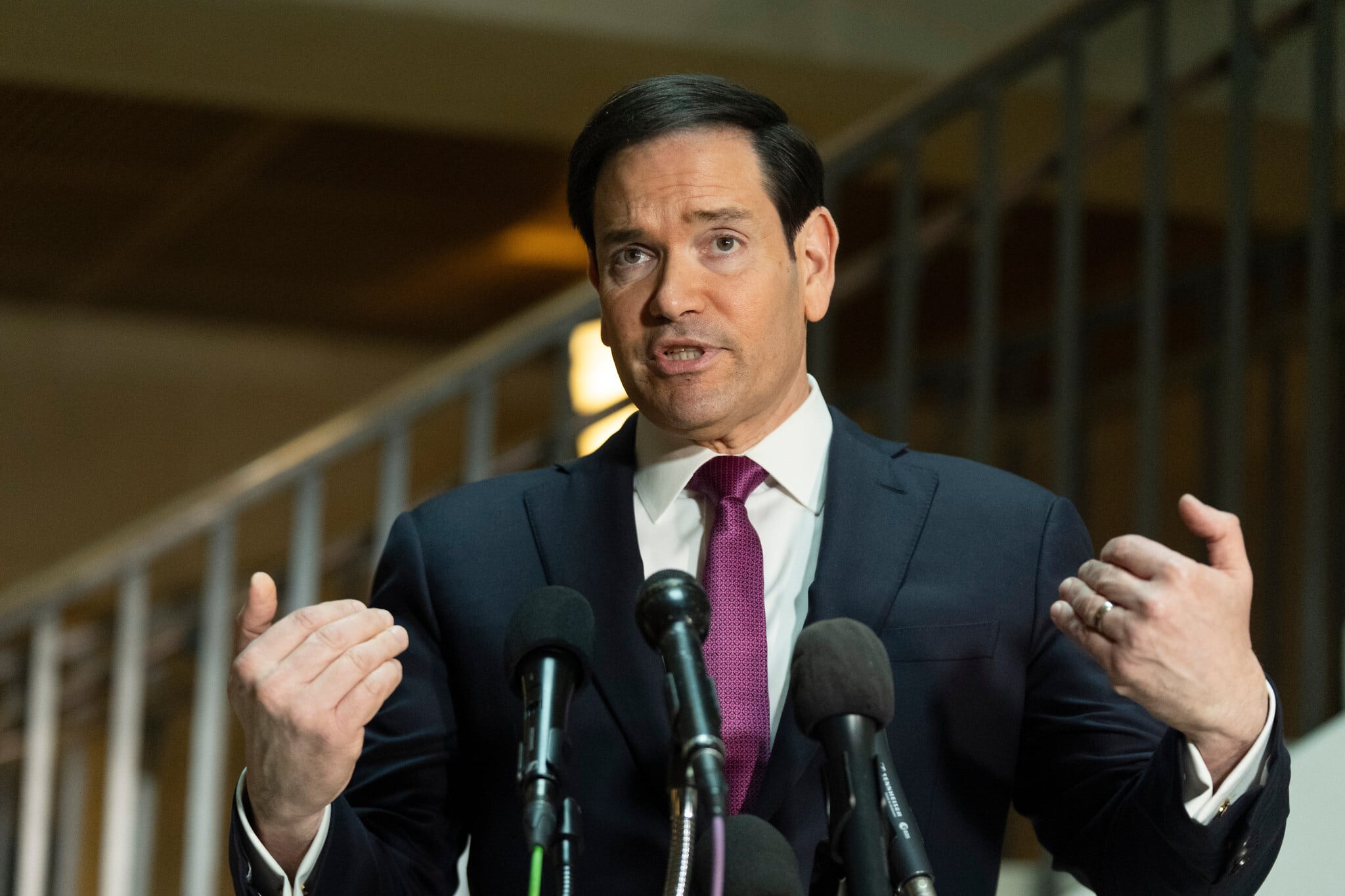
US Secretary of State Marco Rubio speaks to reporters before his scheduled House and Senate Intelligence Committees briefing about Iran on Capitol Hill in Washington, March 2, 2026. (AP Photo/Manuel Balce Ceneta)
The remark further intensified criticism by critics of the administration that Israel had dragged the US into a war with Iran.
Asked to respond to the claim, Netanyahu laughed it off.
“That’s ridiculous. Donald Trump is the strongest leader in the world. He does what he thinks is right for America. He does also what he thinks is right for future generations,” Netanyahu said, arguing that the US president understands the threats posed by Iran.
Netanyahu spent much of the interview praising Trump, who urged his followers to tune in to Fox News ahead of time and was himself likely watching.
Vance: War seeks to change Iran’s ‘mindset’
US Vice President JD Vance was also interviewed on Fox News, and focused largely on the nuclear threat.
He said the goal of the operation was to change the Iranian “mindset” so that it would agree never to pursue a nuclear weapon.
Vance said Trump succeeded in preventing Iran from having the ability to build a nuclear weapon until at least the end of his second term through last June’s Operation Midnight Hammer, at the end of Israel’s 12-day war, which targeted Tehran’s three main nuclear facilities.
“We set them back substantially, but I think the president was looking for the long haul. He was looking for Iran to make a significant long-term commitment that they would never build a nuclear weapon,” the vice president said.
The US then spent nearly a year trying to negotiate with Iran, but Tehran wouldn’t budge, Vance continued.
Trump then realized that achieving his aim “would require, fundamentally, a change in mindset from the Iranian regime,” he said.
“He saw that the Iranian regime was weakened, he knew that they were committed to getting on that brink of a nuclear weapon, and he decided to take action because he felt that was necessary in order to protect the nation’s security,” Vance said.

US President Donald Trump arrives for a Medal of Honor ceremony in the East Room of the White House, on March 2, 2026, in Washington. (AP Photo/Alex Brandon)
Vance insisted that Operation Epic Fury won’t drag out for years because the US has a clear goal.
“There’s just no way that Donald Trump is going to allow this country to get into a multiyear conflict with no clear end in sight and no clear objective,” Vance asserted.
“He’s defined the objective as Iran cannot have a nuclear weapon and has to commit long-term to never trying to rebuild their nuclear capability,” he added.
Witkoff: Iranians bragged of uranium for 11 bombs
US special envoy Steve Witkoff, who together with Trump’s son-in-law Jared Kushner led Washington’s negotiations with Tehran over the disputed nuclear program, said that Iran’s top negotiators boasted in the first round of talks this year of having enough highly enriched uranium to build 11 nuclear bombs.
“In that first meeting, both the Iranian negotiators said to us directly — with no shame — that they controlled 460 kilograms of 60% [enriched uranium] and that they’re aware that could make 11 nuclear bombs,” Witkoff told Fox.
Trump has asserted that the US “obliterated” Iran’s nuclear facilities during the 12-day war last June, which would ostensibly render Iran incapable of immediately turning that enriched uranium into a bomb.
.@SEPeaceMissions Steve Witkoff says Iran “thought they could strong-arm us” during talks:
“We went in there and tried to make a fair deal with them, and it very, very clear that it was going to be impossible…” pic.twitter.com/MSFt8kvJno
— Rapid Response 47 (@RapidResponse47) March 3, 2026
Still, Witkoff said the Iranian negotiators “were proud that they had evaded all sorts of oversight protocols to get to a place where they could deliver 11 nuclear bombs.”
He said that during that first meeting, the Iranian negotiators insisted on “an inalienable right” to enrich their nuclear fuel.
“We responded that the president feels we have the inalienable right to stop you dead in your tracks,” Witkoff recalled. “Jared and I just sort of looked at ourselves flummoxed, and said, ‘We’re really in for it now.’”
Witkoff’s account seemed to comport with details of an NBC report earlier in the day that claimed Iranian Foreign Minister Abbas Araghchi had shouted at the envoy about Iran’s enrichment rights during their meeting.
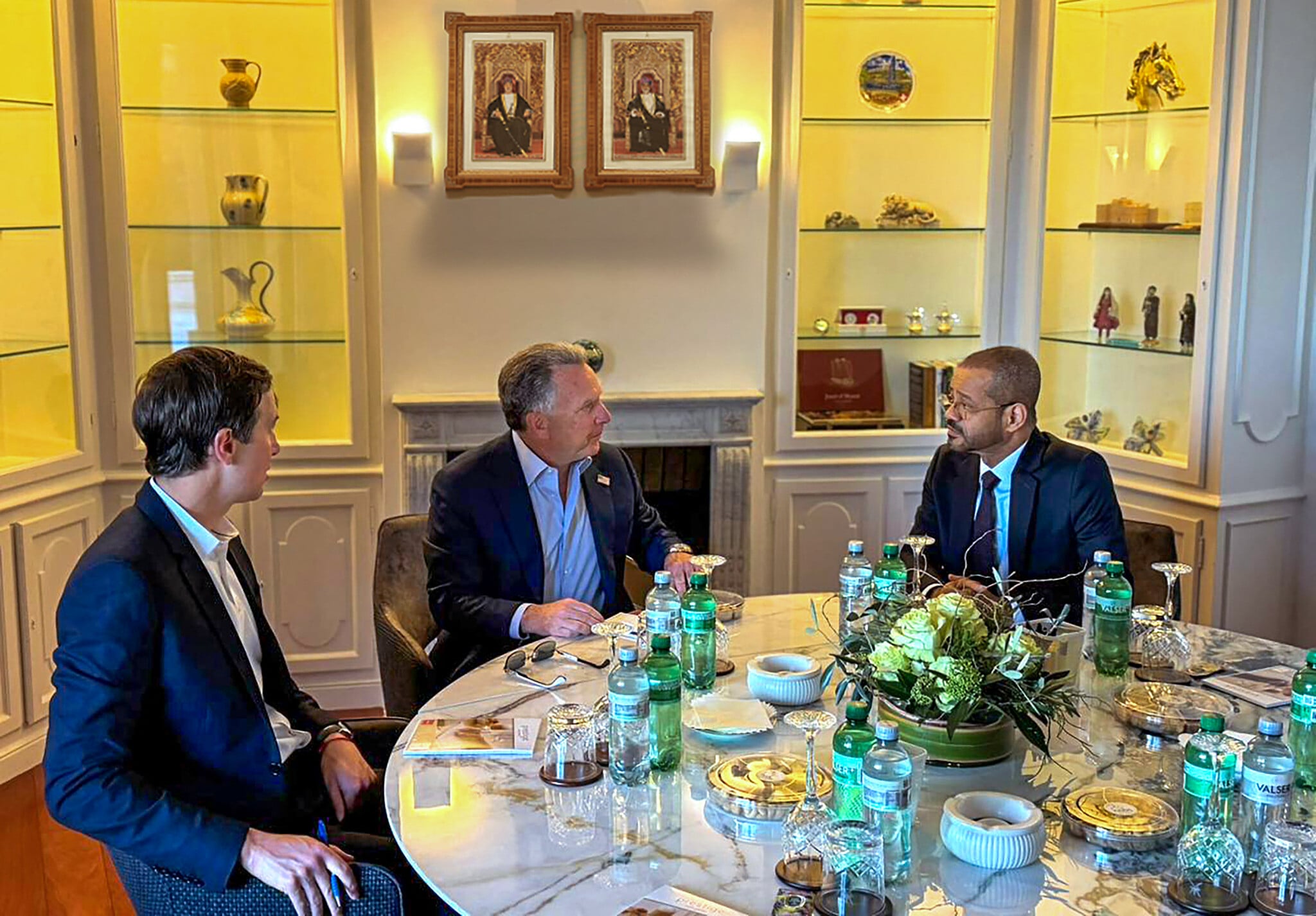
In this handout photo released by the Omani Ministry of Foreign Affairs on February 26, 2026, US special envoy Steve Witkoff (center) and Jared Kushner hold a meeting with Oman’s Foreign Minister Badr Albusaidi (right) in Geneva. (Omani Foreign Ministry / AFP)
Witkoff reiterated his claim that the highly enriched uranium that Iran had stockpiled could be turned into weapons-grade within a week or 10 days, though this would again require nuclear facilities that the US says it destroyed in strikes last year.
Witkoff said Trump had dispatched him and Kushner to hold talks with Iran to reach a deal in which Tehran would agree to eliminate its missile program, cease its support for proxies, eliminate its navy “so we can have freedom of the seas,” and cease its nuclear enrichment.
“We went in there and tried to make a fair deal with them, and it was very, very clear that it was going to be impossible — probably by the end of the second meeting, but we then went back for the third meeting just to give it the last college try,” Witkoff said.
“They wanted us to report positivity. It was not positive, that meeting,” he added.
Israeli officials warn missiles won’t all be destroyed
Israel has cited the Islamic Republic’s ballistic missile arsenal and its ability to manufacture more as an existential threat to the Jewish state.
In Jerusalem, security officials warned cabinet ministers during a Monday night meeting that the Iranian “ballistic missile threat will not be destroyed” in the current round of fighting, according to a report by Channel 12.
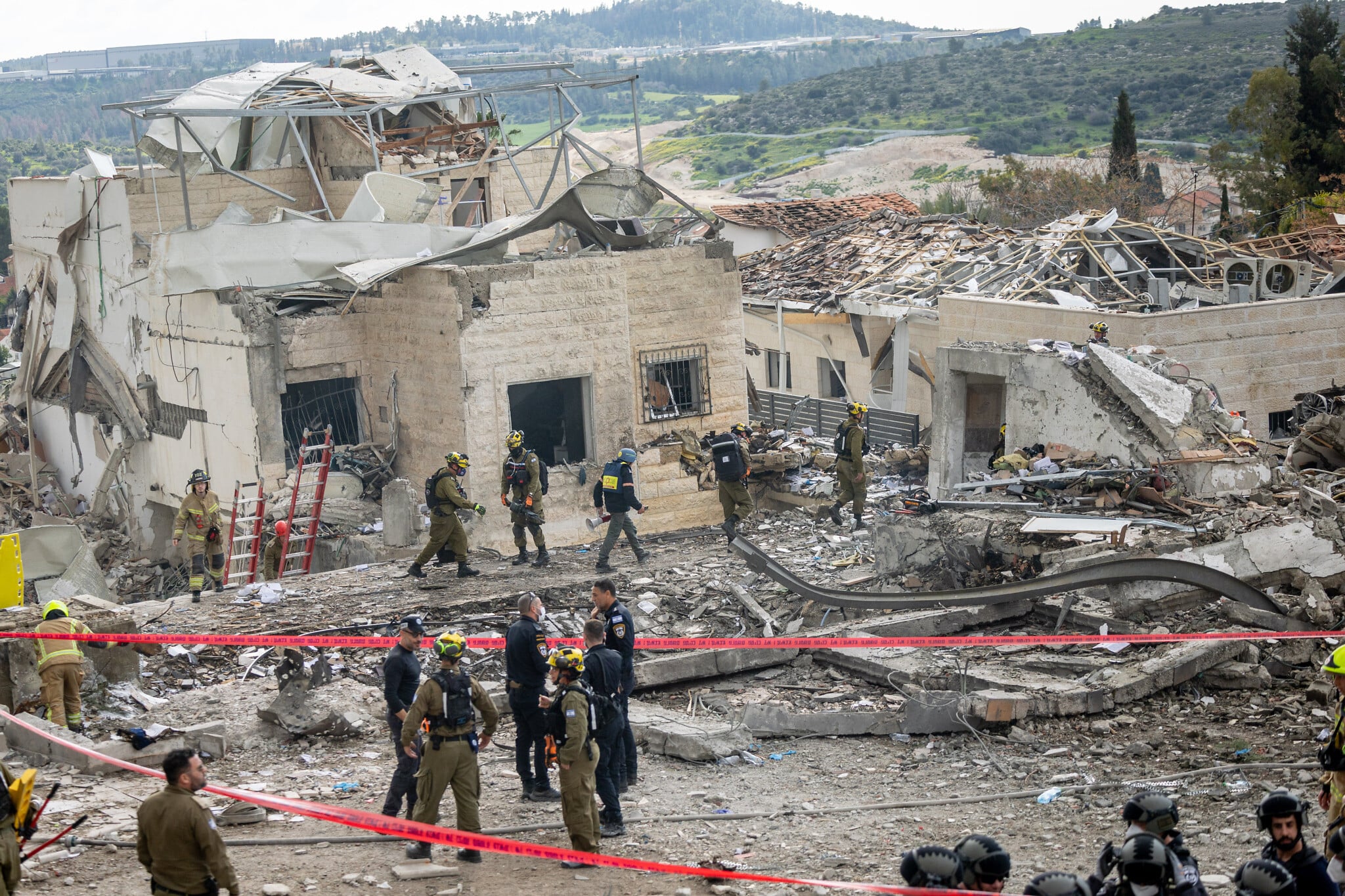
The scene where a ballistic missile fired from Iran hit Beit Shemesh, March 1, 2026. (Yonatan Sindel/Flash90)
The security officials were quoted as saying that Iran is keeping some of its missile systems below ground, and that it intends to bring those out on “the day after.” They were also quoted as saying that the Islamic Republic is “trying to save what is possible from the nuclear sites” as well.
“After the campaign, they will try to reuse what we blew up,” the officials reportedly added.
However, if the war plans work as intended, the officials reportedly said, the IDF will have significantly degraded Iran’s ballistic capabilities, as well as its ability to rebuild them.