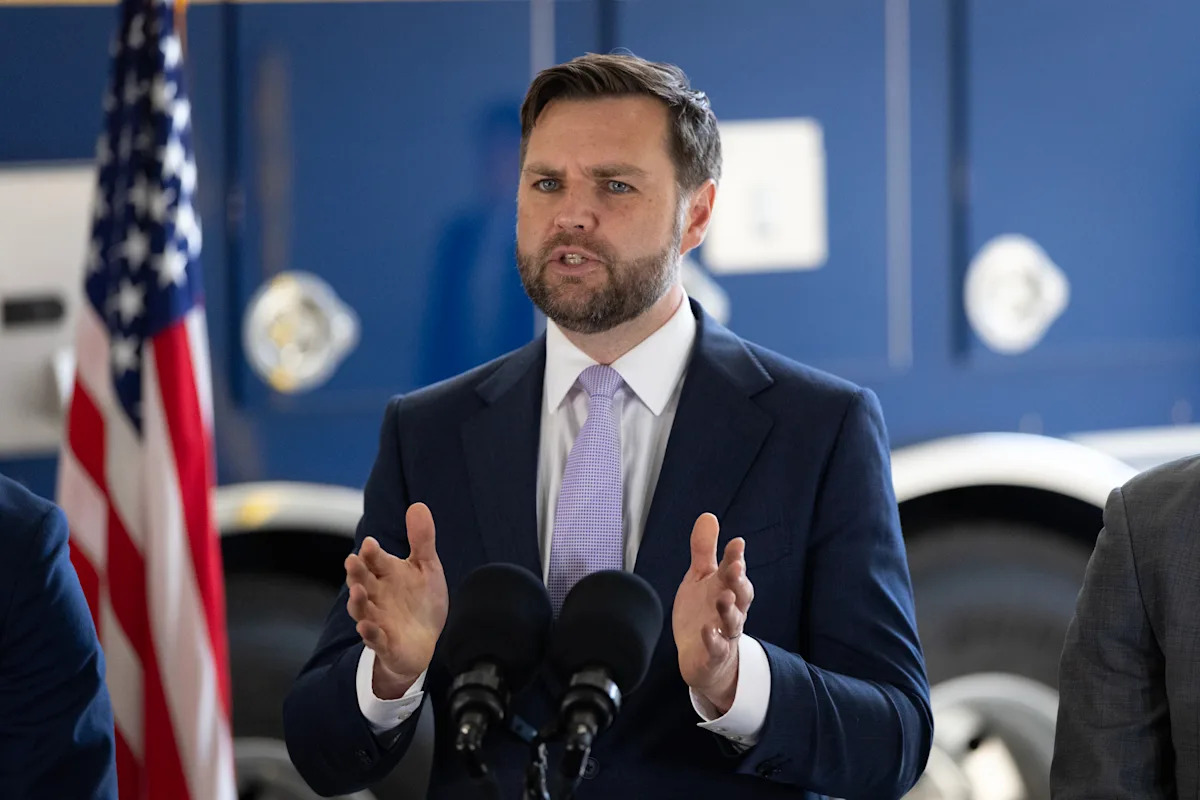
J.D. Vance has a Kamala Harris problem. Like his predecessor, the current veep is positioning himself as the heir apparent to an aging president. And while the office he now occupies gives him a clear edge in a hypothetical 2028 Republican primary, it can also enormously complicate his ambitions: Also like his predecessor, his career is tied to an unpopular president to whom he owes unwavering public support.
President Trump’s approval rating has steadily fallen to a dismal 41 percent in the New York Times average, and more than 80 percent of Americans say the top issue of affordability has not improved on Trump’s watch. Polls show an electorate either starkly divided or strongly disapproving of the president’s undeclared war against Iran, depending on how the question is asked, with CNN finding nearly 60 percent disapproval. Some recent polls show that Trump is even less popular than Joe Biden was when Harris lost the election to be his successor—with a little under three years to go.
In fact, Vance’s conundrum may be even more complex than Harris’s. After all, by the time Harris told the hosts of The View that “not a thing … comes to mind� that she would have done differently than Biden as president, she was already her party’s nominee. And while she, too, risked angering her party’s base by embracing a controversial foreign-policy position—in her case, Biden’s staunch support of Israel’s war in Gaza—she didn’t have a long public track record of arguing against the very kinds of policies her boss had decided to embrace.
Vance, however, has been characteristically vocal about his isolationist stance, and his now-infamous 2023 Wall Street Journal op-ed praising Trump for “not starting any wars� was ricocheting around social media as soon as American bombs started falling on Tehran. Almost as quickly came the leaks and the think pieces about how the vice president, an ostensible intervention-skeptical Global War on Terror veteran who has accused “people like Kamala Harris� of “sending our young people to fight in stupid wars,� had found himself backing two regime-change operations in as many months. The Times reported that while Vance leaned against the attacks, he said in the Situation Room that the U.S. should “go big and go fast� if they decided to strike. Vance himself seemingly tried to reconcile his past stances with his current one while pushing the president’s message, insisting to Jesse Watters on Fox News this week that “we’re not going to get into the problems that we had in Iraq and Afghanistan.�
Vance is clearly sensitive to the coverage. “The vice president has been the focus of constant leaks left and right by people trying to project their views onto him,� said his spokesman, Taylor Van Kirk. “As a result, there have been countless inconsistent accounts of the vice president’s views published, which shows the mainstream media has no idea what they’re talking about. The vice president, a proud member of the president’s national security team, keeps his counsel to the president private.�
But Trump’s increasingly expansive definition of “America First�—which now includes serial regime-change operations, the bombing of seven countries (so far), and threats to seize Greenland—has put Vance in the near-impossible position of appeasing his party’s vocal anti-interventionist wing while courting a Republican base that stands behind their president no matter what. His political fate may depend on holding these opposing wings of his coalition together.
Full of Shapeshifting
Still, if anyone other than Trump himself can pull this off, Vance has considerable advantages. Allies and critics alike point to his talent as a rhetorician—one Democratic senator told me that Vance has been able to get this far because of his ability to talk his way into and out of any situation. He even managed to talk his way out of comparing Trump to Hitler in 2016. California Gov. Gavin Newsom, himself a potential 2028 contender, noted to my colleague Peter Hamby that Vance has since “shapeshifted� into one of Trump’s “biggest cheerleaders.� Even Trump’s chief of staff, Susie Wiles, said Vance’s evolution toward Trump was “sort of political.�
Vance acknowledged his own gifts as a communicator early on. In Hillbilly Elegy, he described his job as a media liaison for the Marines, a position usually reserved for higher-ranking officers than he was at the time, and said it taught him he “could speak clearly and confidently with TV cameras shoved in my face� or “stand in a room with majors, colonels, and generals and hold my own.� That’s why his job during the 2024 campaign was to sit down with media of all ideological stripes, including Sunday shows and even MSNBC.
Indeed, he also allowed himself some flexibility on his antiwar stance during that campaign. “A lot of people recognize that we need to do something with Iran—but not these weak little bombing runs,� he told Sean Hannity during the Republican National Convention. “If you’re going to punch the Iranians, you punch them hard.�
Once in office, he did flex some isolationist instincts—up to a point. The MAGA base cheered when Vance dressed down Ukrainian president Volodymyr Zelensky in the Oval last year. And when top administration officials discussed plans to strike Yemen’s Houthis in a leaked Signal chat last year, Vance chimed in to call the plan “a mistake� and added, “There is a real risk that the public doesn’t understand this, or why it’s necessary.� But he backed down quickly, according to transcripts of the chat, telling Defense Secretary Pete Hegseth, “If you think we should do it then let’s go.� He said he would keep his concerns to himself.
Of course, being associated with Trump remains extremely powerful in MAGA—84 percent of Republicans support Trump’s war in Iran, according to a new Fox News poll—and crossing the president would be more politically damaging than standing up for a previously held position. “J.D. is talented enough to navigate this,� a Republican operative texted me. “So even if there are times that are difficult, on the net it’s clearly a huge advantage for him to be tied to DJT.�
The Antiwar Wing
Yet even if much of MAGA is behind Trump’s Iran intervention, an extremely vocal contingent is not. Among the dissenters are former Trump advisor Steve Bannon, who’s hosted guests critical of the war, such as Blackwater founder Erik Prince, on his War Room podcast; former Rep. Marjorie Taylor Greene; Megyn Kelly; Tucker Carlson; and Sean Davis, the Trump-aligned editor of The Federalist. Their message resonates in particular with the kinds of younger, male voters who swung for Trump partly because of his promise to protect their generation from endless wars. “It’s such a 180 from what I thought,� one conservative Hill staffer said when I asked him about Trump’s overseas gambits. “That doesn’t speak to me.� A young Trump voter from the Midwest I keep in touch with to get the pulse of young conservative men told me he was “so pissed.� “Not what I signed up for!� he said. “Also going to do long-term damage to J.D.�
But will it? Maybe, maybe not—especially if no antiwar Republicans line up for the Republican presidential primary. According to a recent Emerson poll, Vance would beat second-place Marco Rubio by 32 points in a potential primary field that included Rubio, Sen. Ted Cruz, Ron DeSantis, and Nikki Haley, but excluded Greene and Bannon. My colleague Peter Hamby has also documented Vance’s dominance in a potential primary field.
It also matters a great deal how the Iran war turns out. If it’s a resounding success, Vance could count himself one of the fathers of victory and take credit for a Khamenei-free Middle East. In the more likely event the operation drags on—and administration officials have been revising their estimates of the duration upward over the past few days, with Hegseth now positing it could take eight weeks—it could be devastating for Trump’s presidency, and for Vance. Six Americans have already been killed.
Which is one reason there’s a desire for the antiwar, Tucker Carlson wing of the party to have a candidate. “There is a lane for people who are skeptical of military intervention and regime-change wars, especially in the Middle East, but also aren’t siding with the Iranian regime and rooting for America to fail,� conservative commentator Matt Walsh said on his podcast earlier this week. “A great majority, where most Americans live.�
Latest from Puck