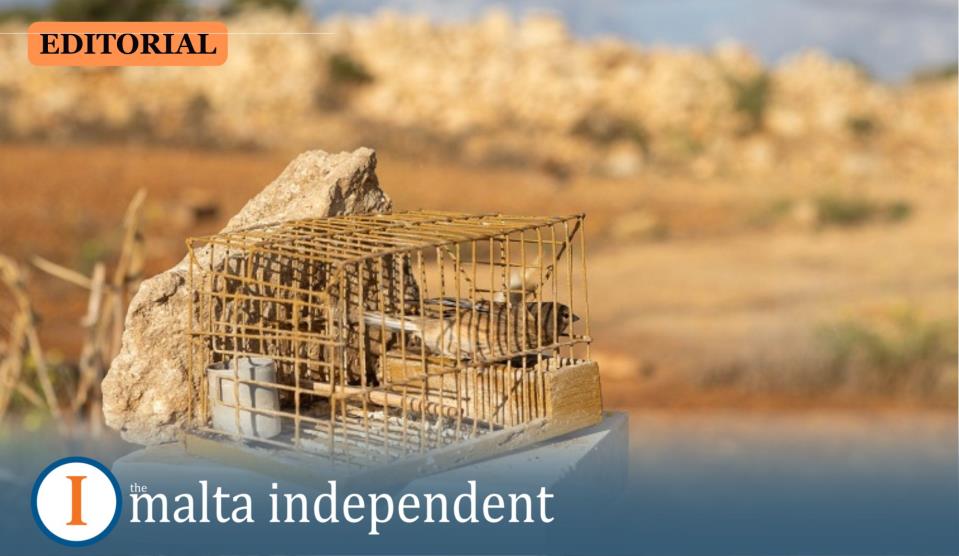

The government’s decision, announced through the Wild Birds Regulation Unit, to reopen applications for new general trapping licences marks yet another troubling departure from Malta’s obligations under European law. It is difficult to interpret the move as anything other than a calculated pre-election gesture aimed at consolidating a niche but vocal constituency, regardless of the broader legal and environmental consequences.
When Malta joined the European Union in 2004, it did so under clear conditions. Finch trapping was to be phased out, with a limited transitional arrangement tied to a breeding programme. No new licences were to be issued. The direction was unambiguous: the practice would gradually diminish. Instead, governments have sought to reframe and repackage trapping schemes, attempting to square domestic political interests with European environmental law.
The European Court of Justice has twice ruled against Malta’s approach. In 2018, it struck down the “recreational” derogation. In September 2024, it rejected the revised “scientific research” framework. These are not marginal legal setbacks open to creative reinterpretation; they are definitive judgments clarifying that Malta’s derogations do not meet the strict requirements of the EU Birds Directive. Persisting along this path risks not only further infringement proceedings but also reputational damage that extends well beyond environmental policy.
The timing of this latest decision reinforces the perception that restraint has given way to electoral arithmetic. Rather than allowing trapping to decline naturally, as originally envisaged, the government is effectively injecting a new generation of trappers into a practice that European institutions have repeatedly deemed unlawful. That is not continuity; it is regression.
Malta’s geographic position on a major migratory corridor between Europe and Africa places particular responsibility on national authorities. The species targeted locally are part of a shared European natural heritage, protected precisely because their conservation depends on collective discipline across borders. Decisions taken on a small island can have cumulative effects along an entire migratory route.
The ecological implications are compounded by spatial realities. Large portions of the countryside are already divided into trapping plots, including within Natura 2000 sites designated for biodiversity protection. Expanding the number of licences will inevitably increase trapping effort, intensify habitat disturbance, and further fragment rural landscapes that are already under pressure from development and infrastructure strain. Public access to, and enjoyment of, these areas risks being further curtailed.
Equally concerning is the enforcement context. The Environmental Protection Unit is widely acknowledged to be under-resourced. Expanding a contentious activity in what can fairly be described as an enforcement vacuum is imprudent. It creates conditions in which licensed and unlicensed activities become harder to distinguish, and in which compliance becomes more theoretical than real.
Reports of trapping during closed seasons and the continued demand for live decoys illustrate the risks. Where oversight is weak, abuses multiply. Rather than narrowing the scope for such practices, the government’s decision broadens it.
What this decision ultimately reveals is not a carefully balanced environmental policy, but a calculated political trade-off. The reopening of licences appears designed to curry favour with trappers in the run-up to an election, even if that means reopening a dispute that Malta has already lost twice before the European Court of Justice. It is difficult to avoid the conclusion that the government is prioritising a narrow electoral dividend over legal certainty and environmental stewardship.
In doing so, it risks provoking renewed action from the European Union – infringement proceedings, financial penalties, and further damage to Malta’s credibility within the bloc. The warning signs are neither subtle nor new. They have been spelled out in court judgments and formal notices.
Yet the trajectory suggests that these consequences are treated as secondary considerations by the government. The immediate objective seems clear: secure votes now, manage the fallout later. In other words, the government does not care what the EU thinks so long as it earns votes.