
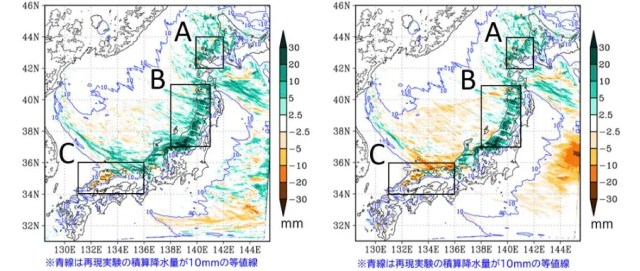
 The study found an increase in precipitation in Northern Japan. | Image: Study: “Global warming affects the heavy snowfall in late January 2026”
A new analysis by researchers at Japan’s science ministry and the Meteorological Research Institute at Japan Meteorological Agency suggests that climate change may actually increase snowfall in some parts of Japan, even as warming temperatures reduce snow in others. The study was entitled “Global warming affects the heavy snowfall in late January 2026,” and was published on March 3, 2026, on the website of the Japan Meteorological Agency website.
The study examined the severe snowstorms that struck Japan between January 21 and January 31 this year, when a prolonged surge of extremely cold air swept across the archipelago. The cold outbreak produced widespread disruption across northern and western Japan, shutting down transportation systems and leaving some communities buried under record snow. Around Sapporo, train services were suspended, while in Aomori Prefecture extreme snowfall dumped up to 6.5 feet (about 2 meters) of snow across parts of northern Japan, prompting the deployment of Japan’s Self-Defense Forces for disaster relief.
Using advanced climate simulations, researchers investigated whether human-caused global warming played a role in the event. The team employed a method known as “event attribution,” which compares weather simulations representing the current climate with simulations of a hypothetical climate unaffected by human-driven warming. The results revealed a complex relationship between climate change and snowfall.
In colder regions along the Sea of Japan coast—particularly in Niigata Prefecture and areas further north—the study found that climate change likely increased snowfall by about 7%. Warmer air holds more moisture, meaning storms can deliver greater amounts of precipitation when temperatures remain cold enough for snow. “Increased atmospheric water vapor can raise the risk of heavier snowfall,” the researchers concluded.
However, the effect was the opposite in warmer parts of the country. In western Japan, where winter temperatures are closer to freezing, the analysis found that snowfall amounts were reduced by roughly seven percent. In these regions, rising temperatures mean that precipitation that once fell as snow increasingly falls as rain instead.
The findings illustrate a counterintuitive aspect of climate change: warming does not always reduce snowfall. Instead, its impact depends heavily on local temperature conditions. In colder areas that remain well below freezing, additional atmospheric moisture can intensify snowstorms, while in milder regions the same warming trend can suppress snowfall.
Climate models used in the study simulated the event under two different scenarios: one reflecting today’s climate conditions, and another representing a world without human-induced warming. By comparing the two, scientists were able to estimate how climate change altered snowfall totals during the late-January storm period.
Researchers emphasize that the results highlight the need for continued preparedness in snowy regions. Heavy snow events can still occur—and in some cases may become more intense—even as global temperatures rise.
 Aomori Spring in Northern Japan is part of the Indy Pass, and annually sees snowfall averages of 500-700″ . | Image: Indy Pass