
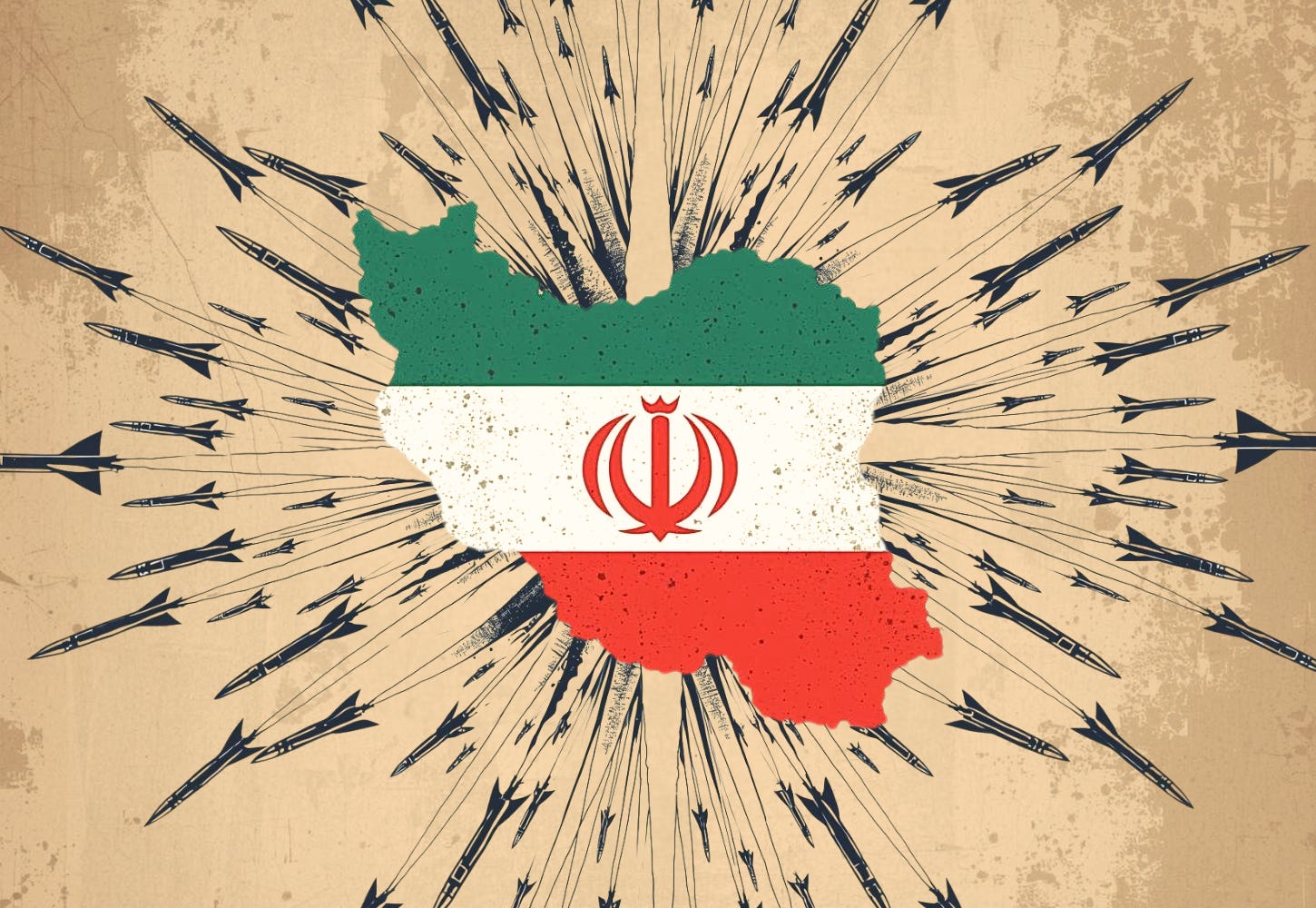
Following weeks of preparation and military build-up in the Middle East, the United States (US) and Israel launched an offensive against Iran on 28th February. Strikes on Tehran eliminated many senior Iranian figures, most notably Ayatollah Ali Khamenei, Supreme Leader of Iran, who was confirmed dead early on 1st March.
Iran retaliated by launching missile strikes against countries throughout the Middle East, while an Iranian drone targeted a Royal Air Force (RAF) air station at Akrotiri on Cyprus on 1st March. Although Britain initially appeared reluctant to show overt support for ‘Operation EPIC FURY’, Sir Keir Starmer, Prime Minister, announced on Monday that the United Kingdom (UK) will allow the US to use British air stations to strike Iran. This development forms the foundation for this week’s Big Ask, in which we asked eight experts: Should Britain embrace a tougher approach towards Iran?
Adjunct Fellow, Council on Geostrategy, and Senior Lecturer in National Security Studies, King’s College London
The UK should take a tougher line with Iran, but this does not equate to escalating. ‘Tough’ should mean making it crystal clear that attacks on British people and territory will bring consequences, and showing that the UK can protect what it uses to operate overseas.
Last weekend’s events, particularly RAF Akrotiri being targeted and Britain allowing America to use its air stations, mean that the UK is now closer to the sharp end, whether it intended to be or not. That makes clear red lines (and committing to them!), stronger air and missile defence, and tightly defined basing permissions essential – while avoiding broad, open-ended escalation.
A ‘small states’ lens helps to explain why Iran puts pressure on places like Cyprus and Gulf ‘hosts’ such as Bahrain, Qatar and Kuwait. Iran often targets the ‘hosts and hubs’ that keep free and open nations’ operations running. These sites are militarily vital, but politically sensitive.
When Iran strikes or threatens such sites in smaller countries, it is not just trying to punish the UK or US. It is also trying to split coalitions by forcing smaller partners to carry the immediate risk: public fear, domestic backlash, economic disruption, political upset and so on.
So, a tougher British approach should prioritise protecting forward hubs (via integrated air defence, drone defence and maritime security); signalling that attacks on the UK’s bases will trigger proportionate, legally grounded responses against launch infrastructure; tightening financial and shipping enforcement against Islamic Revolutionary Guard Corps (IRGC)-linked networks in coordination with Gulf states considering tougher measures; and keeping de-escalation channels open to avoid turning small partners into permanent battlegrounds. It should also be matched by parliamentary scrutiny at home.
By taking these steps, Britain can get tougher on deterrence and resilience, while saying no to maximalist mission creep.
Associate Professor in War Studies, Swedish Defence University
Sir Keir’s response to Operation EPIC FURY has been appropriate and entirely understandable. The British Armed Forces are already stretched, and it makes little strategic sense to extend them further. At present, the services face serious recruitment and retention problems, compounded by the persistent lack of habitable service accommodation.
If the UK struggles with both recruiting personnel and looking after those already serving, it should come as no surprise that it cannot put more ships to sea or generate additional formations for operations. Britain’s defence commentators know all of this, yet the clamour to do more with less continues to dominate the discussion.
If the UK’s commentators want the country to defend its global interests, then defence spending must increase. Without sustained economic growth, however, such ambitions remain little more than rhetorical devices designed to attract political attention.
The prospects for meaningful growth amid current geopolitical upheaval appear slim. Banking on growth therefore amounts to kicking difficult strategic choices down the road in the hope that events will allow Britain to continue avoiding them. Yet, hoping to do more globally while ignoring the immediate security challenges in Europe – challenges that the US has repeatedly told its North Atlantic Treaty Organisation (NATO) allies to prioritise – is the epitome of bad strategy.
Research Fellow (National Security), Council on Geostrategy
Before answering whether a tougher stance on Iran is needed, the UK’s interests must first be established. These can be summarised broadly as:
Avoid being dragged into a conflict which (so far) has no clear endgame;
Protect British people and allies;
Mitigate wider economic spillover effects;
Minimise fallout for the relationship with the US; and
Maintain the credibility of British political will and military capability.
On count one, His Majesty’s (HM) Government was wise to stay out of the initial strikes. On count two, although left underprotected – a Type 45 is only now being prepared to aid in the defence of Akrotiri – the limited British forces in the region are performing well.
However, on counts three, four and five, the UK is not doing great. Here, a tougher stance on Iran would make a lot of difference, and do so without putting the first two interests at risk.
America is frustrated at Britain, Iran lashing out has spooked markets – most importantly shipping insurance – and the decision to downplay the drone strike on Akrotiri risks emboldening other potential foes in the future – particularly pertinent as Coalition of the Willing plans are being worked on.
If another strike occurs and the UK is unwilling to launch a token retaliation strike against a non-nuclear and defanged Iran or its proxies, it should give up the pretence that it would be willing to defend its deterrence force in Ukraine. A tougher stance (although still well short of participation in Operation EPIC FURY) would be a good idea.
The details of what this would entail cannot be outlined in such a short format as this, but proscribing the IRGC as a terrorist group and preparing a limited retaliatory strike in the event of another attack on Akrotiri would be a good start.
International Fellow, Council on Geostrategy, and Senior Vice President of National Security and Intelligence Programmes, Centre for the Study of the Presidency and Congress
Regrettably, it appears that the Prime Minister managed to choose the worst possible option as it relates to American military operations against Iran. While there was likely no good option, there was indeed a less bad option that could well have satisfied – if only partially – the critical audiences in Washington and London.
By initially refusing to allow the US to use British bases for its operations against Iran on legal grounds (necessary for domestic political considerations), Sir Keir set himself up for direct conflict with Donald Trump, President of the US, for very little gain. Trump is decidedly less interested – if at all – in international law, and focuses instead on what allies and partners can do for his country.
The Prime Minister said no, and received nothing in return except Trump’s predictable ire and a regrettable demonstration of the toothlessness of his objections. By contrast, Friedrich Merz, Chancellor of Germany, and Emmanuel Macron, President of France, have been much more supportive; actions recognised favourably by Trump.
From the start, Sir Keir could have said that while the UK could not support offensive military operations on legal grounds, it could instead deploy alongside American forces or Gulf allies in a purely ‘defensive’ counter-missile and counter-drone role. This would have seemingly satisfied the Prime Minister’s legal concerns and domestic political considerations, while reaffirming British reliability and credibility and softening the rejection for Trump.
Indeed, deciding after the fact to deploy British forces to defend Cyprus and sail HMS Dragon to the region (which should have been done in the first place) only reinforces that Sir Keir’s original decision was ill-considered and politically costly.
Assistant Professor in Politics and International Relations, University of Nottingham
British political parties are divided over entering the conflict with Iran; the Liberal Democrats and the Green Party remain firm in their stance of non-intervention, while the Conservatives have called for more offensive action to defend British interests. For now, the Prime Minister appears keen to avoid some of the mistakes made by the Blair government over Iraq.
As a result, there has been a considerable emphasis on the legalities of supporting the American-Israeli operation and the perceived lack of a ‘phase four’ post-combat plan. If lessons from the past are to be heeded, these elements should be resolved before the UK becomes involved in any offensive action.
Consequently, the question becomes less about being tough towards Iran, and more about the challenge to remain firm in policy as the requirement for defensive (and offensive) activity mounts. The pressure to inch further into the conflict will increase exponentially as it becomes more protracted, and if Iran continues its response across the region. Britain has already emphasised its responsibility to protect its citizens, interests and allies, while Trump has made his displeasure at the UK’s initial response well known.
Nonetheless, Sir Keir would do well to remember one of the other most significant lessons, identified by the ‘Chilcot Report’ – the independent Iraq Inquiry report – in 2016: ‘The UK’s relationship with the US has proved strong enough over time to bear the weight of honest disagreement. It does not require unconditional support where our interests or judgements differ.’
This approach is more challenging when the US Government is under a Trump administration, but will remain true in the longer term.
Senior Adviser for Geopolitics, Centre for Risk Studies, and Convenor, Geopolitical Risk Analysis Study Group, University of Cambridge
Yes, Britain should adopt a tougher approach towards Iran.
The UK has a clear strategic interest in confronting a regime which is openly hostile and threatens its allies across the Middle East. Iran has just attacked British sovereign territory in Cyprus – a further reminder of the regime’s willingness to target the UK.
Britain has a strategic interest in aligning with America; its closest and most important ally on which it depends for external security. London shares Washington’s interest in breaking up the People’s Republic of China’s (PRC) international relationships – first Venezuela, now Iran – to ensure it does not attain superpower status.
There is also a strong moral imperative for challenging a regime which has caused so much suffering since 1979, from its repression and impoverishment of the Iranian people, to its sponsorship of terrorism in other parts of the Middle East. Furthermore, against the backdrop of protests at home, the uniting of Arab countries in opposition to Iran, and ongoing attacks by the US and Israel, there is a reasonable chance that, if the UK were to join the anti-Iranian coalition, the regime in Tehran would be seriously weakened and could potentially fall.
At a point when some – including Trump – are expressing doubts about whether Britain is a serious country, HM Government would do well to align itself with an initiative that not only advances the UK’s interests and ends the rule of a murderous tyranny, but might actually work.
Postdoctoral Researcher, King’s College London
This question emerges at a politically sensitive juncture. The Prime Minister faces sustained criticism for privileging foreign policy engagement over urgent domestic priorities, while transatlantic relations are undergoing visible strain. In this context, any shift in Britain’s posture towards Iran carries both strategic and political implications.
A more neutral or restrained approach would represent a departure from earlier patterns of the UK’s foreign policy, particularly the interventionist tendencies associated with the Blair era. Yet, a tougher stance would not be without cost.
Britain is currently seeking to strengthen its defence capabilities and reduce reliance on America. Escalating tensions with Iran could expose the UK’s military assets abroad to retaliation and increase the risk of entanglement in a wider Middle Eastern conflict. The vulnerability of British bases, such as those in Cyprus, underscores the potential political, financial and military consequences of miscalculation.
None of this suggests that inaction is a viable strategy. Rather, it highlights the need for conceptual clarity. Before adopting a more confrontational approach, the UK should define its foreign policy priorities and determine whether such a move genuinely serves its national interest. If so, policymakers should carefully calibrate the diplomatic, economic and military instruments employed to avoid overstretch.
A sustainable Iran policy requires strategic discipline grounded in long-term objectives, rather than solely reactive responses to shifting geopolitical pressures.
Professor of International Relations, University of Kent
With the US and Israel launching a war of choice against Iran, Britain’s interests are to protect its own bases, secure the safety of UK nationals and offer protection to allies in the region. The immediate task is defensive: to reinforce force protection, counter-drone and air and missile defences; and share threat intelligence with allies and partners.
There is also the need to craft a more agile public diplomacy. Britain’s public messaging on its response to reasonable requests made by America has been obfuscatory at best.
Crucially, this is a moment for the UK to reset its strategy towards Iran. Over two decades of nuclear diplomacy, as part of efforts alongside Britain’s European Three (E3) partners France and Germany – together with the European Union (EU) – has not yielded a substantive change in moves by Iran’s theocratic regime to acquire the capacity to build a nuclear weapon and necessary delivery systems. American and Israeli military actions have upended the prolonged attempt to create safeguards and restrictions on Iran’s nuclear programme, and have made enforced nuclear disarmament a credible proposition.
The Iranian regime has acted as a key ally of the Kremlin, as demonstrated by Tehran’s diplomatic and material support for Russia’s full-scale invasion of Ukraine. Reducing Iran’s capacity to support Russia can only benefit the UK in its pursuit of its primary European security concern – namely, ensuring that Ukraine attains peace through military capabilities and meaningful security guarantees.
If you enjoyed this Big Ask, please subscribe or pledge your support!
What do you think about the perspectives put forward in this Big Ask? Why not leave a comment below?