
Whitewashed towns clinging vertiginously to rugged coastal cliffs, bright-blue church domes against blood-orange Aegean sunsets, and every postcard-ready pebbly paralia hugged by turquoise seas you can fit in between:
Italy, Spain, and France may have their charm, but as far as Mediterranean getaways go, no country can touch a 227-island-strong Greece.

I’m sure you’ve all heard of Santorini and its caldera views, Mykonos and the week-round beach partying, and as for every Ancient Greece enthusiast out there, the Athenian Parthenon probably sits somewhere near the top of their bucket list.
Iconic as they may be, these top‑of‑mind, poster‑child Greek destinations have already been flogged to death by all those mainstream travel publications.
Let’s just say I’m definitely not here to give you yet another breathless rundown of the most ostentatious Santorini villas.
I don’t have familial ties to the Hellenic heartland, nor do I claim to be an oracle on Greece, but having been to 20+ Greek islands at this point and traveled extensively around the mainland, it’s fair to say I’ve seen enough of the country to tell tourist trap from genuinely special experiences.
In that spirit, here are 5 incredible destinations in Greece I reckon everyone should visit at least once—including a fenced‑off monastic peninsula that pretty much behaves like a country of its own:
PLUS: We’ve created a quiz for you at the end of this article to find which one is perfect for you, so stick around!
Monemvasia
Croatia may have a world-famous Dubrovnik, but Greece lays claim to an arguably prettier, more mystical, and far less crowded Monemvasia, a walled gem yet to be spoiled by mass tourism.

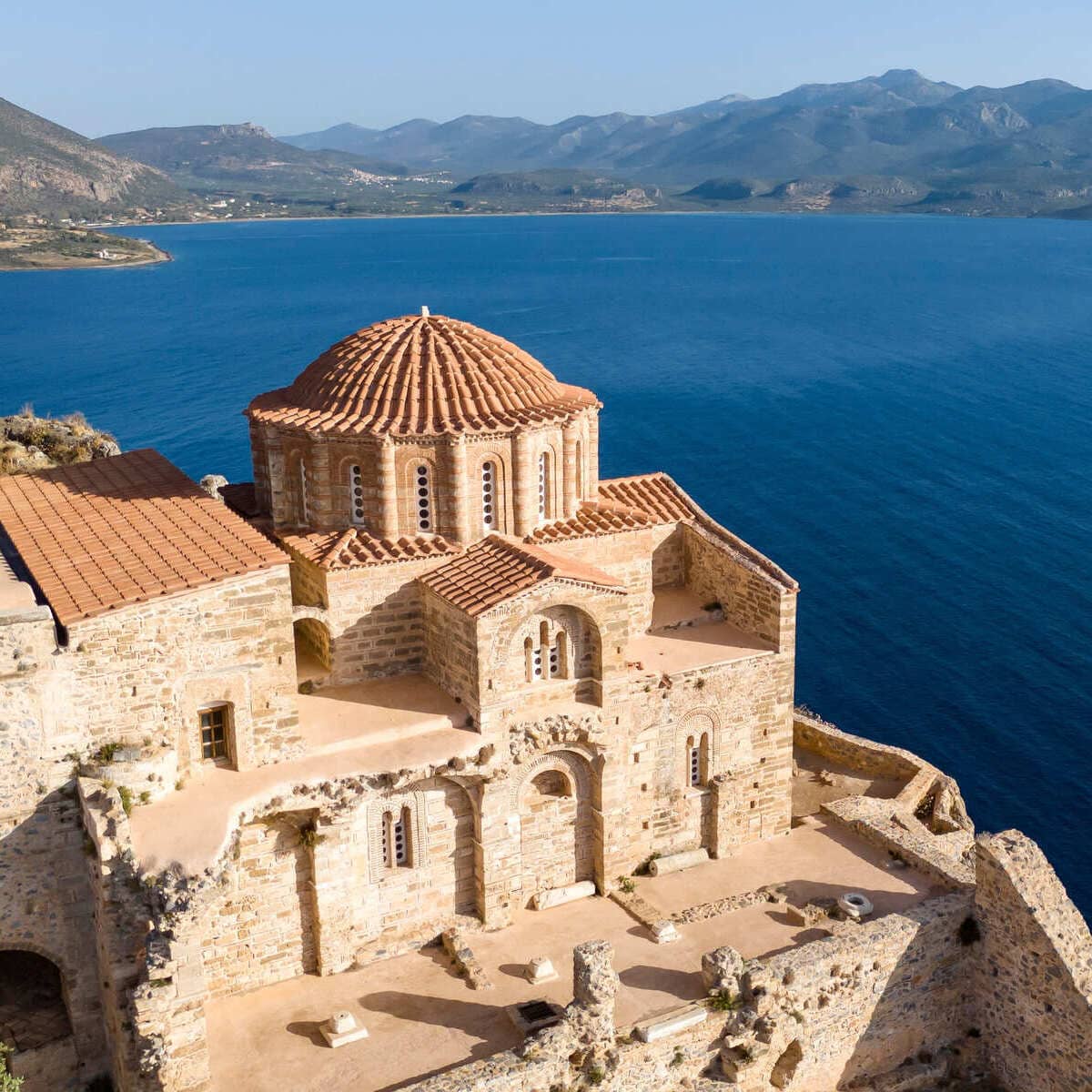
Set on a massive rock island, hooked to the mainland by a skinny causeway, it’s one of the oldest continually inhabited fortified settlements in Europe, all cobbled lanes, centuries‑old stone houses, and little squares anchored by rock‑hewn churches.
Most of what you see dates back to the Byzantine era, and unlike plenty of coastal towns around Greece, it dodged the worst of the European wars and the Ottoman conquest. Its name literally gives the game away:
Moni = Single
Emvasis = Entrance

You can only get in by crossing that narrow isthmus, which made attacking it a bit of a nightmare—no wonder it’s so intact—and even now, the road doesn’t actually reach inside the Old Town, so it’s essentially car‑free.
As I learned the hard way, if you’re driving, you either park up on the mainland and walk across, or leave the car on the roadside just outside the walls.
Unlike places like Santorini or Mykonos, Monemvasia isn’t about all‑nighters and beach raves: it’s about slowing down, wandering the ramparts, trying every last waterfront taverna, and watching the sun drop into the sea from the viewing platforms of the Upper Town.

The Vibe: Greek Dubrovnik without the crowds
Perfect For: slowing it down a notch and soaking up Greek culture and ancient heritage
The ‘Don’t Miss’ Experiences:
The Citadel: an impressive 6th century fortress built onto hard rock, boasting an incredible panorama of the Aegean Sea
Matoula: no-frills taverna with sea views dishing out all your Greek favorites, like moussaka, grilled meat on skewers, and saganaki cheese
Hydra
You might notice I have a bit of a soft spot for car‑free places, but what can I say? There’s no calmer, more old‑school, storybook Greek island than beautiful Hydra.

An easy ferry hop from Piraeus, Athens’ main port, it’s famous for its outright ban on wheeled vehicles. Yep, even motorbikes, scooters, and bikes: the only three ways to get around Hydra are on foot, by water taxi, or—if you’ve no qualms about animal power—by donkey.
Only essential vehicles like emergency services, rubbish trucks, and a few utility carts are allowed, and even then, under tight licences and in restricted numbers.
The main settlement, also called Hydra, is your classic Greek island town: chalk‑white houses stacked amphitheatre‑style around a picturesque harbour, ornate belfries, and bougainvillea‑draped patios flanked by family‑run tavernas.

Before you start fretting about the lack of cars, and even the no‑go on cycling, Hydra is probably smaller than the metropolitan district you call home: roughly 12 miles from end to end, and only a few kilometres across at its widest points.
Most beaches are an easy wander from Hydra Town, like Kamini, a small pebbly cove by the namesake village (a 20‑minute coastal walk away), while the more remote, taverna‑backed Vlychos is around 30–40 minutes on foot, or a short sea‑taxi ride.
Needless to say, Hydra feels deliciously slower, quieter, and more human‑scaled than your average airport‑served, package‑holiday Greek island.

The Vibe: the Greek Holbox. Car-free island with deserted beaches and authentic culture
Perfect For: savoring summer at an unhurried pace and beach-hopping
The ‘Don’t Miss’ Experiences:
Hydra Town: the main town and harbor, with a plethora of traditional tavernas, picture-perfect flower-adorned alleys, and souvenir shops
Profitis Ilias Monastery: a hilltop monastery at the end of a moderately-challenging hike, commanding an impressive coastal panorama
Ioannina
We’re back to mainland Greece for this one.

The country’s main points of interest are (almost) all directly on, or tied to, the Aegean Sea. After all, that body of water is the backbone of Greek heritage and culture, and it’s where most of its ancient civilisations thrived. That’s not to say there wasn’t a bit of action going on in the northern fringes of Hellas.
Straddling a pristine Lake Pamvotis, Ioannina is a historic city blending Byzantine roots and Ottoman flair.
Think quaint townhouses with those classic wooden sarayli balconies, cobblestone‑paved lakeside promenades, and squares where it’s still mostly grizzled pappous frantically flipping their worry beads as they while the afternoon away.
The Ottoman-fortified castle and Turkish‑style bazaars are cool, but if you’re short on time and won’t be staying overnight in Ioannina, take the next boat out to Pamvotis Island, right in the middle of the lake.

Around 700 metres long, it’s fully explorable in under an hour, packed with historic monasteries (some still with monks), traditional houses owned by a handful of local families, and craft shops.
Ioannina is pretty chill (mostly), but Pamvotis Island is a particular kind of magic. It almost feels like a town within a town, and the best part is that the boat crossing takes only 15 minutes.
I have to add, ancient wonders aside, I particularly love Ioannina for how contrastingly lively it can be. At the same time, it’s a proper medieval fortress town with a well‑maintained historic core, it’s also part of a vibrant student city.
It hosts the University of Ioannina, which draws youngsters from all over Greece (1 in every 5 residents is a student). Let’s just say… the town doesn’t feel dead quiet or sleepy at all at the weekends.

The Vibe: lively Greek lakeside town combining Byzantine and Ottoman architecture
Perfect For: escaping the humdrum of the Aegean Coast
The ‘Don’t Miss’ Experiences:
Pamvotis Island: ancient island home to at least 4 monasteries and tight-knit fishermen communities
To Kentrikon: everyone’s go to Epirotic Old Town spot, famous for its pies, slow-cooked meats, and grilled lake fish
Kastellorizo

Something I’ve learned from years of Greek island-hopping: the more remote the island, the better the payoff, and Kastellorizo is the Final Offbeat Boss.
With only 594 permanent residents, located a whopping 78 miles east of Rhodes, the nearest inhabited Greek island, and separated from the Turkish coast by a mere 1.2‑mile stretch of water, it’s one of those geographical anomalies that has always intrigued me.
The only way to get there is flying in from Rhodes (and there aren’t that many flights per week), or if you don’t mind painstakingly slow journeys, an Aegean ferry. Of course, if you’re in Kaş, the Turkish town staring across the strait from Kastellorizo, it’s a breezy 10–20 minute boat crossing.

Treaty of Lausanne or not, I don’t know how Turkey never moved to seize control of Kastellorizo, given its near‑total isolation, but it’s been staunchly Greek since 1947.
Geopolitics aside, Kastellorizo couldn’t quite shake off its Turkish heritage entirely: dominating the harbor, there’s a vivid‑red minaret towering above a cluster of pastel‑hue Neoclassical houses.
It’s not an active mosque anymore, but it serves as a stark reminder of the island’s intertwined history with Turkey.
In fact, Kastellorizo’s entire identity revolves around proudly reaffirming its Greekness in the face of Turkish proximity.

Sitting atop a sheer hill, the Castle of the Knights of St. John was built precisely to fend off foreign incursions from Asia Minor, and a stone’s throw away from the island itself, Rho is a craggy islet associated with Lela Karagianni.
The Greek Joan of Arc.
After moving from Kastellorizo to Rho, she repeatedly raised the Greek flag over the inhospitable terrain, every day, even before Greece asserted sovereignty over the island, in defiance of Ottoman rule.
All in all, if it’s that almost end‑of‑the‑world, proper Greece vibe you’re craving, Kastellorizo is it.

The Vibe: the remotest Greek island, practically touching Turkey
Perfect For: experiencing authentic Greek island life amid crystal-clear waters
The ‘Don’t Miss’ Experiences:
Heroine’s Islet (Rho): the chosen home of the Greek Joan of Arc, virtually synonymous with Greek patriotism
Blue Cave: a stunning sea cave near the island, known for its bright turquoise waters. Accessible by boat tours only
Athos
The Third Halkidiki Finger
If you’ve ever glanced at a map of mainland Greece, you might’ve noticed three narrow peninsulas jutting into the Aegean, almost like fingers.

These are the 3 Halkidiki Fingers, a favorite weekend escape for Thessaloniki locals thanks to their golden beaches, laid-back coastal towns, and… self-governed monastic communities.
The first two fingers are fully under Greek jurisdiction, but the third, centered on Mount Athos, is technically an independent republic within Greece. Think an Orthodox Vatican.
Everyone raves about Meteora and its cliff-hanging monasteries, but Athos is home to even more impressive monasteries, sheltering hundreds of monks. Some date back over a thousand years, and with their cliffside, coastal locations, they’re especially breathtaking.

Athos isn’t an internationally recognized country, but the Greek constitution practically acknowledges as one. It has its own administration, laws, and entry rules. You can’t just wander from mainland Greece into the third finger.
There’s A Big Catch
You need a permit, and here’s the catch:
Only men can get it. Women are strictly banned from setting foot on the Athos peninsula.
This rule goes back to Byzantine times, meant to preserve monastic celibacy and spiritual focus. Today, it’s written into Greek law and protected by the constitution as a religious exception.
The closest women can legally get is Ouranoupoli, the last mainland town, or by taking boat tours to view the ancient monasteries from the water.

For the men interested in visiting, the “visa” you’re looking for is called a Diamonitirion, and in 2026, the operating fees are:
Orthodox Christian pilgrim: €25
Non-Orthodox pilgrim: €30
Students (with valid ID): €10
Large families (father + male children only): free
Numbers are limited daily, so you usually need to reserve months in advance. You pick up the Diamonitirion in Ouranoupoli with your passport.
Which Monasteries To Visit?

As for the monasteries, the motherhouse of the peninsula is Great Lavra Monastery, founded in 963. Fortress-like on a hilltop, it’s the oldest, guarding some of the finest Byzantine frescoes and icons around.
Vatopedi is famed for relics and a massive manuscript library, while Iviron, founded by Georgian monks, is home to stunning Orthodox icons and a tight-knit monastic community.
Overall, there are 20 main monasteries, and unlike the crowded, open-to-all Meteora, Athos feels far more secluded and serene. Maybe because half of the global publication isn’t allowed in.
So… who’s up for a bros trip?

The Vibe: The Orthodox Vatican. Strict rules on the presence of women apply
Perfect For: getting a taste of genuine monastic life without the Meteora crowds
The ‘Don’t Miss’ Experiences:
The Great Lava Monastery: a castle-monastery dating back over a thousand of years
Boat Tour Around Mount Athos: incredible views of the coastal monasteries and Athos’ unspoiled coast. It’s also the only women-friendly activity in the region
Take this quiz to find your perfect match!
