
Read Part I here and Part II here.
One of the featured thought leaders of the Ground Shift initiative is Lynn Scarlett, who vaulted to prominence as the president of the Reason Foundation. This is a libertarian think tank, closely affiliated with the Heritage Foundation and funded by such anti-environmental actors as the Farm Bureau, the Koch Brothers, numerous big oil corporations, and best known for publishing Reason Magazine. During her time at the Foundation, she authored an article praising Gayle Norton as Secretary of Interior, and promoted replacing environmental regulations with market-based incentives.
In 2001, she was appointed by George W. Bush as Assistant Secretary of the Interior for Policy, Management and Budget. In November 2005, she was promoted to Deputy Interior Secretary in G.W. Bush’s administration, positioning her to oversee the Bureau of Land Management and U.S. Fish and Wildlife Service.
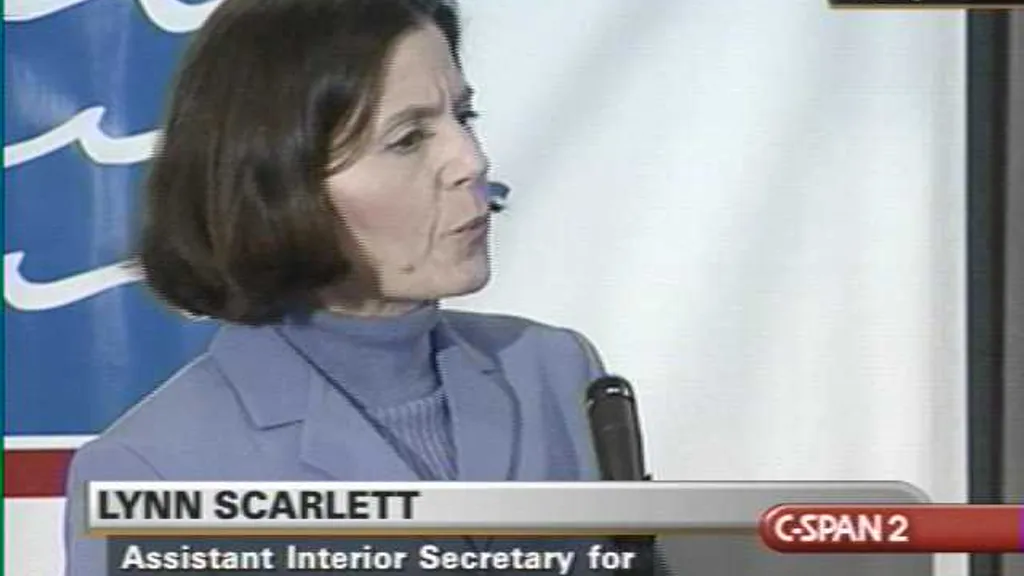
In 2018, the Audubon Society gave Scarlett their Conservation Hero award, stating, “In government, Scarlett was a leader in tackling climate change, which is the greatest threat that birds face.” While there is good documentation that Scarlett is an avid birder, her climate credentials leave something to be desired.
Under her tenure as the Interior Department’s chief of operations, Scarlett oversaw the approval of western Wyoming’s Jonah Field near Pinedale, authorizing 64 to 128 wellpads per square mile (rejecting the more innovative alternative of using directional drilling to produce the same gas from existing wellpads); the resulting gas field gained national (and international) notoriety as the worst-impact oil and gas field in modern times. Between the Jonah Field and the Pinedale Anticline, smog from oil and gas extraction got worse than in Los Angeles, leading the Wyoming Department of Environmental Quality to issue ‘ground ozone alerts’ telling local residents to remain indoors to avoid health impacts from the rampant air pollution. Scarlett oversaw a decision to lease 2 million acres of public land for oil shale and tar sand development, the two dirtiest and most climate-impacting methods of oil and gas development. She was in charge when the Bush administration offered offshore oil and gas leases in the Chukchi Sea, one of the largest oil and gas lease sales in U.S. history. Hardly a climate record worthy of “hero” status, and not exactly exemplary of new ideas for conservation.
In her early years, Scarlett was a coauthor of a report cynically framing itself as “Progressive Environmentalism,” but in reality a who’s who of right-wing, corporatist, and anti-regulation activists seeking a corporate takeover of environmental policy. Here’s an excerpt from the report, with emphasis from the original document:
“Most of our environmental problems arise because resources such as air, water, forests and many species of birds, fish and other wildlife are owned in common. Because these resources have no owners, they have few protectors and defenders.”
Once installed in government, Scarlett co-chaired the Recreation Fee Leadership Council, described as a federal interagency group to coordinate recreation fee policy and practices on federal lands. While there, she was an advocate for the Fee Demo Program, a project to run public land agencies as a business, charging the public to access public lands at National Park entrance stations, campgrounds, and trailheads. This was a major shift away from past federal “parks are for people” policies that provided access free-of-charge and funded by taxes, to a free-enterprise model where visitors who could afford it could access public lands on a pay-to-play basis, a discriminatory practice that excluded lower-income Americans on the basis of wealth.
Scarlett ultimately testified in favor of legislation to lock in and expand these fees, with the justification of addressing the backlog of road and facilities maintenance on public lands. Under this program, maintenance of public lands got worse, not better, due to flagging congressional appropriations. But the program did succeed in reducing public access—and with it public enthusiasm for protecting public lands—and helped bring to fruition the corporate and anti-environmental strategy to re-cast the environmental movement, long based in grassroots concern, as an elitist cause.
Scarlett recognized that public-land livestock grazing is a heavily-subsidized proposition, but nonetheless defended the below-cost rent that federal agencies were charging for grazing on public lands. In 2005, the General Accounting Office issued a report critical of the grazing fees, and pointed to the Department of Defense policy to hold competitive auctions to determine grazing rent for the McGregor Bombing Range in New Mexico, a process that garnered bids ranging from $5 to $14.50 per Animal Unit Month (for comparison, those rents are only $1.69 per AUM today). “Comparisons of alternative fee structures, such as the McGregor Range, however, are for the most part useless,” Scarlett wrote in her letter to the GAO. “The western ranch economy could not operate under a system that had bidding similar to McGregor Range, nor would it provide the stability called for by law.”
Not all of Scarlett’s ideas have been bad ones. After the Bush administration took office, and assumed responsibility for the newly-created Grand Staircase-Escalante National Monument, Interior Secretary Gale Norton responded to a query from Rep. Chris Cannon (R-UT) that voluntary grazing lease buyouts would continue to be supported under the new administration. “We remain committed to support your efforts to work with the ranchers within the Grand Staircase-Escalante National Monument to voluntarily retire their grazing permits,” Lynn Scarlett stated in a letter to Grand Canyon Trust, “Because this initiative would be done in perpetuity, it is paramount that all affected parties reach a favorable solution.”
Scarlett is credited with establishing the concept of Master Leasing Plans (MLPs), a concept with mixed results, from beneficial to very harmful. Possibly the worst-case example was the proposal of a Greater Chaco Canyon MLP, by The Wilderness Society and National Parks Conservation Association, which designated Navajo communities as a ‘Designated Development Zone’ in exchange for protections for the Chaco Canyon National Park. The proposal split the conservation community.
At the end of the Bush presidency in 2009, Scarlett was hired as a consultant by the Environmental Defense Fund. In 2013, she took a position with The Nature Conservancy (TNC), first as the Vice President for Policy and Government Affairs, and then as their Chief of Global External Affairs, where she worked until 2021. During her time at TNC, Scarlett was lead author of a paper announcing the establishment of an Upper Green Conservation Exchange, the same area that had been so devastated by oil and gas development during her time with the Bush administration. According to Linda Baker of the Upper Green River Valley Coalition, the foremost local conservationist in the Upper Green, the idea never amounted to anything. Meanwhile, populations of sage grouse, pronghorn, and mule deer continued to plummet in the Upper Green River Basin.
This is hardly the résumé of a conservation leader. Anti-conservation leader would be a more accurate description, as Scarlett has consistently argued that profit-driven industries, not the agencies that regulate them, should lead conservation efforts.
Without regulations, and the courts to enforce environmental laws, there would be no one to curb the damaging excesses of the industries that exploit lands and wildlife. The road to turning the Earth into an utterly destroyed hellscape, incapable of supporting life, is paved with market-based incentives, voluntary conservation measures, collaborative committees, and compensatory mitigation funds. These aren’t smart bets on which to stake our environmental future. And Lynn Scarlett’s environmental record disqualifies her from shaping that future.
Erik Molvar is the executive director of Western Watersheds Project.
This piece is part of a three-part series examining the network of power behind the Ground Shift initiative—and the records of the officials now positioned to shape conservation’s future. Read Part I here and Part II here.