
Summary and Key Points: Dr. Andrew Latham, a defense professor and fellow at Defense Priorities, evaluates the enduring legacy of the Gotland exercise in the context of 2026 maritime competition. The 2005 Gotland exercise—where a Swedish diesel submarine “sunk” a U.S. aircraft carrier—is often cited as the death knell of the supercarrier.
-However, as of March 2026, naval doctrine has reframed this not as proof of obsolescence, but as a warning of “littoral compression.”

Gotland-Class Fleet of Submarines. Image Credit: Creative Commons.
-The exercise exposed how shallow, acoustically complex waters like the South China Sea or the Persian Gulf can neutralize blue-water advantages.
-While the aircraft carrier remains the U.S. Navy’s premier power projection tool, the geography of 2026 maritime rivalry is tightening, forcing the fleet toward dispersed formations and longer-range air wings to survive the “denial zones” of modern diesel-electric threats.
The $6 Billion Myth: Why the Gotland Submarine Exercise Didn’t Actually Kill the Aircraft Carrier
For two decades, the Gotland exercise has circulated as proof that the aircraft carrier’s era is ending.
The anecdote is familiar. A Swedish diesel submarine penetrates a U.S. carrier strike group during exercises and records simulated kills.
The cost comparison does the rhetorical heavy lifting. A modest undersea platform humiliates a capital ship that anchors American naval power. From there, the conclusion tends to arrive quickly: the supercarrier has entered terminal decline.
That myth rests on a misreading of what the exercise actually revealed, one that has persisted long after the exercise’s real operational implications became clear.
Gotland did not expose the weakness of a single platform. It exposed the reemergence of a battlespace many naval planners had come to treat as secondary. The encounter unfolded during Pacific training exercises off the U.S. West Coast — in coastal waters that, while far deeper than the Baltic, still imposed the frictions of a littoral environment shaped by irregular bottom topography close to shore.
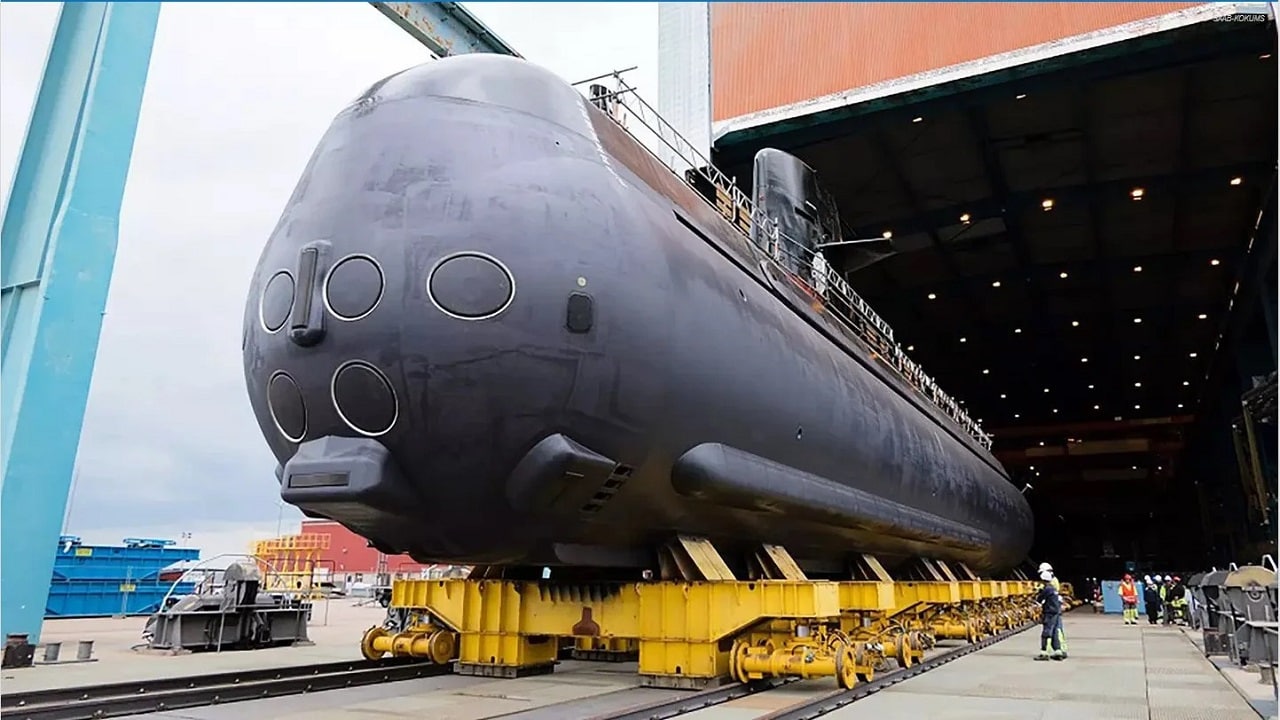
Gotland-Class. Image Credit: Creative Commons.

Gotland-class submarine. Image Credit: Creative Commons.
The submarine that penetrated the screen had been designed and trained for shallow, acoustically complex warfare in the Baltic. Southern California is not the Baltic. But operating close to shore can still result in compressed detection margins, unlike in the open ocean. That environmental contrast shaped everything that followed.
The Baltic Was the Real Story
Shallow water alters sonar performance in operationally unforgiving ways. Detection becomes uncertain well before contact is established, at times degrading to the point where classification itself grows tenuous. Civilian shipping introduces interference that masks movement.
The seabed contributes to a distortion that further compresses awareness. Under those conditions, anti-submarine warfare loses depth. Warning time shrinks. A quiet diesel boat operating close to familiar coastline becomes far harder to manage than it would be in blue water.
The submarine’s success did not stem solely from technological novelty. Swedish crews trained continuously in those waters. They knew traffic rhythms, seabed contours, and acoustic shadows accumulated through years of repetition.
The U.S. strike group entered as an expeditionary formation shaped by deep-ocean operating assumptions. One side maneuvered inside the terrain it understood instinctively.

Dec. 4, 2017) Sailors man the rails as the Navy’s forward-deployed aircraft carrier, USS Ronald Reagan (CVN 76), arrives at Commander, Fleet Activities Yokosuka after a scheduled patrol. The Ronald Reagan Carrier Strike Group conducted 87 days of strike group operations in the Western Pacific, including the waters south of Japan, the Philippine Sea and the South China Sea. Ronald Reagan provides a combat-ready force, which protects and defends the collective maritime interests of the U.S. and its allies and partners in the Indo-Asia-Pacific region. (U.S. Navy photo by Mass Communication Specialist 2nd Class Janweb B. Lagazo/Released)
That dynamic has since become structural rather than episodic. Regional naval powers now operate within enclosed seas where geography narrows external advantages. Chinese submarines train in the layered shallows of the South China Sea.
Iranian boats navigate congested Gulf approaches where detection windows open briefly, then close again. Russian undersea doctrine reflects similar familiarity with northern littorals. Coastal complexity does not erase American naval superiority. It complicates the application of that superiority when fleets operate close to defended shores.
Time Beneath the Surface
Air-Independent Propulsion introduced a quieter but equally consequential variable. Endurance altered the tempo of the encounter. The submarine could remain submerged without snorkeling, waiting for exposure to develop. Time began tilting in its favor.

San Diego (Oct. 1, 2005) The Swedish diesel-powered attack submarine HMS Gotland transits through San Diego Harbor with the Nimitz-class aircraft carrier USS Ronald Reagan (CVN 76) following close behind during the ÒSea and Air ParadeÓ held as part of Fleet Week San Diego 2005. Fleet Week San Diego is a three-week tribute to Southern California-area military members and their families. U.S. Navy photo by Photographer’s Mate 1st Class Michael Moriatis (RELEASED)
A carrier strike group cannot suspend flight operations indefinitely. Sortie generation creates operational signatures that accumulate rather than dissipate. Persistence, not speed, became the undersea advantage.
Step back from the exercise, and its significance sharpens. What would later be labeled anti-access warfare did not originate with coastal missile batteries. Its core logic—denial platforms operating inside geography that helped conceal them—was already visible here.
The Swedish submarine sat squarely inside that pattern. It did not have to destroy the carrier. Complicating its movement was enough to impose caution across the strike group.
A Narrowing Battlespace
That complication now defines much of the contemporary maritime environment. Naval competition is concentrated in confined waters where surveillance systems, coastal defenses, and undersea forces intersect. The Baltic offers one case. The South China Sea offers another. Conditions differ, yet the operational pressure imposed on surface fleets feels strikingly familiar. Visibility above the surface expands. Opacity below it persists.
This is where the Gotland lesson extends beyond the exercise itself. Carriers remain formidable instruments of sea-based airpower, but the space within which they can operate freely is tightening. Sea-based aviation still delivers reach that no other platform can match at a comparable scale.
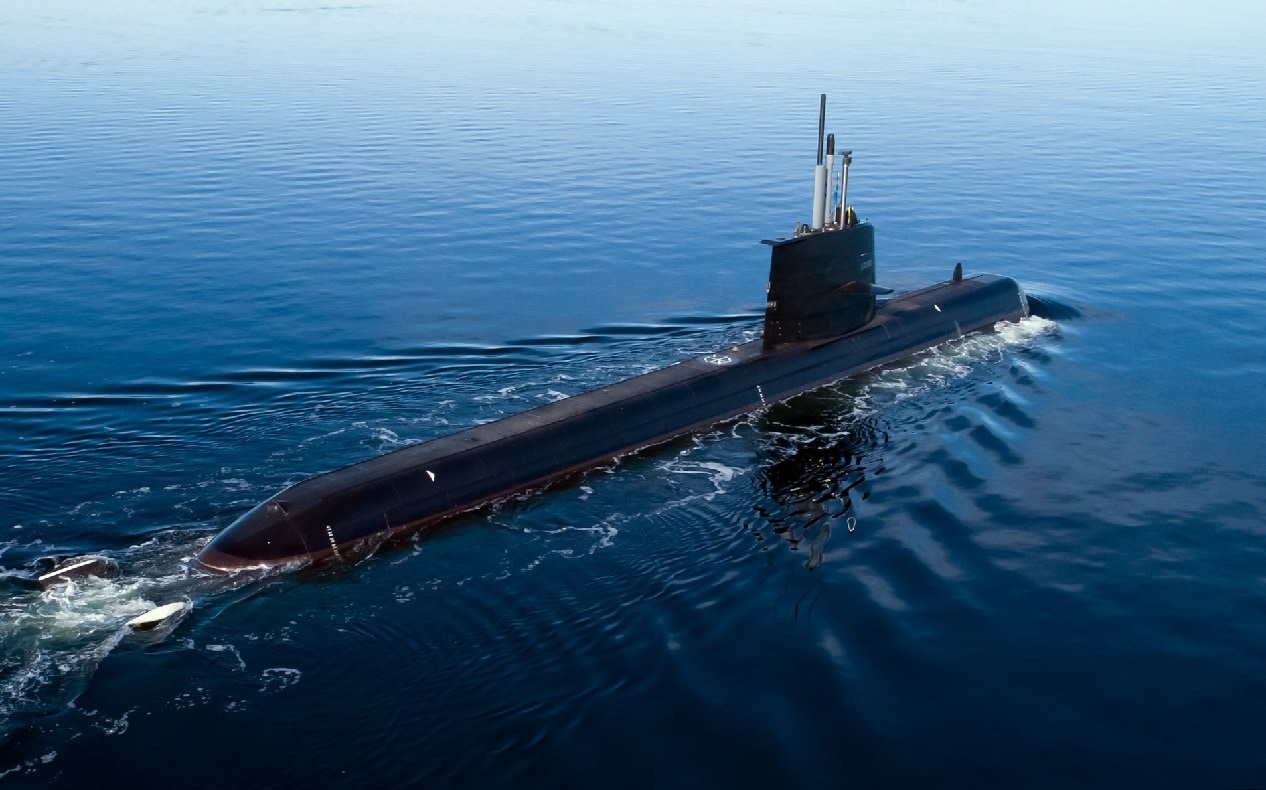
Image of Gotland-class Submarine.
Strike capacity remains tied to the carrier air wing. What has shifted is the geography framing that power, operating envelopes contract near hostile shores. Risk calculations grow more exacting as detection and denial overlap.
Naval doctrine has been adjusting in response. Dispersed formations complicate targeting solutions. Undersea screening regains prominence. Carrier air wings are evolving toward longer-range strike profiles that reduce the need to close distance. Adaptation has followed exposure, as it has throughout the carrier’s operational history under changing technological pressure.
Adaptation, Not Obsolescence
The Navy’s response to the Gotland exercise reflected that institutional instinct. The submarine was leased to replicate advanced diesel threats under controlled conditions. Training cycles evolved. Anti-submarine tactics were refined to account for littoral complexity. The exercise did more than inform planning discussions. It forced reconsideration of assumptions that had hardened under blue-water dominance. Exposure drove adjustment.
What the exercise ultimately previewed was not the demise of the supercarrier but the environment in which it would increasingly be asked to operate. Surface fleets are becoming easier to track at range.

U.S. Navy Aircraft Carrier Ronald Reagan.
Undersea threats remain difficult to localize, particularly in shallow contested waters where detection physics impose hard limits. The resulting battlespace favors denial, narrowing maneuver without eliminating power projection.
The enduring lesson of 2005 lies there — and it speaks less to the vulnerability of carriers than to the geography into which naval competition is moving.
The Swedish submarine did not invalidate the aircraft carrier as an instrument of naval power. It illuminated how confined seas can compress even dominant fleets when they operate close to contested coasts. As maritime rivalry intensifies across enclosed waters, that constraint will shape naval operations far more than cost comparisons or wargame anecdotes ever could.
About the Author: Dr. Andrew Latham
Andrew Latham is a non-resident fellow at Defense Priorities and a professor of international relations and political theory at Macalester College in Saint Paul, MN. You can follow him on X: @aakatham.