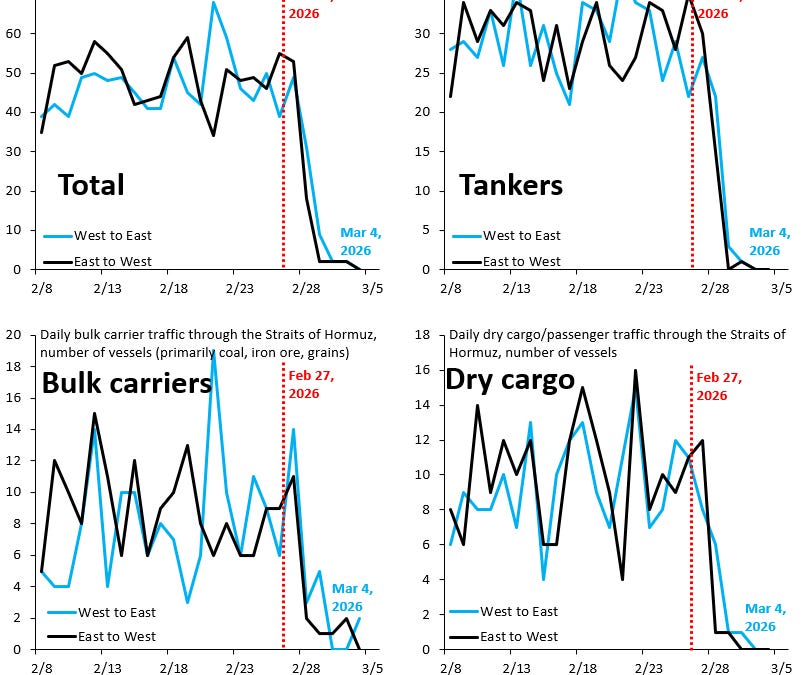
In yesterday’s post, I wrote about how oil tanker traffic through the Straits of Hormuz has essentially ceased. A number of readers commented that this understates the scale of what’s a de facto blockade, because there’s lots of other traffic – not just oil tankers – that transits the Straits. That’s perfectly true. This follow-up post looks at all vessels going through the Straits of Hormuz. During normal times, there’s around 50 vessels that leave the Persian Gulf through the Straits every day and 50 ships going the other way. So, on any given day, there’s 100 ships in transit. Two-thirds of these are tankers of some sort, carrying crude oil, refined product or LNG. The remainder are cargo ships carrying things like coal, iron ore and grains.
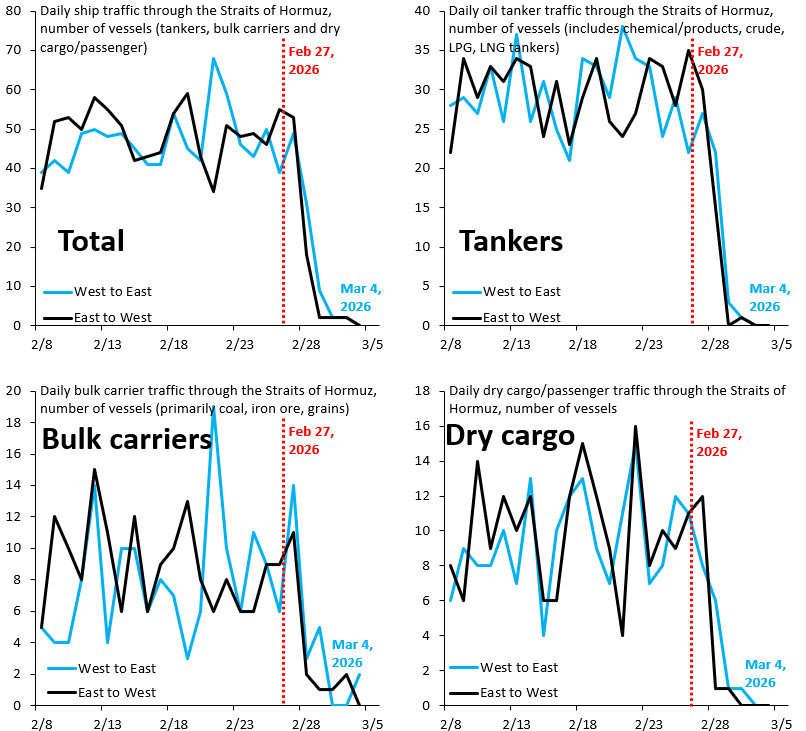
The four charts above show daily ship traffic through the Straits of Hormuz. The top left chart shows total inbound (black line) and outbound (blue line) ship traffic from the Persian Gulf. There’s around 50 vessels going in each direction every day until the outbreak of hostilities on February 28. Thereafter, shipping activity essentially ceases and this is where we remain today – one week after the outbreak of hostilities. The top right chart shows tanker movements, while the bottom two charts show cargo traffic. Across the board, ship traffic has almost ceased, so there’s a de facto blockade in place.
The interesting thing about this blockade is that Iran had little military capability to begin with and – what little there was – has been almost completely vaporized by now. But the hard truth is that it doesn’t take much more than a few drones to blow up an oil tanker and herein lies the problem. Even if the US provides insurance and naval protection to ships going through the Straits of Hormuz, the cost to Iran of blowing up just one vessel – and that’s really all it takes – is asymmetrically low. That’s why it’s highly unlikely that ship traffic will return to anything like 100 ships per day any time soon, even under the cover of US insurance and protection.
Oil prices have now risen 28 percent from the end of last week and the complacency that marked the start of this week has given way to all-out panic. While people at the start of the week seemed convinced oil prices would barely rise, now everyone’s sure Brent is headed above $100 per barrel. My two cents on this are as follows. Within the first 10 days of Russia’s invasion of Ukraine in 2022, Brent rose 32 percent. The Straits of Hormuz are roughly three times as important for the global oil market as Russia, so – while we’ve now priced some risk premium – we arguably still have some room to the upside. The bottom line is that this shock still has room to build, but we’re now also closer to where a reasonable risk premium has been priced for oil.