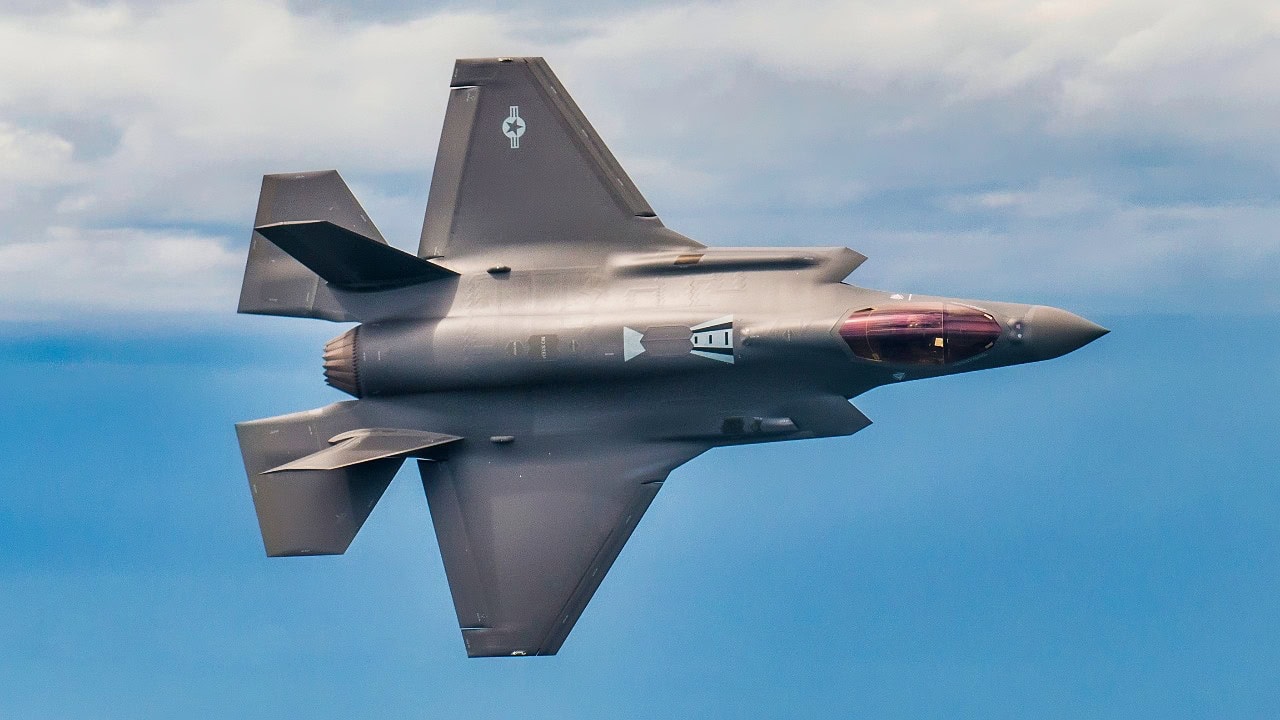
Summary and Key Points: National security analyst Stephen Silver evaluates the dual reality of the F-35 Lightning II in 2026.
-While the Israeli Air Force (IAF) recorded the platform’s first manned air-to-air kill—downing an Iranian Yak-130 over Tehran—Switzerland has cut its acquisition to 30 jets due to rising costs.
-This report analyzes the Trump administration’s potential use of the Link 16/MIDS system as a “lever” to prevent Prime Minister Mark Carney’s government from opting for the Saab Gripen.
-Silver concludes that despite procurement friction, the F-35’s 2026 combat debut has established absolute air supremacy in the Middle East.
Switzerland’s F-35 Cut: Evaluating the $7.68 Billion Budget Cap and the Shift to European Defenses
In the latest bit of drama over which countries will buy F-35 jets and how many, Switzerland’s government announced this week that it would purchase fewer F-35s than previously announced.
The council will buy 30 jets, instead of the previously announced 36.
According to the Wall Street Journal, the Swiss Federal Council cited rising prices and added that it “might procure one additional air defense system manufactured in Europe.”
“With this decision, the Swiss government aims for the order to stay within the originally budgeted 6 billion Swiss francs ($7.68 billion), it said in a statement. Going ahead with the original plan of buying 36 F-35s would require an additional 1.1 billion Swiss francs, it added,” the Journal reported. The official number of jets will be determined later, once the actual costs are determined.
Switzerland also announced that it’s moving forward with a missile system purchase.

A U.S. Air Force F-35 Lightning II fighter jet from the 56th Fighter Wing, Luke Air Force Base, Arizona, displays it’s crew-designed red, white and blue inlet covers while parked in a military aircraft shelter at the Atlantic City International Airport in Egg Harbor Township, N.J. on May 26, 2016. Pilots and crew from the USAF F-35 Heritage Flight Team made a stop at the 177th Fighter Wing of the New Jersey Air National Guard on the way to their performance at the Jones Beach Airshow in Wantagh, New York on May 28 and 29. (U.S. Air National Guard photo by Master Sgt. Andrew J. Moseley/Released)
“Meanwhile, Bern confirmed plans to purchase five Patriot long-range air defense systems, made by Lockheed Martin and U.S. peer RTX, and said it is considering buying one more, potentially from a European manufacturer,” the Journal said. “This is intended to fill a 4-to-5-year delay to the delivery of the Patriots, caused by the U.S. decision to prioritize deliveries to Ukraine, the council said.”
“This second system should preferably be produced in Europe,” the Swiss Council said in a statement. “Specifically, this means it would have to be a European system or a non-European system manufactured in Europe. This reduces dependence on a single supply chain or country and also ensures better availability.”
What About Canada?
The Canadian government, meanwhile, is nearing the one-year mark in a review of its F-35 jet purchase, seeking to determine whether to proceed with a full purchase of F-35s or mix its fleet with other aircraft.
What’s the latest? According to a CBC report this week, “there is a way the U.S. could play hardball with Canada, if the Liberal government of Prime Minister Mark Carney decides it wants to limit its purchase of F-35s in favour of the Gripen.”

JAS 39 Gripen. Image Credit: Creative Commons.

JAS 39 Gripen. Image Credit: Creative Commons.

JAS 39 Gripen Fighter from Sweden.
While it’s often been suggested that Gripens would not be interoperable with F-35s as part of the NORAD system — something often alleged by the U.S. ambassador to Canada, Pete Hoekstra — CBC notes that “that’s not what you see at the NATO air policing mission in Iceland, where Danish-owned F-35s have been training and operating alongside Swedish JAS-39 Gripens-Cs.”
“The two fighters from different generations speak to each other and share data over a highly sophisticated U.S.-owned system known as Link 16, which contains a cutting-edge anti-jamming and encryption device called a multifunctional information distribution system (MIDS),” CBC said, citing commanders from the Swedish and Danish air forces.
However, as noted by CBC, those jets work together through a U.S.-owned system called Link 16, which includes the multifunctional information distribution system (MIDS). The U.S. must grant access to that system, and could choose to block it if Canada opts for the Gripen jets.
And per CBC, “in this new geopolitical world where everything is weaponized and leveraged, there are concerns the Trump administration is prepared to pull this lever.”
“If Canada is the first country where the U.S. draws the red card, then we have a problem,” Lt.-Col. Johan Legardt, Sweden’s detachment Commander, told CBC.
The U.S. has never done that, nor have they publicly threatened to do so in this situation.
“Gripen meets Canada’s interoperability and security needs. This is not up for debate,” Sierra Fullerton, a spokesperson for Gripen manufacturer Saab, said in a statement.
F-35 History is Made
Meanwhile, a couple of milestones related to the F-35 took place last week.
Per Business Insider, British F-35s shot down drones over Jordan, in what the U.K. government touted as “the first time a Royal Air Force F-35 has destroyed a hostile target during operations.”
Britain is not offensively involved in the Iran conflict, but they have been shooting down drones in the region.

F-35 Fighter. Image Credit: Industry Handout.
“We are moving quickly further to reinforce our defensive presence in the Eastern Mediterranean,” U.K. Defense Secretary John Healey said, per BI. “HMS Dragon brings world-class air defense capability, and our Wildcat helicopters are armed with Martlet missiles to counter the growing drone threat.”
Britain’s F-35 jets have been operational since 2018.
The F-35B jets the UK operates are designed for air-to-air, air-to-surface, and electronic warfare missions. They have short takeoff and vertical landing capabilities that allow the fighter jet to operate from austere environments, amphibious assault ships, and aircraft carriers,” BI said.
The Guardian published an interview with the operator of the British F-35.
“It’s not a euphoric sense of success. I get out of the way and get back on to doing the job again,” the pilot, who the story did not name, told the newspaper.
Meanwhile, per the Times of Israel, an Israeli Air Force F-35I fighter jet shot down an Iranian Yak-130 jet over Tehran this week, in the first dogfight of the war.
The engagement, the newspaper said, is “the first-ever downing of a manned aircraft by an F-35,” and the first time Israel’s Air Force has “engaged in air-to-air combat with manned aircraft” in more than 40 years, since the shooting down of two Syrian MiG-23 fighters over Lebanon in November of 1986.
As noted by the Jerusalem Post, “Iran’s air force, including the F-4 and F-5 fighters, is mostly antiquated and no real match for Israel’s F-15s, F-16s, and F-35s, but the YAK-130 is more advanced than some of the others… Israel and the US established general air supremacy in the Tehran area, where they can carry out stand-in attacks, hovering above potential targets unimpeded for an extended period, within the first two days of the conflict.”
About the Author: Stephen Silver
Stephen Silver is an award-winning journalist, essayist, and film critic, and contributor to the Philadelphia Inquirer, the Jewish Telegraphic Agency, Broad Street Review, and Splice Today. The co-founder of the Philadelphia Film Critics Circle, Stephen lives in suburban Philadelphia with his wife and two sons. For over a decade, Stephen has authored thousands of articles that focus on politics, national security, technology, and the economy. Follow him on X (formerly Twitter) at @StephenSilver, and subscribe to his Substack newsletter.