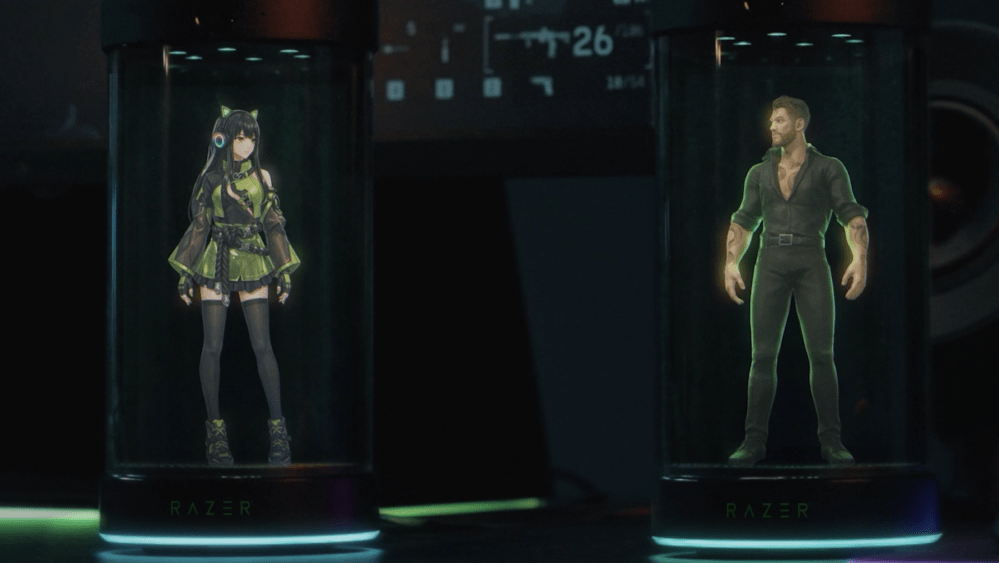
Razer will unveil new features for its upcoming AI companion, Razer AVA, during the GDC Festival of Gaming Monday, including the ability for the product to be “fully agentic” running locally on PC and on the cloud.
First revealed as a conceptual project last year and most recently promoted as a 5.5-inch animated 3D hologram desk companion at CES in January, Razer AVA will now be a “more capable” assistant with the ability to understand goals, plan tasks, and take action across a user’s third-party apps, services, and devices.
The new agentic system is meant to shift the AI companion experience from “simple chat responses to true task completion,” and elevate AVA “from a reactive companion to a practical everyday AI assistant for all users, from professionals to gamers.”
“Agentic means that it will be able to do multiple tasks with one ask,” Razer’s vice president of software Quyen Quach told Variety. “So things like, if you wanted to work on your expense report, and then you asked it to take a snapshot of this and put it in your expense report, that it would have to perform multiple tasks to be able to open up your expense tracker and then insert that. Running locally and in the cloud is important, because most AI right now runs in the cloud, just because it’s really powerful processing, and there are certain tasks that we don’t need to go to the cloud. So we’ve been doing testing on being able to just run everything on your PC. That’s going to led to much faster response times. It’s going to be cheaper for the user. We can do things like, if you were to ask, ‘What time is it?,’ then it doesn’t really need to go to the cloud for that, it can just check your system for the time and respond.”

Since Razer AVA was first unveiled, Quach says she’s noticed the “main appeal” and “what has really resonated with people” is “a step beyond AI companions as something that’s just a prompt — that’s a software on your system — but something you can visualize.”
Per Razer, the newly announced capabilities for AVA include:
Powered by the New Razer Inference Control Plane: Routes requests intelligently between local and cloud models for lower latency, smoother multi-step continuity, and efficient execution as tasks grow more complex.
Third Party Apps and Services Integration: Able to interface with supported services, chat platforms, and apps such as Spotify to act on behalf of the user with real‑time companion reactions.
Agentic Workflows: Plans and executes multi‑step tasks autonomously, turning intent into completion across connected tools.
Companion‑to‑Companion Coordination: Enables agent‑to-agent communication so AVA companions can coordinate end-to-end tasks across users, including proposing meeting times, booking calendars, and confirming schedules.
Sign‑ups are now open for the Razer AVA beta on Razer Cortex. Early access invitations will begin rolling out to select users beginning in Q2.
“We have really big plans for Ava, so this is just the beginning. I can’t talk about too much of the future yet, but we fully, fully believe that AI is going to make huge strides and differences in how people experience games and the entire gaming lifestyle,” Quach said. “AI has always been in games, since the very beginning with NPC characters inside games and things like that. But to provide experiences where users can be more immersive and interactive, and to be able to take that experience outside of their computer, that’s one of the things that Razer is an expert at; actually taking it outside of your screen.”
In her decades of working within the tech and gaming industry, Quach has “been the only woman in the room” on more than one occasion. Quach said she’s prioritized awareness of the gender disparity in the male-dominated field not only out of concern for her employees, but for Razer’s customers.
Razer
“I feel like being in a leadership role, you have a responsibility to talk about it. Whether you’re a male or female, just being aware of the fact that having more diverse teams when we’re creating products creates better products,” Quach said. “It’s not just a social responsibility kind of a thing, we don’t talk about it in that way. It’s really about understanding the customer and creating great products. And so being open minded when you’re having those conversations in our teams, and we’re creating products, and making sure that that we have the teams to be able to facilitate that is important. The gaming industry customer base is about 50% women, but that’s not always reflected in how the employment numbers look in the industry. So including women, and having their opinion from the grassroots beginning, with those that design, can be incredibly important and impactful for the products and how they resonate with customers later, so that it’s representative of those customers.”
As Razer continues to move forward with its AI software innovations, Quach says she is excited to push boundaries but also very focused on “responsible” efforts.
“I just love tech. I’m super lucky to be able to to keep evolving with whatever the latest is that tech brings, but also making sure that we’re doing that in a responsible way,” Quach said. “We do have lots of conversations about how to be responsible about it, because myself as a techie, but also a mom, I’m making sure that we’re creating things that are ultimately going to be enjoyed by people of all age ranges. So making sure that we’re thinking through that when we’re building products.”