
For traders, it’s a market defined by divergence, between a cautious Federal Reserve and a cornered European Central Bank, between resilient rhetoric and weakening fundamentals.
The core conflict facing the Euro is that the ECB remains trapped by stubborn price pressures while the region’s economic fundamentals continue to erode. The tension is amplified by policy divergence, with the Fed turning dovish amid concerns about the labor market, while the ECB remains reluctant to ease.
Internal risks with the Eurozone, from France’s fiscal challenges to Germany’s deepening slowdown, add another layer of fragility. Externally, rising geopolitical tensions, particularly the renewed US-China trade dispute, further darken the outlook.
Market sentiment, meanwhile, remains cautiously optimistic. Speculative positioning suggests a bullish stance of the Euro, indicating that much of the positive narrative, including policy divergence, may already be priced in. That makes the single currency increasingly vulnerable to negative surprises in economic data.
Snapshot of Key Macroeconomic Indicators (as of October 21, 2025)
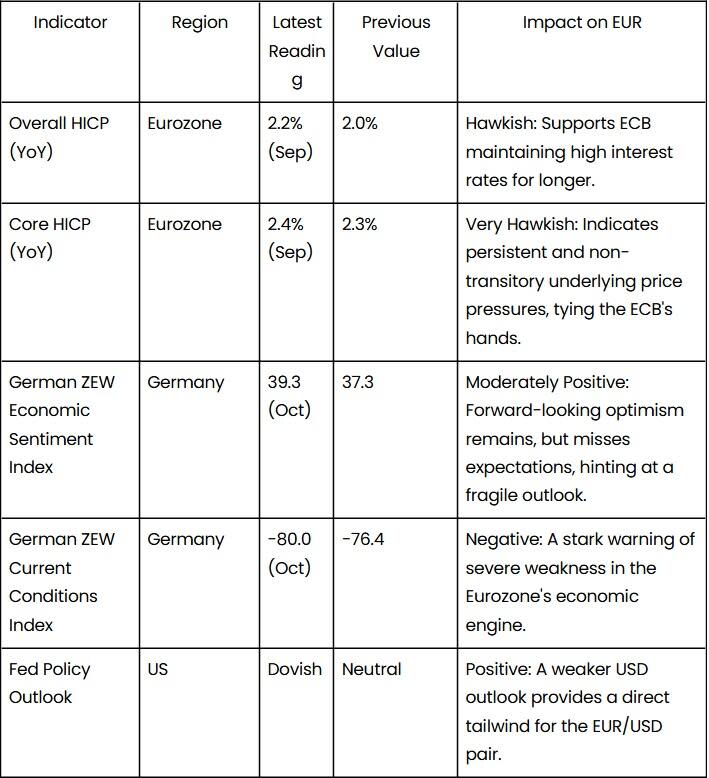

The stickiness of core inflation is almost entirely driven by the services sector, where inflation edged up from 3.1% to 3.2%.
Services inflation is a closely watched indicator by the ECB. It is closely linked to domestic demand and wage growth, is less susceptible to global factors, and is harder to control through monetary policy.
In contrast, non-energy industrial goods inflation remains subdued, holding steady at 0.8% 2, indicating continued weak demand in the manufacturing sector. This internal structural divergence – hot services and cold industrial goods – makes the ECB’s policy decisions exceptionally complex.
Inflation trends in the Eurozone vary considerably across its member states.
Germany, as the largest economy in the Eurozone, saw its inflation rate unexpectedly rise to 2.4%, mainly driven by strong services CPI. Meanwhile, France’s inflation was much milder, at only 1.1%. This divergence poses a significant challenge to the ECB “one-size-fits-all” monetary policy. Tightening policies to curb inflation in Germany could cause unnecessary harm to lower-inflation economies like France.
The combination of above-target headline inflation and accelerating core inflation has effectively closed the door to another ECB rate cut in 2025. The central bank is now locked into a data-dependent decision-making mode, and current data clearly indicates that “inflation has not yet been defeated.”
This solidifies its hawkish policy stance, which alone is beneficial for the Euro. Recent remarks by ECB President Christine Lagarde have also repeatedly emphasized the determination to bring inflation back to target, further reinforcing this message.
Story Continues