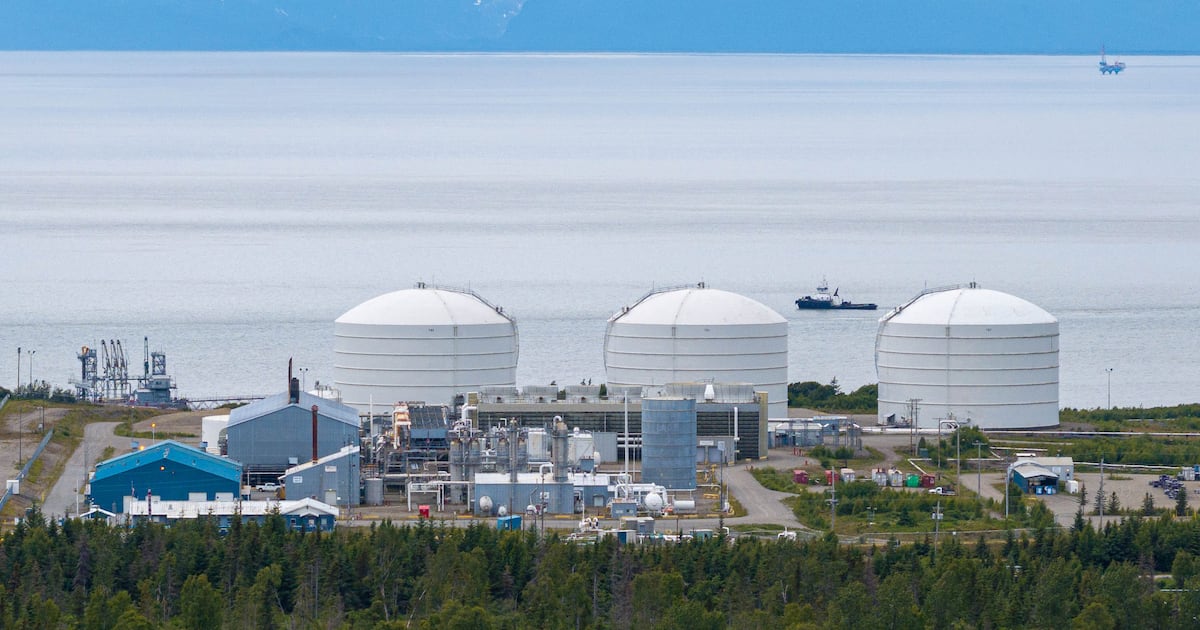
 The shuttered Kenai LNG plant, photographed in July 2024 in Nikiski. The plant stopped producing LNG in 2015 amid a decline in Cook Inlet natural gas supply. (Loren Holmes / ADN archive)
Two of Alaska’s largest utilities told state regulators this week why they support separate projects to import natural gas into the state, amid concerns that two competing plants will be excessive and boost customer costs.
Enstar, the natural gas company for Southcentral Alaska, and Chugach Electric Association, the largest power company in the state, provided the answers to the Regulatory Commission of Alaska this week, which recently opened an investigation on the issue.
Imports of liquefied natural gas, or LNG, into Southcentral Alaska could soon be necessary, and grow in the years to come. Gas produced in the Cook Inlet basin near Anchorage continues to dwindle, threatening the main source of energy that heats and powers the region.
For its part, Enstar is working with Glenfarne under an exclusivity agreement. The deal commits the utility to working exclusively with the private developer to advance a new LNG import facility in Nikiski. The project is called the Cook Inlet Gateway import terminal.
Glenfarne is also leading the longstanding Alaska LNG megaproject that seeks to transport vast amounts of gas from the North Slope to Nikiski, providing gas sales to Alaskan and Asian utilities, if it can ever be built.
Chugach Electric has said it’s looking at buying gas from a project led by Harvest Midstream, a privately held affiliate of Hilcorp, the leading gas producer in Cook Inlet. That project, also in Nikiski, proposes to convert a former LNG export facility, the Kenai LNG terminal, into an import operation.
The projects could cost hundreds of millions of dollars apiece. The Glenfarne project is expected to be much larger than the Harvest project.
The regulatory commission has said it lacks authority over decisions to develop “duplicative” LNG import plants.
But it can review utility costs that might affect rates paid by customers.
It has warned Chugach and Enstar that it can consider whether the utilities made the right choice in sticking with one plant over another.
In their submissions, Enstar and Chugach provided details about the projects they’re supporting. They also asked to keep some information confidential as the investigation moves along.
[Previous coverage: Alaska lawmakers and regulators question need for 2 gas import facilities in Southcentral]
Chugach: Harvest project is less susceptible to delay
Allan Rudeck Jr., chief strategic officer for Chugach Electric, told the regulatory agency that the Harvest project is farther along in its development than the Glenfarne project, which is a “greenfield” project that would be built new from scratch.
Rudeck said the Harvest project is more likely to meet the electric utility’s need for gas starting in 2029.
Glenfarne early last year provided Chugach Electric with “certain high-level preliminary cost inputs” about its project, Rudeck said.
But the two sides soon stopped working together.
“Due to the terms of Chugach’s now-expired nondisclosure agreement with Glenfarne, Chugach was required to return or destroy any information previously received from Glenfarne,” Rudeck said.
“Chugach and Glenfarne did not engage in further discussions at that time due to Chugach’s inability to execute an exclusivity agreement with Glenfarne,” Rudeck said.
Chugach Electric will consider supporting any LNG import project with the right attributes, Rudeck said.
Chugach Electric is not bound by an exclusivity agreement, he said.
Chugach ”remains open to any LNG import or in-state gas supply alternative that best balances cost, reliability, schedule certainty, and long-term flexibility,” Rudeck said.
Harvest’s project involves converting a facility that exported liquefied natural gas for nearly half a century, starting in 1969.
The estimated cost of the conversion is around $325 million, Rudeck said.
The proposed import plant could provide 20 billion cubic feet of natural gas, close to one-third of the needs for the Railbelt region from Homer to Fairbanks.
But the Harvest project can be upsized to meet the region’s full gas demand, if needed, with regulatory approval and additional investment, Rudeck said.
A phased approach to development will reduce the risk that the project is overbuilt, which can help protect customers, he said.
The Harvest project appear to be a “right-sized approach” to meet gas needs in Southcentral, Rudeck said.
“Based on publicly available information, the Glenfarne LNG import project would have a higher capital cost,” he said.
Those costs create more “cost exposure” to customers compared to the Harvest project, Rudeck said.
Harvest has filed details of its project with the Federal Energy Regulatory Commission, seeking approval to import gas as early as next year. It wants to amend an existing permit from the federal agency that allows smaller amounts of LNG imports.
“The Harvest project involves redevelopment of an existing LNG facility with established dock structures, storage tanks, and pipeline interconnections,” Rudeck said.
“Its scope is primarily refurbishment and regasification installation rather than full greenfield development,” Rudeck said.
Harvest has reported that the environmental risk with its project is lower than Glenfarne’s in part because it will use “infrastructure that has demonstrated operational reliability for decades,” Rudeck said.
Chugach Electric has visited the Kenai facility numerous times including for engineering inspections, he said. The electric utility understands that Harvest has performed “extensive due diligence” to inspect every area, including piping, valves, LNG tanks and docking facilities, he said.
Glenfarne has said its project could be ready to receive gas imports starting in 2029.
But long-time RCA commissioner Bob Pickett, who recently stepped down from the commission, said in January that the Glenfarne project has not applied for a license from the Federal Energy Regulatory Commission, raising serious questions about whether its timeline can be met.
Glenfarne said most of its proposed import project is already fully permitted for construction.
“Glenfarne is committed to delivering reliable, affordable energy,” the company said in a statement from spokesperson Tim Fitzpatrick.
“The Cook Inlet Gateway import terminal and Alaska LNG are both part of our broader integrated Alaska energy security strategy,” Glenfarne said.
Rudeck, with Chugach Electric, said the Glenfarne project could be more prone to delays than Harvest’s project.
Development “associated with the Glenfarne greenfield concept may involve broader marine construction, new infrastructure installation, and additional permitting procedures,” compared to the Harvest project, Rudeck said.
“Projects with larger initial construction scope and more interdependent components are typically more susceptible to schedule variability,” Rudeck said.
Enstar says it chose Glenfarne after extensive search
Enstar President John Sims last year said the gas utility cannot participate in a gas-import project led by a Hilcorp-owned entity, referring to Harvest.
Relying on a company with so much dominance in the Cook Inlet gas market creates too much risk for Enstar customers, he said.
Hilcorp provides 85% of Enstar’s gas. Its gas supply contract with Enstar is set to end in 2033.
In the gas utility’s filing this week, attorneys for Enstar said the Glenfarne project is the best option for its customers.
Enstar provided fewer details about its project to state regulators than Chugach Electric did.
But the gas utility said more documents are to come.
“Potential LNG-related arrangements are still in flux and under negotiation,” and much of the information is commercially sensitive, Enstar’s filing said.
Enstar is “continuing to work to identify responsive documents and to determine compliance with third-party agreements before producing documents,” the utility said. “Therefore, the Company will need to supplement this filing within the coming weeks.”
Enstar said it undertook a “very deliberate process” to understand LNG import options before working with Glenfarne.
Enstar formed a working group in 2022 with other utilities and state agencies to evaluate the need and options for gas imports. The group, through Enstar, engaged a consultant to study the issue, while the gas utility has worked with dozens of entities to address the problem, its filing said.
The process involved a “request for information” to consider various LNG import options. Glenfarne, with its deep experience in LNG infrastructure development, was selected as the best choice, Enstar’s filing said.
In 2024, Enstar signed the exclusivity agreement with Glenfarne to facilitate development of the import project.
The plant would be colocated with the much larger Alaska LNG export plant and pipeline terminus, if that project can be built.
The Glenfarne import project “represents the best option for ENSTAR and its customers for a variety of reasons,” Enstar’s filing says. “Based on preliminary information from Glenfarne, ENSTAR will be able to acquire gas supply from the Project at a reasonable cost to the Company and its customers while meeting existing and future demand scenarios.”
The Glenfarne facility would have the capacity to deliver 109 billion cubic feet of gas annually, providing room for growth since it’s much more than the Railbelt currently uses, Enstar has said.
The import plans call for a final investment decision by the end of this year that would determine if the project gets a green light, Enstar’s filing said.
The Glenfarne import project could be converted in the future to support the Alaska LNG export project.
“The co-location with the pipeline was a key draw” of the import project, Enstar’s filing said.
That allows Enstar to “spread project costs over a longer period of time, thus allowing prices to be stabilized for its customers,” Enstar’s filing said.
It also allows Enstar to provide gas from Alaska in the future, when the pipeline for the Alaska LNG project is built, the filing said.
Enstar has previously asked the state regulatory commission to allow it to apply close to $50 million to future customer rates, for development costs for the Glenfarne project, even if the project is not built.
The commission plans to review that request at a future date.
Enstar’s filing included a confidential cost reimbursement deal with Glenfarne.
“Because ENSTAR and Glenfarne have not fully negotiated all of the necessary agreements, the Company does not have final estimates of the projected costs it would seek to recover from customers through rates,” Enstar’s filing said.
Enstar also said that because it has not executed final agreements with Glenfarne, the potential costs for gas supply from the project are uncertain.
The Glenfarne import terminal is “the only project that will deliver enough energy to meet all Railbelt needs,” Glenfarne said in the statement from Fitzpatrick.
“With the Cook Inlet Gateway, Alaskans won’t be required to pay for redundant import infrastructure when the full Alaska LNG project comes online,” the company said. “Glenfarne is engaged with the Railbelt utilities about Alaska energy solutions and continues to advance these important projects toward construction.”
Enstar said in its filing that as it was evaluating different LNG import options, it was concerned about locking into one project.
Another option might arise later that meets Enstar’s requirements at a lower price, Enstar’s filing said.
But Enstar has concluded that only the Alaska LNG megaproject is capable of providing the best price in the end, the gas utility said.
At that time, Enstar customers will pay much less for their gas, compared to current gas prices or LNG import prices, Enstar said.