Fleur de Passion, a research boat owned by the Geneva-based NGO Fondation Pacifique, will leave its home port in Portugal at the end of April for a four-year voyage around the world. On board, scientists will study the health of mangroves and work with at-risk youth.
Since 2002, Fondation Pacific’s legendary sailing ship Fleur de Passion has been sailing the world’s oceans, pursuing socio-educational and scientific goals. On board, young people facing social or educational difficulties spend two months experiencing what it’s like navigating the high seas, accompanied by educators, researchers, and artists. More than 300 young people have already participated in this multidisciplinary project. Last week, the foundation presented its next expedition, “Mangroves,” which will depart from the port of Portimão in southern Portugal in two months and last until 2030.
Read also: Science diplomacy to save the Red Sea corals
“Until now, our destinations had been driven by our dreams, such as circumnavigating the globe in the footsteps of Ferdinand Magellan, and traversing the Arctic via the Northwest Passage. During these expeditions, we were able to observe the human pressures exerted on the environment,” explains Pietro Godenzi, director of the Pacific Foundation, at a conference held at the Geneva Press Club. “This time, we are heading towards the mangroves, ecosystems that play an important role in carbon storage, but are threatened by global warming and human activities,” he adds.
Half of the world’s mangroves are threatened
Globally, approximately 15 per cent of coastlines are bordered by mangroves. They thrive in brackish water, where seas and rivers meet, and in the intertidal zone (exposed at low tide) of tropical and subtropical regions. According to the IUCN Red List of Mangroves, published in 2024, half of these ecosystems are at risk of collapse, with one in five classified as endangered or even critically endangered. Mangroves provide essential ecosystem services to humans by offering habitat for biodiversity, protecting coastlines from erosion, and absorbing CO2.
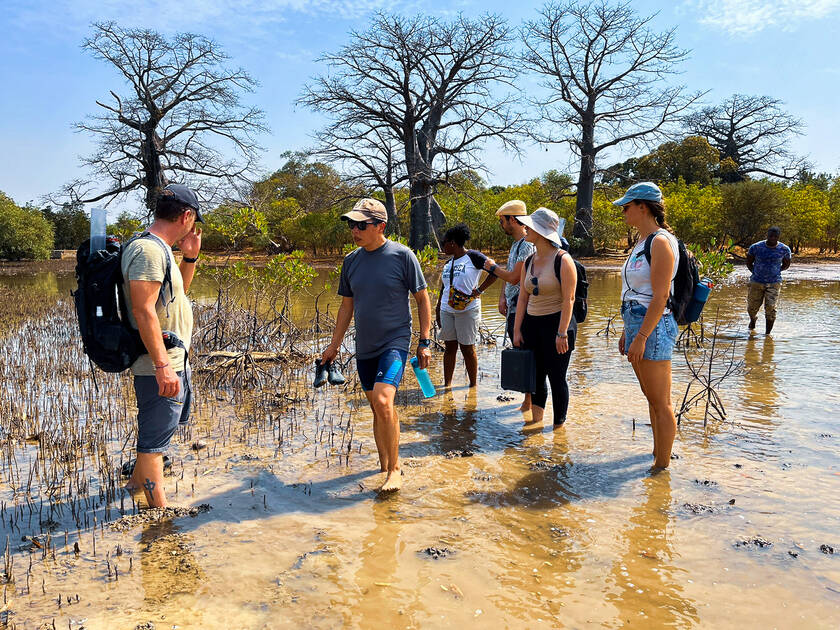
“Rising sea levels and increased salinity are destroying mangroves, as is human use of coastlines, including shrimp farming, port construction, and other infrastructure,” says César Ordoñez, an aquatic physicist at the University of Geneva (Unige). He previously participated in Pacific’s “Sail for Mangroves in the Gambia” project, which studied mangroves along the banks of the Gambia River in collaboration with local communities. The new expedition will return to Gambia before travelling to other regions. Discussions are still ongoing but these are expected to include Colombia, Brazil, and Vietnam.
Demystifying mangrove health
Mangroves remain poorly understood, the research explained. “We were surprised, when studying satellite images of Gambia, to see that some parts of the mangrove were dying while others nearby were thriving. We don’t yet know why,” he says.
The 33-meter wooden vessel has been transformed into a floating laboratory, equipped to monitor the health of the mangrove. On board will be a sonar-type instrument to measure water depth, speed and currents, as well as probes to assess the water’s oxygen, methane, and CO2 levels. They will also analyse the quantity of nutrients such as nitrogen and phosphorus, the salinity of the water, its temperature, and photosynthetic activity.
“We tried to identify the sedimentation rate, an important factor in understanding CO2 sequestration by a mangrove. But it’s complicated because the environment is disturbed by tides that stir up the sediments. Crabs, too, which are numerous on the shores, contribute to the suspension of sand particles and organic matter,” says Ordoñez, recounting his experiences in Gambia. The physicist’s earlier research was mainly focused on lakes, which are much calmer.
“I didn’t expect to encounter so many technical challenges, such as simply accessing the environment. You literally have to climb on roots and trees to move around, because otherwise you easily sink halfway into the mud,” he adds. All the data collected during the expedition will be compiled and made freely available.
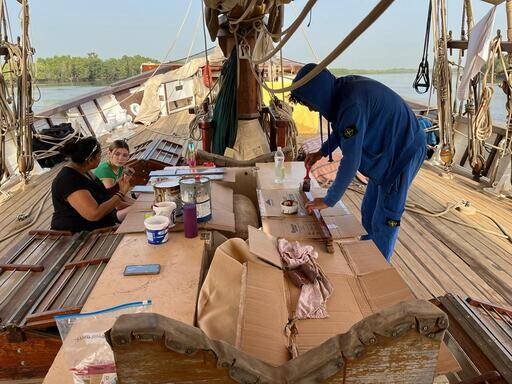
The Fleur de Passion sailboat, pictured here in Gambia, is participating in mangrove research while also promoting the reintegration of at-risk youth. (© Anja von Senger)
Céline Girardet, a researcher at Unige specialising in educational sciences, will also be boarding the ship as part of a research project conducted in collaboration with her colleagues from the psychology department at Unige and the University of Toulouse-Jean Jaurès. Their aim is to study the development of young people while they are separated from their families, loved ones, and smartphones. “What interests us is the regulation of emotions and learning – that is, how a young person, after defining their goal and acquiring the ability to self-assess, adjusts. For example, anxiety, memory, and sleep can influence this process, on top of all the constraints that exist on a boat,” she explains.
For the expert, the sailboat, with its rules and communal living, will serve as a “magnifying glass” to “amplify phenomena” that are then easier to study. The young sailors will have to answer questionnaires, keep a sleep diary, and take tests one month before departure, then on board, and again for six months after their return. “We want to see how this transformation unfolds after the experience, and if it lasts.” According to Pacifique, a young person’s participation is successful in 75 per cent of cases. “After fifteen years of experience, we know it works, but we want to know why,” says Godenzi. The research is expected to begin in September.
This article was originally published in French in Le Temps. It has been adapted and translated into English by Geneva Solutions. Articles from third-party websites are not licensed under Creative Commons and cannot be republished without the media’s consent.