The Republic of Moldova announced in early March that the process to withdraw from the Commonwealth of Independent States (CIS) is moving forward. The decision to leave this bloc highlights Moldova’s foreign policy strategy of reducing ties with Russia while increasing engagement with European organizations.
The CIS: A Brief Overview
The Commonwealth of Independent States is one of the many Eurasian organizations that sprouted from the dissolution of the Soviet Union. Besides Moldova, its member states are Armenia, Azerbaijan, Belarus, Kazakhstan, Kyrgyzstan, Tajikistan, Uzbekistan, and the Russian Federation. (Turkmenistan reduced its status to an associate member in 2005).
Moscow utilizes the CIS to maintain influence and strong relations with the former Soviet Republics. The organization is led by a General Secretary—anecdotally, between 1993 and today, there have been six Secretaries General, two from Belarus and four from Russia. The current SG is the Russian Sergei Lebedev, which demonstrates the historical influence Moscow has in this bloc. (Lebedev was appointed to a new three-year term in 2025).
Besides the secretary general and the Inter-Parliamentary Assembly, the CIS has several committees, agencies, and ongoing projects. For example, a Working Group of the CIS Council for Cooperation in Education is developing a strategy for cooperation based on the principle of implementing inclusion in education. Meanwhile, the Interstate Council for Cooperation in Scientific, Technical, and Innovation Spheres is working on a draft concept for the CIS IT Startup Technoparks Alliance. The bloc is also looking to promote integration via sports, as Kazan (in Tatarstan, Russia) may host the first-ever CIS Winter Games.
Eurasia has regional blocs focused on military cooperation, namely the Shanghai Cooperation Organization and the Collective Security Treaty Organization. The CIS is not as heavily focused on defense issues as these other blocs, but discussions on defense cooperation do occur. In January, Lebedev told the Russian news agency RIA Novosti that the “main goals of military cooperation” among the CIS countries in the medium term are greater coordination across various areas. A military concept strategy for 2030 developed by CIS includes developing a unified air defense system, a unified radar identification system, and a unified system for monitoring and assessing CBRN (chemical, biological, radioactive, and nuclear) issues, among others.
How effective the CIS has been at promoting cooperation and integration among its member states is debatable. Armenia and Azerbaijan, two CIS members, have a well-known territorial dispute, and the recent armed conflicts are fresh in memory. Baku and Yerevan are negotiating a peace agreement, but it is unclear if it will be successful; much will depend on the upcoming parliamentary elections in Armenia in June. Kyrgyzstan and Tajikistan also had a series of border clashes between 2021 and 2022, but the two governments signed a peace deal in 2025.
Moreover, it is similarly debatable to what extent other CIS member states want to further integrate with Russia. Certainly, Russia’s neighbors do not want to antagonize Moscow and also wish to maintain levels of cooperation and good relations; however, becoming further part of Russia’s sphere of influence is generally not something CIS states may want.
Moldova leaves the CIS.
As for Moldova, after the Russian invasion of Ukraine commenced, the Moldovan government announced that it was considering withdrawing from the Commonwealth. In 2023, Chisinau recalled its representative to the CIS Inter-Parliamentary Assembly; in May of the same year, the President of the Moldovan Parliament, Igor Grosu, announced that the country would withdraw from the Assembly.
Jump forward a few years. The Moldovan news agency NewsMaker reported in early March that the government has “initiated the procedures for its final withdrawal from the statutory bodies of the Commonwealth of Independent States,” as the “Parliament’s Foreign Policy Committee approved on March 4 the advisory opinions for the denunciation of the Agreement establishing the CIS, the protocol to this Agreement, and the CIS Statute.” The agency also noted that Moldova has signed 283 agreements with the CIS: 71 have been denounced, and 60 are currently being denounced. The priority for Chisinau is to denounce the CIS Statute, the Agreement on the Creation of the CIS, and its annexes, thereby effectively terminating membership in this bloc.
Speaking of the ongoing bureaucratic process to denounce the CIS agreements, Grocu said that “the opinion on withdrawal from the agreement is now being sent back to the Government, which must make the decision and submit the draft to Parliament,” adding that “we will settle the final stage here, so I hope that in two weeks it will be completed—it’s not a complicated procedure.”
The government noted that withdrawing from the CIS will save the state 3.1 million lei (USD $180 thousand) annually in fees and operations. For a country with a limited state budget like Moldova, any financial savings are greatly appreciated.
Back in January, in response to a question about Moldova’s withdrawal from the CIS, Russian Foreign Ministry Spokeswoman Maria Zakharova explained that while “the denunciation of the core treaties within the CIS framework is undoubtedly the sovereign right of the Republic of Moldova,” Chisinau’s decision “has been widely characterized as further evidence of the government’s short-sighted foreign policy, as it recklessly prioritizes exclusive cooperation with the European Union while severing long-standing ties across the Eurasian space.” We can assume that Moscow is generally unhappy with Chisinau’s decision, but the Russian authorities are not surprised by it.
Moldova, Sandu, and the EU
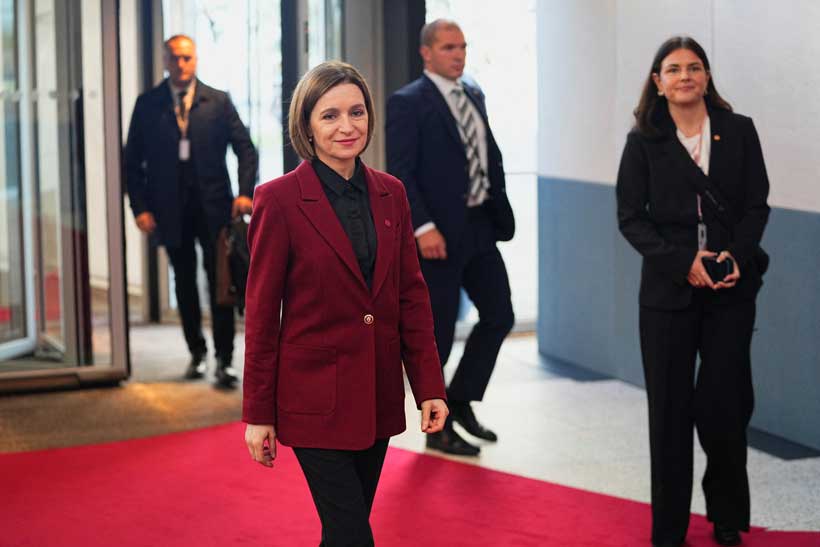
Since coming to power in 2020, President Maia Sandu has led her country towards Europe; the Russian invasion of Ukraine convinced the Moldovan leader that EU membership was the country’s future. Sandu was re-elected in 2024, and a pro-EU referendum (narrowly) passed that year as well. Sandu’s political party, the Party of Action and Solidarity (Partidul Acțiune și Solidaritate, PAS), maintained a narrow majority in Parliament in the 2025 parliamentary elections.
President Sandu and her government are confident that Moldova will be ready to join the European Union by the end of the decade, but Sandu’s second (and final) presidential term ends in 2028. Hence, Moldova’s European future may depend on the next head of state.
Thus, the Sandu government’s decision to withdraw from the CIS must be put in the proper context, as it reinforces Moldova’s European objective. While Chisinau moves forward with its withdrawal from the Commonwealth, the country is also currently the president of the Committee of Ministers of the Council of Europe for six months (from November 14, 2025, until May 15, 2026). Moreover, President Sandu and senior officials, such as the Minister of Foreign Affairs, regularly meet with European leaders; for example, Minister Mihai Popșoi recently met with Germany’s Federal Minister for Foreign Affairs, Johann Wadephul. Generally speaking, Moldova will lose very little by leaving the CIS, particularly given the strained relations between Chisinau and Moscow and because Europe is the primary supporter and partner (politically and economically) of Moldova these days.
The future of Moldova and the blocs
While the withdrawal of any member state is a hit to any bloc, CIS will survive. Membership in this particular bloc is more focused on maintaining positive relations between member states and Moscow than on other benefits CIS membership provides. It is worth noting that Moldova is not the first country to leave the bloc; Georgia did so in 2009, following the Russo-Georgian war and the loss of the separatist regions of Abkhazia and South Ossetia. The change in Georgia’s government after the 2024 elections to a more Moscow-friendly one may mean Tbilisi’s eventual return to this bloc.
The Republic of Moldova, led by President Sandu, is focused on becoming part of the European family. Much still needs to be done domestically for Moldova to be ready, including reforming and strengthening the country’s judicial system, combating corruption, improving the economy, and addressing Moldova’s longstanding brain drain. Solving the Transnistria separatist issue is another ongoing challenge (the author of this commentary has extensively written about Moldovan affairs and the Moldova-Transnistria issue for over a decade). How the war between Ukraine and Russia will continue to affect Moldova and its aspirations remains to be seen, as the conflict has now passed its fourth anniversary.
As for the country’s foreign policy, engagement with the European Union, European institutions, and individual European states continues, so these entities and states are aware of what the Moldovan government is doing to prepare for EU membership and that the Moldovan government remains committed to joining the union.
Given the ongoing global turmoil, the Republic of Moldova’s withdrawal from the Commonwealth of Independent States is a minor detail. However, for Chisinau, it is highly indicative of the Sandu administration’s European goals.