
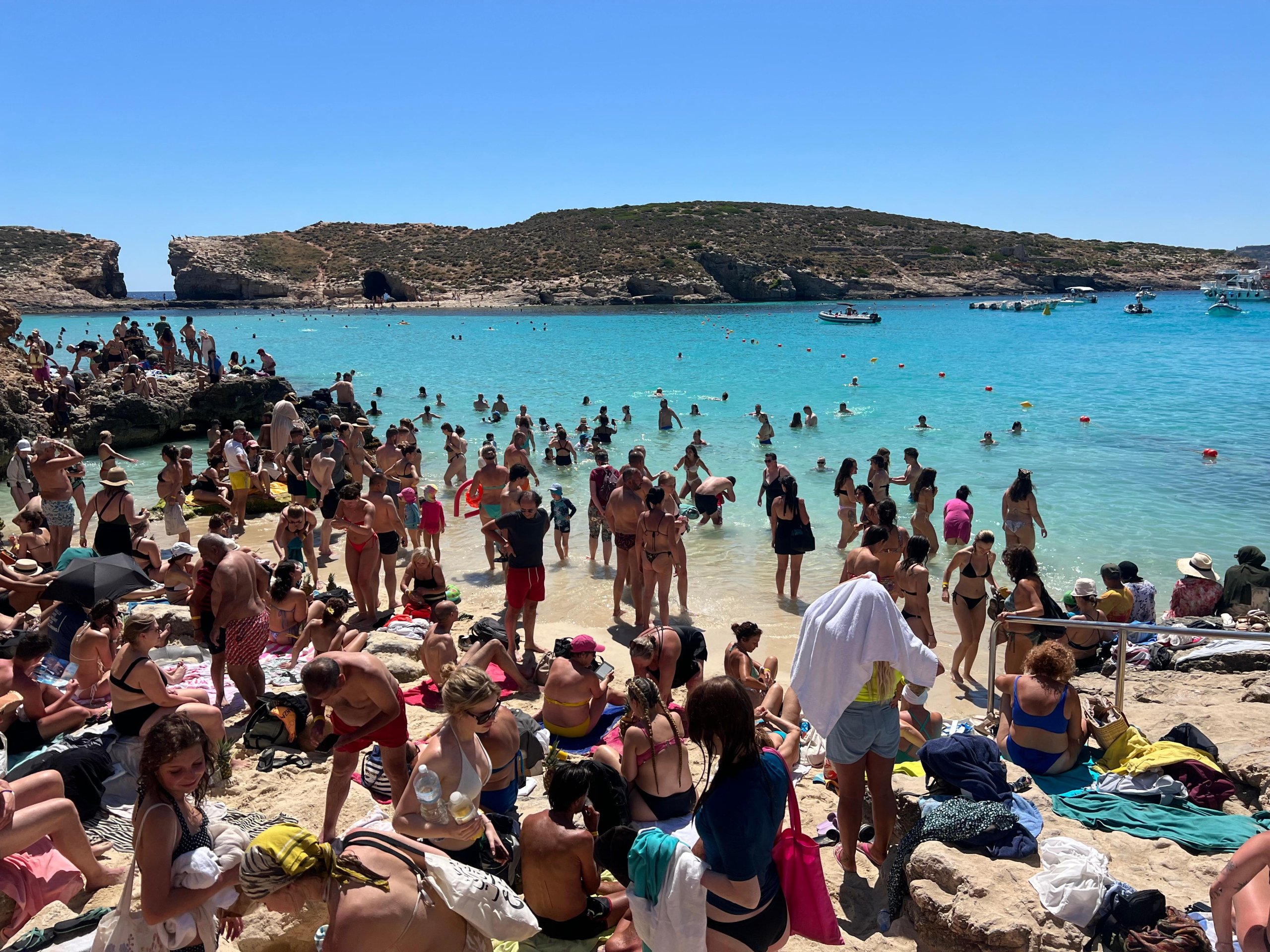
 Despite the visitor cap, the Blue Lagoon remains overcrowded — raising questions about actual enforcement (Photo: Miguela Xuereb)
A Malta Chamber report published on Monday calls for a fundamental shift from volume to value in tourism as it pointed out that the current volumes of visitors strain infrastructure, environment and resident wellbeing.
Malta welcomed more than four million tourists last year, an all-time record, but the country’s leading business body has published a blunt assessment warning that the island is becoming a victim of its own success and must urgently rethink how it grows.
The report, Rediscover to Align, produced by the Malta Chamber of Commerce, Enterprise and Industry with technical support from EY Parthenon, paints a picture of a destination at a crossroads.

It acknowledges a remarkable recovery from the Covid pandemic but concludes that the model driving Malta’s tourism boom is no longer sustainable and, left unreformed, risks damaging the island’s competitive standing, its communities and its environment.
And the figures are striking. In 2024 Malta recorded approximately 7,500 tourists for every 1,000 residents, a ratio that places it alongside Venice and Dubrovnik among the Europe’s most tourism-intense destinations.
During peak summer months the island’s effective population doubles, placing acute pressure on roads, utilities, heritage sites and coastal ecosystems. The Sliema–Gżira promenade, the report notes with some bite, has not seen significant investment since the 1990s and is blighted by visual pollution.
Yet the raw numbers mask a deeper problem. Despite total tourism expenditure rising from €1.6 billion in 2015 to €3.9 billion last year, real spending per tourist has actually fallen – from €919 a decade ago to €771 today – as visitors stay fewer nights and the island packs in more of them rather than attracting those who spend more. The average length of stay has shrunk from nearly eight nights in 2015 to just over six.

The report reserves some of its sharpest language for the accommodation sector. A policy allowing hotels to add two extra floors has, it says, shifted from a supply-side tool into “a speculative mechanism� that has generated significant oversupply. Catering licence regulations, meanwhile, remain largely unchanged since the 1990s and lack basic modern due diligence requirements.
On the labour market, the authors are equally direct: unnecessary public sector employment is “draining local talent� from an industry that increasingly relies on foreign workers to fill gaps, with 28 per cent of the workforce in accommodation and food services now comprising third-country nationals. The report states plainly that a government job “cannot continue to be perceived as a cushy job for life.�
The strategic prescription is a fundamental repositioning of Malta’s tourism brand, away from what the report calls its current “drink and entertainment� image and towards culture, heritage and culinary excellence. The authors call for culture and tourism to be reconsolidated under a single ministry, for an inter-ministerial function to be created in the Office of the Prime Minister, and for dedicated locality managers to be appointed across tourist areas to address what the report describes as chronic soft infrastructure failures.

The environmental warnings are equally urgent. There is no routine measurement of carbon emissions per tourist night, no systematic assessment of resident sentiment, and no consistent monitoring of crowding pressure in hotspots such as Valletta and St Julian’s.
The Blue Lagoon on Comino, a protected Natura 2000 site, can receive thousands of visitors per day during peak season. The report calls for timed entry systems, real-time visitor flow management tools and the long-overdue overhaul of the island’s spatial planning framework, last updated in 2015.
With an election expected within a year, the debate over tourism’s future has sharpened politically, and the report’s authors, led by Malta Chamber president William Spiteri Bailey and chief executive Marthese Portelli, are careful to frame their recommendations in economic rather than partisan terms. “Tourism cannot be defined solely by the number of arrivals and bed nights,� the foreword states. The next chapter, it concludes, must be about growing “responsibly, competitively, and sustainably.�


