
Formerly “butchers, bakers and mechanics”, only half of the Ukrainian civilians who took part in an Australian-run infantry training camp in 2023 had used a gun before.
But in light of the Russian invasion of their country, these men found themselves in the UK, undertaking a compressed five-week combat course under Australia’s Operation Kudu.
They were given basic weapons training and taught skills from trench warfare to how to hide from drones.

Most photographs on show at the exhibition document the training given to Ukrainian forces by the Australian Defence Force. (ABC News: Callum Flinn)
“The Ukrainians were picking up the basics of trench warfare, defending urban warfare, woodland warfare and just training them in the basic techniques of weapon handling and combat defending themselves,” Bryce Abraham, assistant curator at the Australian War Memorial (AWM), said.
Snippets of that time feature in Operation Kudu: Supporting Ukraine — a new exhibition at the War Memorial that details Australia’s efforts to aid Ukraine in the war.
The exhibition captures a moment in time; the war was underway, and the civilians-turned-soldiers were dealing with its impacts in different ways.

Assistant curator Bryce Abraham says some Ukrainian trainees were joking around while others were more sombre during the five-week combat course. (ABC News: Callum Flinn)
“Some of them tried to detach themselves from the reality of it, that general soldier humour, have jokes and muck around a little bit, while trying to get on with the training,” Mr Abraham said.
“Others were more sombre because they clearly understood the realities of both what they were doing and what they were about to do.
“Some had lost family, friends and other loved ones in the conflict already.”
Translators, music among training tools

Included in the Operation Kudu: Supporting Ukraine exhibition is this diagram, which Australian trainers used to explain trench movements using Sour Patch Kids. (Supplied: ADF)
The language barrier between the soldiers and recruits was an issue, but Ukrainian women who had fled to the UK volunteered as translators.
As such, a well-thumbed notebook filled with translated words is on display at the exhibition, alongside a diagram explaining trench movements using Sour Patch Kids lollies.
Mr Abraham said the trainers used many innovative methods to best prepare the Ukrainians for the war, citing one example where a trained used music during building clearance exercises.

The majority of images on show in the exhibition were gathered at the training camp in late 2023. (Supplied: ADF)
“[The trainer] got onto YouTube and blared this extremely loud YouTube clip called War Sounds,” Mr Abraham said.
“It was a mix of that heavy metal, screamo music versus explosions and stuff.
“So that kind of battle inoculation, it really seemed to work for the Ukrainians.
“They were able to focus and get into the mindset they needed to.”
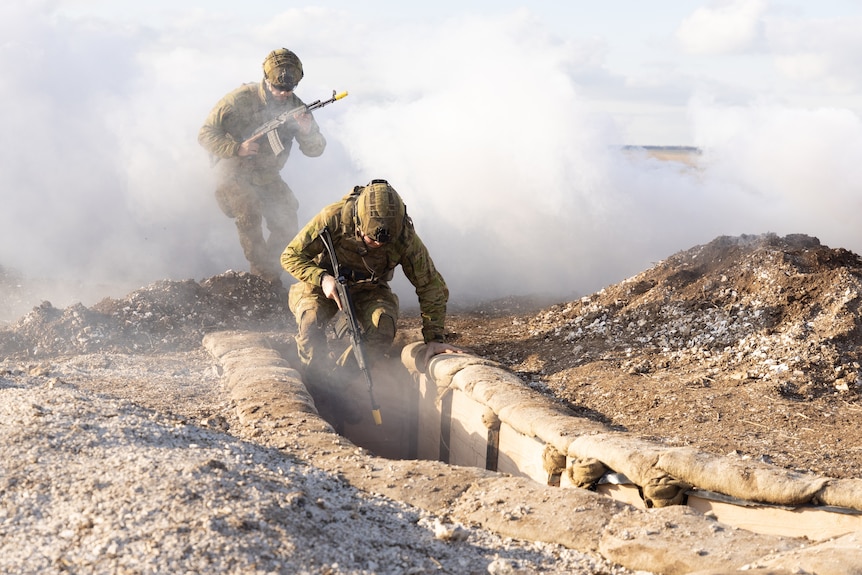
Australian Army instructors trained the Ukrainians in the same place where Australian soldiers once prepared for trench warfare during World War I. (Supplied: ADF)
Mr Abraham said the Australians trained the Ukrainians in the same place Australian soldiers had prepared to go to World War I and fight in trenches.
“If you took a photograph of part of the trench system in Ukraine and compared it to somewhere in the First World War, you might not be able to tell the difference,” he said.
Operation Kudu continues
The majority of the photographs and footage on show in the exhibition were gathered at the training camp in late 2023, but Operation Kudu continues.
The initial training of civilians was replaced in 2024 with Australians training more experienced Ukrainian soldiers, such as section commanders and patrol commanders, with the focus on professionalism and leadership.

Curator Sarah Kershaw says it’s important the War Memorial shares the contemporary Australian experience of war. (ABC News: Callum Flinn)
AWM curator Sarah Kershaw said Australia’s assistance to Ukraine covered more than just training.
“There have been a couple of deployments of an Air Force Wedgetail aircraft and crew to Europe, and also the provision and transport of military aid and equipment into Europe, which is then forwarded on to Ukraine,” she said.
Ms Kershaw said it was important that the AWM continued to share the contemporary Australian experience of war.
“While Australia is not directly involved in the conflict in Ukraine, Australian service personnel are making a valuable contribution that should be acknowledged back at home,” she said.
Operation Kudu: Supporting Ukraine is the AWM’s first exhibition in the newly completed Anzac Hall mezzanine.
It will run at the War Memorial until Wednesday, September 9, 2026.