
24/7 Wall St.
(24/7 Wall St.)
Quick Read
Global X Uranium ETF (URA) has $7.6B in assets and returned 120% over the past year, anchored by Cameco at 24% weight; Range Nuclear Renaissance Index ETF (NUKZ) spread across reactor builders, utilities, and modular reactor developers with $875M in assets and 73% annual returns; Themes Uranium & Nuclear ETF (URAN) blends uranium miners and nuclear utilities at a 0.35% expense ratio with $30.6M in assets and 74% annual returns.
AI data center demand is driving record U.S. power consumption growth through 2027, positioning nuclear as a reliable zero-carbon energy source that is gaining market share in the generation mix.
A recent study identified one single habit that doubled Americans’ retirement savings and moved retirement from dream, to reality. Read more here.
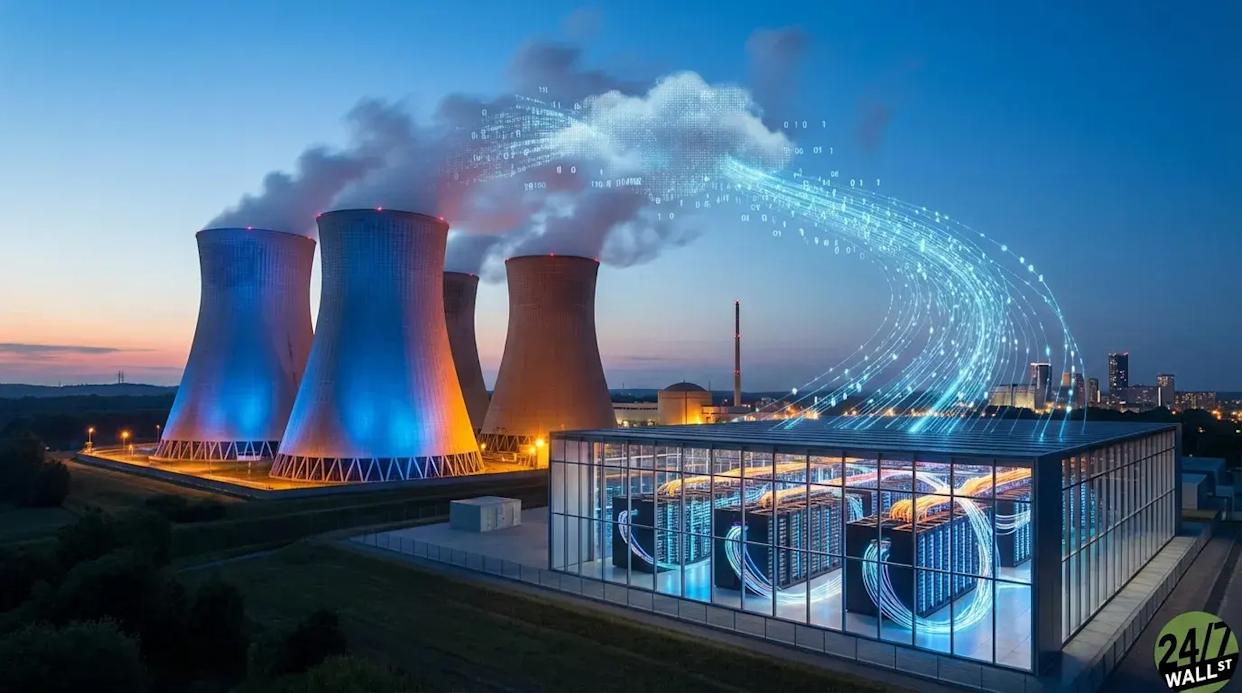
The U.S. Energy Information Administration projected in March 2026 that American power demand will climb to a new record in 2026 and keep rising through 2027, driven largely by AI data centers. Nuclear is one of the few energy sources positioned to absorb that load reliably, and its share of the generation mix is forecast to tick up. That structural shift is already visible in the market, with the three ETFs below posting strong gains over the past year as the underlying thesis continues to build.
URA: The Benchmark Uranium Fund With 15 Years of Track Record
Global X Uranium ETF (NYSEARCA:URA) is the category anchor. Launched in November 2010, it has grown to $7.6 billion in assets, making it by far the largest and most liquid nuclear-themed fund available to retail investors — a meaningful advantage for investors who need to move in and out of positions without slippage. That scale and longevity have made URA the default benchmark for the uranium trade, and its performance reflects it: the fund has returned 120% over the past year as uranium demand expectations reset higher, and remains up 15% year-to-date in 2026 despite broader market volatility. Its 0.69% expense ratio reflects its position as the category’s established standard-bearer.
The portfolio is built around the uranium supply chain rather than the power grid. Cameco holds a 24% weight, making it the single largest position, followed by NexGen Energy, Uranium Energy Corp, and Kazatomprom, the world’s largest uranium producer by volume. The Sprott Physical Uranium Trust also appears in the top ten, giving investors a slice of physical uranium exposure alongside the miners. This is a fund that profits most directly when uranium prices rise, because its holdings are the companies extracting and selling the fuel.
Read: Data Shows One Habit Doubles American’s Savings And Boosts Retirement
Most Americans drastically underestimate how much they need to retire and overestimate how prepared they are. But data shows that people with one habit have more than double the savings of those who don’t.
The tradeoff is concentration in the commodity cycle. When uranium prices pull back, URA tends to amplify the move. It also carries meaningful exposure to smaller-cap miners that can be volatile individually, even when the broader thesis is intact.
NUKZ: The Widest Lens on the Nuclear Infrastructure Build
Range Nuclear Renaissance Index ETF (NYSEARCA:NUKZ) takes a fundamentally different approach. Where URA concentrates on uranium miners, NUKZ spreads across the entire nuclear ecosystem: the companies that build reactors, supply components, operate the plants, and develop next-generation technology. Its $875 million in assets and January 2024 inception date make it younger than URA, but it has grown quickly as the nuclear renaissance narrative gained traction. Over the past year, it returned 73%.
The sector breakdown tells the story: industrials make up 31.5% of the fund, reflecting heavy weight in engineering and construction firms like GE Vernova, Quanta Services, and Rolls-Royce Holdings. Utilities account for another 19.6%, anchored by Constellation Energy, which has become the bellwether for nuclear power supply agreements with hyperscalers. Constellation Energy has been a standout beneficiary of AI-era power purchase agreements, as hyperscalers pay a premium for firm, carbon-free baseload electricity.
NUKZ also holds a cluster of small modular reactor developers including Oklo, NuScale Power, and Nano Nuclear Energy. These are early-stage companies with no commercial reactors yet operating, but they represent the long-duration bet embedded in the fund. Oklo alone has returned 144% over the past year, with shares pulling back year-to-date as investors have rotated out of speculative names in early 2026.
The geographic reach is worth noting. NUKZ holds positions in Korean conglomerates like Samsung C&T and Doosan, Japanese industrials like Hitachi and Mitsubishi Heavy Industries, and European utilities with nuclear exposure. This international diversification means NUKZ is less a pure uranium play and more a bet on global nuclear infrastructure capacity expanding over the next decade. The tradeoff is that the fund’s industrial weighting dilutes the direct commodity sensitivity you get with URA. In a uranium price spike, NUKZ will lag. In a sustained buildout cycle where engineering and construction firms win contracts, it should outperform.
URAN: A Balanced Middle Ground With a Notably Lower Fee
Themes Uranium & Nuclear ETF (NYSEARCA:URAN) launched in September 2024 and sits between the other two in strategy. It blends uranium miners with nuclear utilities and a smaller allocation to technology suppliers, creating a portfolio that responds to both fuel price movements and power demand growth. At $30.6 million in assets, it is the smallest of the three and the least liquid, which matters for investors trading in size. Its expense ratio of 0.35% is meaningfully lower than either URA or NUKZ, which is a real structural advantage over a multi-year hold.
The portfolio gives utilities a 24% weight, led by Constellation Energy, PG&E, American Electric Power, and Duke Energy, all of which operate nuclear generating capacity. Uranium miners including Cameco, NexGen, Paladin, and Denison account for a large share of the remaining exposure. The fund also holds Chinese nuclear names like CGN Power and China National Nuclear Power, which adds a dimension neither URA nor NUKZ provides in meaningful size. That international breadth reflects the reality that nuclear buildout in 2026 is a global story, not just a North American one.
URAN returned 74% over the past year, nearly identical to NUKZ and well behind URA’s pace. The performance gap between URAN and URA reflects the drag from utility holdings during periods when uranium miners outrun the broader sector. The tradeoff with URAN is its limited track record and thin asset base. Smaller ETFs by asset size typically carry wider bid-ask spreads and have historically shown higher closure rates than larger funds, a structural characteristic of the ETF industry.
Key Differences at a Glance
URA is the most direct expression of uranium supply and price, with a 15-year track record and the largest asset base of the three. NUKZ takes the broadest approach, spanning engineering, construction, and fuel supply across global nuclear infrastructure. URAN blends miners and utilities at the lowest expense ratio of the three, though its asset base is the smallest of the group.
Data Shows One Habit Doubles American’s Savings And Boosts Retirement
Most Americans drastically underestimate how much they need to retire and overestimate how prepared they are. But data shows that people with one habit have more than double the savings of those who don’t.
And no, it’s got nothing to do with increasing your income, savings, clipping coupons, or even cutting back on your lifestyle. It’s much more straightforward (and powerful) than any of that. Frankly, it’s shocking more people don’t adopt the habit given how easy it is.