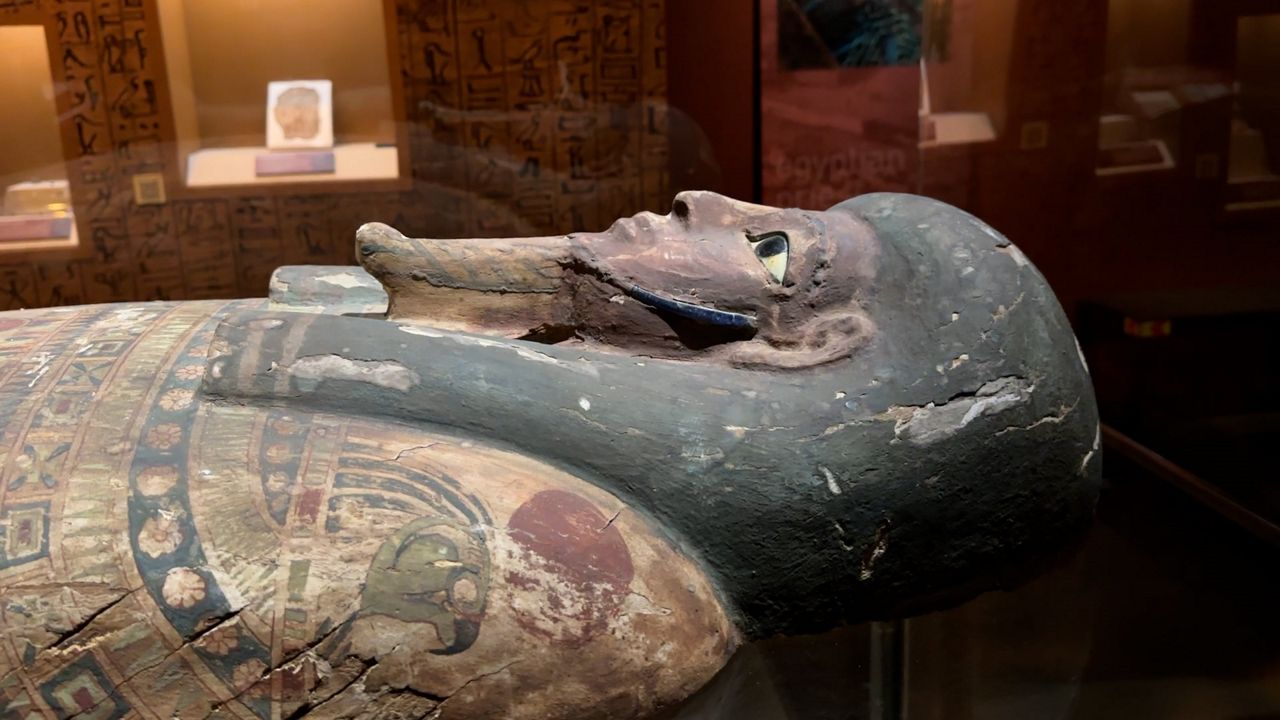
LOS ANGELES — There are two mummies who lived 2,000 years ago on display at the California Science Center, and we know what medical issues they had at death.
Researchers from USC’s Keck School of Medicine were able to bring the mummies into their facilities and conduct CT scans on what remains of their bodies. They found out that one had a collapsed vertebra, while the other had major hip problems.
“Yes, they’re mummies, but they were human people walking around,” said Dr. Summer Decker, who is the director of USC’s Center for Innovation and Medical Visualization. “People who cared about them and respected them, and loved them enough to preserve them for eternity.”
The mummies are part of an exhibit at the California Science Center titled “Mummies of the World,” which will be on display until September.
“It’s an exhibition that shows real human and animal mummies from South America, Europe, and from ancient Egypt,” said the senior vice president for special projects at the California Science Center, Diane Perlov. “What’s incredible about these specimens is that some of them have never been shown before.”
Perlov added that in working with researchers from the Keck School of Medicine, there have been discoveries made on how medical care may have worked thousands of years ago.
“The mummies that show cases of broken bones, and dental abscesses and things like that, these were self-healed,” she said. “It’s not like they showed that broken bones were set and they healed; no, these healed on their own.”
Researchers are also able to compare and contrast some of the diseases and illnesses from ancient times that are still an issue for human beings today.
“They discovered tuberculosis, which is a disease that still afflicts humanity,” Perlov said. “And studying the ancient past of a pathogen, scientists feel, may help them find eventually a cure for things that still afflict us.”
That’s what has been exciting for Dr. Decker. She’s also the 3D imaging lead at Keck Medicine of USC and was able to print 3D replicas that are the exact size and shape of the body parts that showed injuries and wear-and-tear on mummies from 2,000 years ago. Dr. Decker adds having facilities with 3D printing capabilities here locally in SoCal helps reduce costs for patients and providers.
“One of the parts that I’m thinking of, we can do for $7,” she said. “Instead of the $10,000 dollars that is costs if you have to outsource that and get it from somewhere else.”
Another example Dr. Decker pointed out is where she and her colleagues were able to 3D print a liver with tumors on it. She says having the ability to physically produce exact body parts and show patients in real time what they’re going through is a game-changer.
“Being able to have that in their hands, it’s a different level,” Dr. Decker said. “And a different conversation that health care workers can have with the patient.”
The National Institutes of Health says using 3D printing has helped cut surgery time by 62 minutes on average because physicians can practice ahead of time on the models and come up with a plan to maximize recovery and efficiency.
The 3D printing industry will continue to grow in the medical field, but researchers believe there’s still more to be discovered.
“Bioprinting has already begun to take off,” said Dr. Decker. “So being able to take cells and stem cells, and being able to train them and say we need to print this type of tissue.”