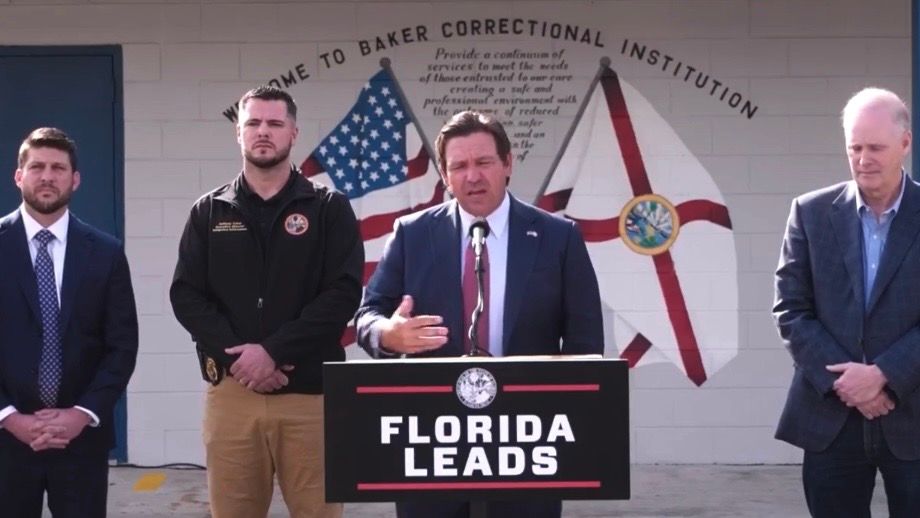
Florida Gov. Ron DeSantis responded to the recent push to change immigration enforcement rules in the state, and lawmakers could reconsider an AI bill of rights.

DeSantis comments on movement to change immigration enforcement in Florida
Gov. Ron DeSantis said he stands by following Florida’s immigration policies and does not agree with the concerns made by the state’s immigration enforcement council.
Earlier this week, some members suggested there should be a path to citizenship for undocumented migrants without a criminal history.
In the meeting, Florida sheriffs talked about writing a letter to President Donald Trump and Congress asking for changes to the current mass deportation strategy.
DeSantis said he does not support that.
“You can’t have a situation where (former president Joe) Biden can bring in 10 million people and then we’re not allowed to remove them back to their home country. This idea that unless you’re an ax murderer, you should be able to stay, that is not consistent with our laws and it’s also not good policy,” DeSantis said. “We have different people that are victimized by illegal aliens every day in this country. Not all of them have criminal records. Probably most of them don’t. But under some view, yeah, you come illegally and then stay until you commit a crime, that just doesn’t work. It’s incoherent. It’s not what the president ran on. So to send a letter to him, asking him to go back on his campaign policy, I would not advise that to be done.”
He went on to say that Florida has set the standard on deportations, and he wants to keep the momentum going.
On that front, DeSantis spent more than $600 million of the state’s emergency fund to build and operate migrant detention centers like “Alligator Alcatraz” in the Florida Everglades.
The governor said the federal government would pay the state back, but no reimbursement has happened yet.
A Federal Emergency Management Agency spokesperson said that the agency is, “working closely with the Florida Division of Emergency Management and the state of Florida. No funds are being held up; reimbursement requests are in process, and the initial tranche of funds is moving forward.”
State leaders could take up an AI bill of rights in April
State leaders could try again in the upcoming April special session to pass what they’ve dubbed the AI Bill of Rights.
The proposal would create state protections and safeguards, including mandatory disclosures to consumers when interacting with a chat bot.
The proposed AI bill of rights has more than consumer protections. It would also require parental consent for minors.
That said, it passed in the state Senate yet failed in the Florida House.
Gov. Ron DeSantis says Florida needs that AI bill of rights sooner rather than later.
“I’ll tell you, I’m glad I grew up in the 80s and 90s, and we didn’t have any of this crap. I’m telling you,” DeSantis said.
The bill’s sponsor is State Sen. Tom Leek (R-District 7). He, too, said he believes the bill deserves a second bite at the apple in Tallahassee.
“I’ll work with the governor’s office to see if we can get this AI bill of rights into the call. For a special session to come, whether that’s in April or some point in the future, I don’t know, but I’m going to continue to work on it,” Leek said.
The renewed effort comes after the Trump administration urged states to stay away from creating policy.
“If they had to get 50 different approvals from 50 different states, you can forget it because it’s not possible to do, especially if you have some hostile actor. All you need is one hostile actor, and you wouldn’t be able to do it,” Trump said.
The Florida House heeded that message in the regular legislative session, opting not to approve Florida’s AI bill of rights.
“The federal government should take care of AI and whatever legislation or policy has to pass on a national level, as opposed to doing it on a state-by-state basis. I’ve been pretty consistent in stating that,” Speaker of the House Danny Perez said.
Meanwhile, Florida Democrats are warning about AI’s downstream effects.
In order to pass, state leaders would need to find some sort of compromise with the Florida House.