

Suzenne A’Neile, an 83-year-old retiree from Ardeer in suburban Melbourne, seen on March 10, 2026.(ABC News: Danielle Bonica)
Every month, Suzenne A’Neile meticulously logs her personal expenses in a ledger.
Broken down by category, the 83-year-old retiree knows where every cent in her budget is spent.
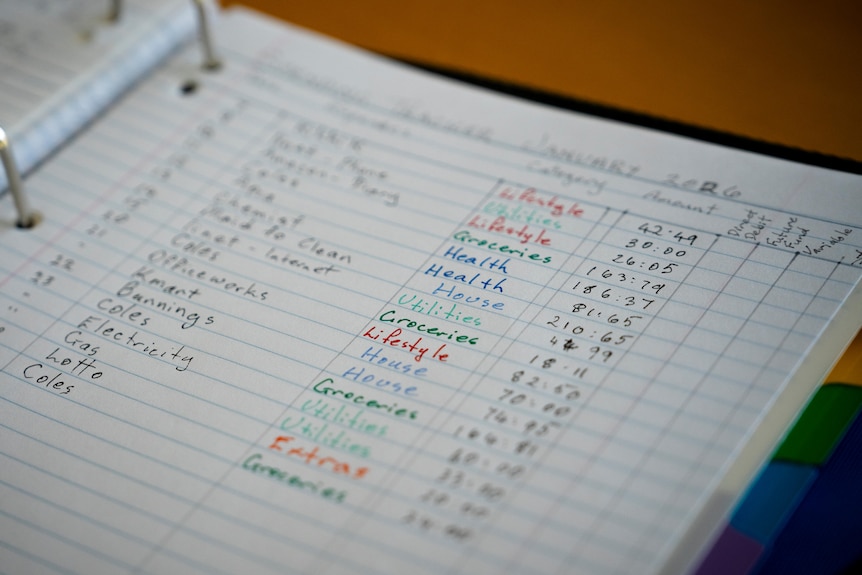
The personal budget ledger of Suzenne A’Neile, a retiree from Melbourne, seen on March 10, 2026.(ABC News: Danielle Bonica)
Suzenne receives about $1,100 each fortnight in aged pension payments.
After covering expenses from health care to groceries, she has as little as $300 to spare at the end of some months.
Suzenne is among hundreds of Australians who shared with ABC Your Say information about their personal budgets — their biggest expenses and the areas where they have been forced to cut back to make ends meet.
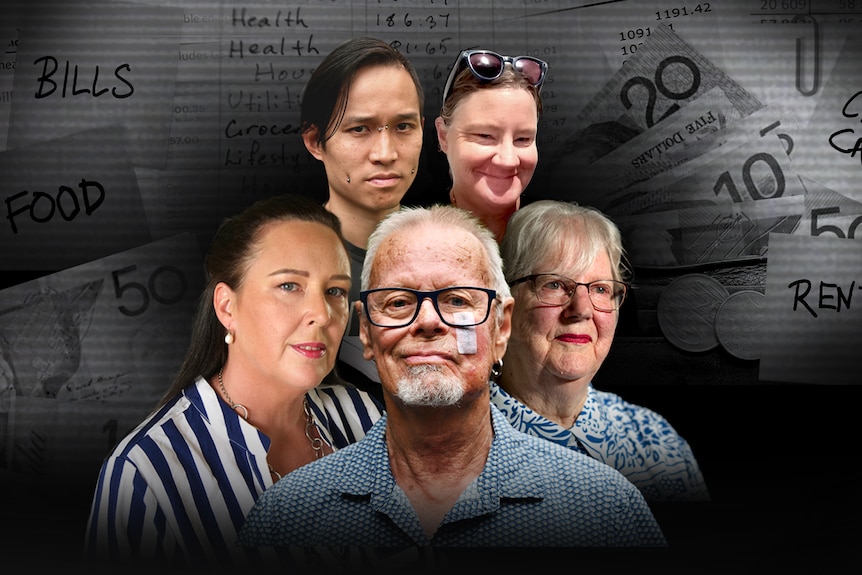
Australian men and women who have spoken with ABC Your Say about their personal finances and budgeting.(ABC News: Sharon Gordon)
It’s no secret Australians are struggling.
In the more than four years since the COVID-19 pandemic intensified the cost of living crisis across the country — and now amid the war in the Middle East — people from all different walks of life have been struggling.
Last month, ABC Your Say asked ordinary Australians what they had given up, what they considered a “splurge” and how they were making ends meet.
Among the hundreds of messages received, many detailed the difficulty paying rent, making insurance payments and buying groceries.
For some, a “splurge” is filling a script for medication they desperately need.
Suzenne lives in Ardeer, an outer suburb in Melbourne’s west.

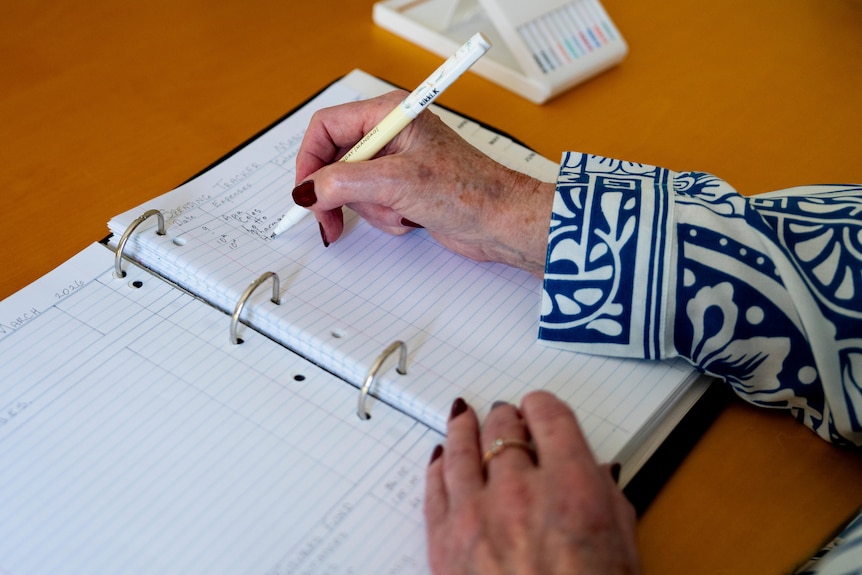
Suzenne makes time each month to work through her personal budget.(ABC News: Danielle Bonica)
She says she started her detailed budget because she was struggling to pay off her mortgage in the wake of interest rate rises.
Her family then helped to pay the remainder of her home loan.
“I guess, I’d pat myself on the back and say, ‘Look, I haven’t had to borrow any money from anybody to pay any of my expenses,'” she says.
Suzenne says she is proud of how she manages her finances.(ABC News: Danielle Bonica)
Her biggest expenses are groceries, electricity and water bills.
Suzenne’s personal budget
Annual Income: $29,000
Biggest expenses: Groceries, electricity and water bills
Cut backs: Home gardening and cleaning services
She tries to cut down on those as much as possible.
“I want to make sure that what I’m eating is good quality, and it’s providing me with the energy and everything else to keep my health benefits,” she says.
Her family has been trying to convince her to consider at-home care services or moving into an aged care facility, but she wants to stay at home as long as possible.
“I do get a bit anxious about some things, but not to the point of, ‘Isn’t it dreadful? Isn’t it awful? There’s nothing we can do,'” she says.
“I think there is a lot of stuff that we can do.”

Suzenne also keeps a list of services and other costs that may impact her budget in coming months.(ABC News: Danielle Bonica)
The Australian Bureau of Statistics produces the Living Cost Indexes.
It shows costs spiked by 2.3 to 4.2 per cent last year, with the biggest whammy delivered to aged pensioners.
Annual housing costs were the largest expense.
For full-time carers receiving pensions, along with households whose main income comes from government payments, those costs grew by 9.1 per cent.

Joanna, a 49-year-old single mother from Rockhampton in central Queensland, seen on March 18, 2026.(ABC News: Katrina Beavan)
Joanna, who requested to only be identified by her first name to avoid identifying her son, is a 49-year-old single mum from Rockhampton, in central Queensland.
She is a full-time carer for her 13-year-old son, who lives with autism and attention-deficit hyperactivity disorder. He cannot be left alone.
She receives about $1,600 a fortnight on the carers’ pension and shells out $904 a fortnight to keep a roof over their heads. She is bracing for an almost $200 rent increase coming in two months.
Joanna says she suffers from arthritis and cluster migraines, but struggles to afford the medication to ease her pain.
Joanna’s personal budget
Annual income: $42,000
Biggest expenses: Rent
Cutbacks: Prescription medication, meals, electricity usage
“I’m just sort of caught in this trap … if I work, I have the money to be able to pay for things like pain specialists and rheumatology appointments,” she says.
“I cannot be working full-time and that’s why I’m on the carers’ allowance.
“But if I don’t work, I can’t pay for those things and I have to be on a wait list for between two to five years.”
She may have to give up her private health insurance — something that’s “really not ideal” in a regional town.

Joanna says she has struggled to balance finding a full-time job while also caring for her son.(ABC News: Katrina Beavan)
“[Hopefully] my son’s condition gets to a point where I’m not having to claim a carer’s allowance for him eventually,” she says.
“Then I will be able to work full-time and I will be able to save a house deposit and I will be able to potentially have a loan and pay it off before I retire.
A devastating diagnosis raises fears of ‘astronomical’ debt
The ABC began researching and speaking to ordinary Australians for this story in early February.

Lisa Bingham, a 46-year-old mum of seven children from Lakelands, Western Australia.(Supplied: Lisa Bingham)
Lisa Bingham, from Lakelands in Western Australia, also wants a home of her own.
“I want my own kids to have that … I can’t do it. I can’t physically afford to do it,” she says.
She receives $2,100 per fortnight in welfare payments and pays $1,200 a fortnight for two rooms in a community housing share property for herself and five of her seven children who still live at home.
“[It] scares the crap out of me, because I’m thinking, ‘How the hell am I gonna survive?'” she says.
Lisa says she often goes without eating to feed her children and has previously relied on church food hampers.
Lisa’s personal budget
Annual income: $46,500
Biggest expenses: Rent, food, medical costs
Cutbacks: Private health insurance, kids’ swimming lessons, weekend activities
Last year, she cut the family’s private health insurance.
The 46-year-old mum lives with sickle cell disease — a genetic disorder that blocks blood flow, causing anaemia and severe pain.

Lisa’s biggest budget expenses are the family grocery shop and rent.(Supplied: Lisa Bingham)
Last month, when she first spoke to the ABC, Lisa was waiting for her doctor to determine if she had cervical cancer.
She said a cancer diagnosis would leave her budget “completely blown”.
“It’s astronomical, the amount I’m going to be in debt,” she says.
Her fears of a cancer diagnosis have since been confirmed.
She says car registration will be the next expense to go if things get tougher.
“My anxiety goes through the roof every week when I have to do a budget and I struggle big time,” she said.
“We don’t have any money for the weekends to go out. We’re always just home all the time and it’s taking its toll.”
Older Australians feeling the pinch
Many of those who contacted the ABC were retirees or older Australians.
COTA Australia, the peak body advocating for older Australians, has recently released its State of the Older Nation report.
The report echoed many of the concerns shared with the ABC — costs of prescription medication, isolation, and rising energy costs.
Geoff Harrison is a 72-year-old retiree in Goonellabah in regional NSW, living on a pension of $1100 per fortnight.

Geoff Harrison.(ABC News: Cathy Adams)
“I don’t know what would help … because you work out what you’re cutting out,” he says.
“I used to do a lot in the theatre and cinemas, I never do that anymore. Or go out to restaurants, I don’t do that [except] rarely.”
Geoff’s personal budget
Annual income: $28,600
Biggest expenses: Food, strata, utilities and increased medical bills
Cutbacks: Cinemas, restaurants, buying new things
Now, he says, he hangs onto things, carefully documenting every expense and how much it has changed each week.
He also keeps up a gym membership to stay fit as he gets older, but that will likely be the next thing to go.
For an affordable getaway, he heads out in the caravan he bought a few years ago.
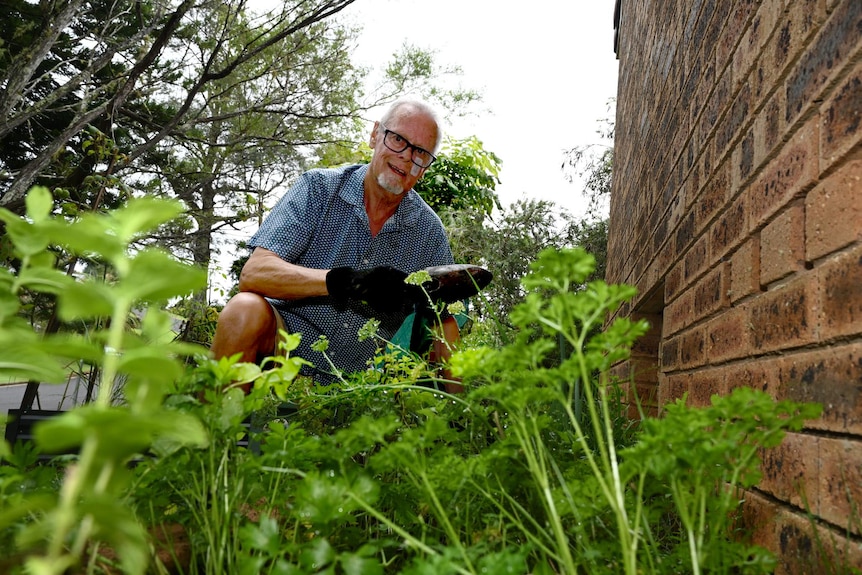
He opts for quiet getaways and tries to stay fit. (ABC News: Cathy Adams )

Geoff has largely given up going out to restaurants or to the cinema.(ABC News: Cathy Adams)
“It’s a really small one, but it’s easy for me to disappear out to national parks, which I love,” he says.
“There’s one place I’ve used for however long we’ve been in the area, many, many years, and it’s usually fine.
“We went there last weekend, and it was packed. And on a Monday, packed. It just shows people are going out [for] a holiday runaway to somewhere inexpensive.”
‘We’re opting to do it the hard way’

William Kwan and his wife want one parent to stay home with their young children.(ABC News: Mark Leonardi)
William Kwan is a 38-year-old postdoctoral researcher in Brisbane, earning $101k per year.
He’s married with two young children aged four and six, and his wife stays at home to raise them.
Both of them, he says, have strong memories of having a stay-at-home parent, and feel it positively affected the kind of adults they became.

William Kwan is a 38-year-old postdoctoral researcher in Brisbane earning $101k per year.(ABC News: Mark Leonardi)
“We know we could change our lifestyles dramatically to bring in more money to our house,” he says.
“[People in my field] usually put their kids in childcare or after-school care on a full-time basis.
“And it’s really something neither my partner nor I want for our kids. So we’re opting to do it the hard way.”
Of the 2.7 million two-parent households across Australia in 2025, almost 73 per cent had both parents employed, according to the Australian Bureau of Statistics.
That proportion has been increasing steadily since 2005.
The proportion with just one employed parent, meanwhile, decreased from 33 per cent to 22 per cent.
William’s personal budget
Annual income: $101,000
Biggest expenses: Rent
Cutbacks: Hobbies, going out, travel
In William’s home, “everything goes towards the kids”.
“When they’re really little, nappies are really expensive and that adds up really, really fast. And when they get past [that] stage, they enter the blueberry phase or the raspberry phase, and that’s also expensive,” he says.
“My partner and I joke, we end up equating how much things cost as punnets of raspberries.
“So I go out for a beer very, very rarely because I’ll be like, ‘a pint of beer is kind of like two pints of raspberries’.
“I get more enjoyment and I feel like a more responsible parent, giving my kids fruit versus necking a pint on a hot summer’s day in five minutes.”

All of the couple’s spare income goes towards their children.(ABC News: Mark Leonardi)
While he says saving money and being thrifty isn’t anything new for them, it has made his family more socially isolated.
They’re trying to plan to have William’s mother fly from Melbourne to see her grandchildren. His wife, originally from the US, hasn’t seen her family since before the pandemic.
“We’re just trying to single-income it and have my partner be a full-time stay-at-home parent, so she can be active with their school excursions, after-school care, stuff like that,” he says.
Credits