
This article contains affiliate links; if you click such a link and make a purchase, we may earn a commission.
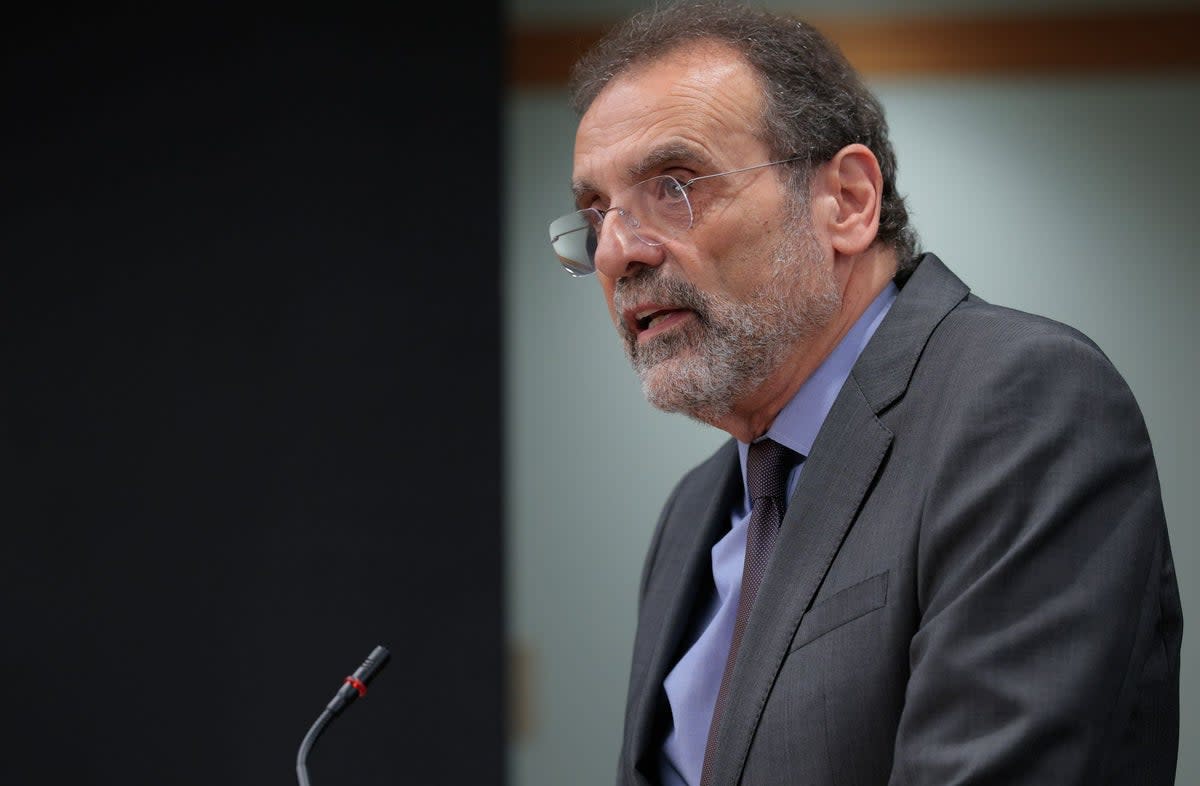
Shalom Baranes, the architect who agreed to see through President Donald Trump’s White House ballroom addition, has baffled colleagues in Washington, D.C. by taking on the controversial project late in his career.
Baranes, 75, is a longtime, well-respected architect in D.C. who has worked on dozens of contemporary additions to federal buildings.
He also has a history of being critical of the Trump administration’s harsh anti-immigration policies, as the son of Jewish Libyan refugees who came to the United States at 6 years old.
“Why would he do this?” and “Wonder if the firm needs the business?” were among the questions posed by the reports and editors at Washington Biz Journal in December when they announced that the architect they had been covering for nearly 20 years had agreed to take over the 90,000 square-foot ballroom project.
“I am totally baffled why he would take this on,” Nancy MacWood, a preservationist familiar with Baranes’ work, told the New York Times.
(Getty)
In an interview with the New York Times last week, Baranes repeated his criticisms of the Trump administration, saying: “What’s happening now is heartbreaking.”
“I do hope there’s a realization at some point that this country depends on immigration. We have to normalize our policies,” Baranes added.
His legacy as a well-tempered, creative and collaborative architect was already cemented in the nation’s Capitol by 2006, when the Washington Post said “it would be hard to find an architect who knows more about designing in Washington” than him.
That, combined with his criticisms of the administration, has left some of his colleagues scratching their heads, wondering why he would take on the $400 million addition that has been scrutinized by fellow architects, the public and lawmakers.
“I don’t understand why he would put himself in such a hot seat right now,” David M. Schwarz, an architect in D.C. who has known Baranes since their days at the Yale School of Architecture, told the New York Times.
Baranes agreed to take over the project after the original architect, James McCrery II, stepped down.

Rendering for the new White House ballroom show the massive 90,000-square foot structure attached to the main residence (AP)
Baranes is under a nondisclosure agreement with the White House and declined to explain his motivations for taking on the project to the New York Times.
But he denied allegations that his architecture firm needs the undisclosed amount of money from the job.
Others in the architecture community said they could totally understand his taking on the job.
“If I had to pick who would do this job, it would be Shalom,” said Richard Nash Gould, a New York architect and Trump supporter who spoke to him recently about the ballroom. “He’s happy, he’s bulletproof and he’s really smart.
“Why wouldn’t he?” he said. “It’s an incredibly interesting job.”
High-profile jobs Baranes has done around D.C., include the renovation of the Department of Homeland Security headquarters, the Federal Reserve Building, the American Red Cross Building and the Treasury – to name a few.
Perhaps most notably, though, Baranes and his firm were the architects who renovated the Pentagon after it was damaged on September 11, 2001, when a plane crashed into the side of the building.
He referred to that project as his “proudest moment,” in a 2017 op-ed for the Washington Post in which he lightly criticized the president’s immigration policies during his first term.
“My hope is that the Trump administration will take actions to ensure that the travel ban is indeed temporary, so that good, hard-working individuals fleeing tyranny can find a new home as I did — and that each of them will be given the same opportunity to help build this great nation that I had,” Baranes wrote in the 2017 piece.
The architect appears to be putting any personal feelings about the Trump administration policies aside to take on the new ballroom, which Trump demanded because the White House does not have a large enough entertaining space for state dinners and other events.