
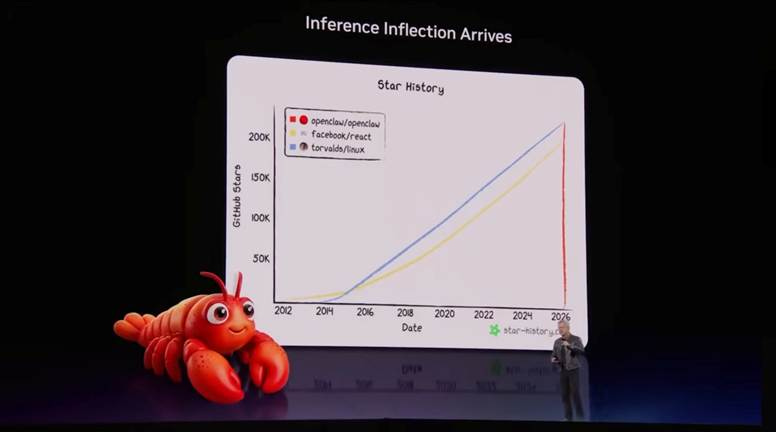
 Figure 1. Jensen Huang thinks OpenClaw is kind of a big deal. He’s such a believer, he made NemoClaw, which has a security layer for OpenClaw to make it enterprise-ready and bring Nvidia’s Nemotron AI models to work with OpenClaw.
The biggest AI announcements this week came from Nvidia’s GTC 2026 conference, where Nvidia announced AI chips, systems, models, and applications throughout the AI stack:
CEO Jensen Huang’s most emphatic statement in his keynote was how significant OpenClaw was for agentic AI – ‘the next ChatGPT.’ To support OpenClaw adoption, Nvidia announced NemoClaw for the OpenClaw community as a stack that installs Nemotron models and the new OpenShell runtime in a single command. The release includes built-in privacy and security controls intended to make autonomous AI agents more trustworthy, scalable and easier to deploy.
Nvidia announced broader enterprise agent software advances centered on the open source Agent Toolkit for autonomous, self-evolving enterprise AI agents. The company’s Agent Toolkit effort is aimed at increasing agent safety, security and efficiency, and it ties together products including NemoClaw, OpenShell, Nemotron and DGX systems.
Nvidia announced the Vera Rubin platform is in full production for large AI factories, with seven new chips providing infrastructure for agentic AI. The platform combines new GPU, CPU, networking and storage elements to scale high-performance AI systems, supporting faster inference and reasoning workloads. Nvidia’s Vera CPU delivers twice the efficiency and 50% faster performance than traditional rack-scale CPUs.
Nvidia announced Dynamo 1.0 as an open-source inference operating system for AI factories. It integrates with frameworks including LangChain and vLLM, and it can increase Blackwell inference performance by up to 7x while being supported across major cloud providers and inference companies.
Nvidia announced an expanded Nemotron model lineup for agentic, physical and healthcare AI. The company said the new Nemotron 3 Ultra, Omni and VoiceChat models are designed to support natural conversations, complex reasoning and visual understanding for specialized AI agents.
Some of Nvidia’s other GTC announcements:
MiniMax announced M2.7, a proprietary AI model optimized for agentic AI tasks and AI code. M2.7 is at the frontier level for powering advanced AI agents such as KiloCode, boasting a SWE-Pro score of 56.2% and GDPval-AA ELO score of 1495. Leveraging AI-enabled acceleration, MiniMax used “Self-Evolution” where the AI model helped automatically train itself and handled up to 50% of its own development by analyzing failure trajectories:
M2.7 is capable of building complex agent harnesses and completing highly elaborate productivity tasks, leveraging capabilities such as Agent Teams, complex Skills, and dynamic tool search. For example, when developing M2.7, we let the model update its own memory and build dozens of complex skills in its harness to help with reinforcement learning experiments.
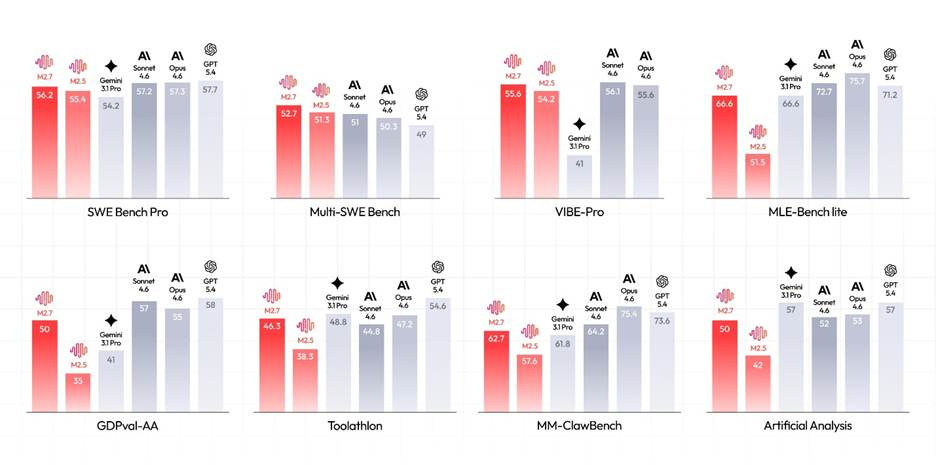 Figure 2. Minimax M2.7 is on par with top frontier AI models on AI coding and agentic benchmarks.
OpenAI expanded its GPT-5.4 with the release of GPT-5.4 mini and nano, smaller models optimized for speed and cost-efficiency in agentic workflows. These models are designed to handle high-token background tasks for autonomous agents, maintaining near-frontier performance in computer use and tool-calling at lower latency. GPT-5.4 mini has strong performance for its cost (costs $0.75 / $4.50 per 1M input / output tokens) with a 54.4% on SWE-bench Pro, 72.1% on OSWorld-Verified, and 88% on GPQA Diamond.
Mistral AI launched Mistral Small 4, an open-weights AI model that combines reasoning, multi-modal, and agentic coding capabilities in a single model. As Mistral puts it, “Mistral Small 4 consolidates the strengths of Magistral (reasoning), Devstral (coding agents), and Mistral Small (instruct) into a single model.” Built as an MoE model with 119B parameters and 6B active parameters, it competes with AI models such as OpenAI’s GPT-OSS-120B.
Google expanded Stitch with “vibe design” features to make it an AI-native software design canvas for UI design. The update adds an infinite canvas for high-fidelity UI work, a design agent that can reason across a project’s history, and a new DESIGN.md format for exporting or importing design rules into other coding and design tools. Integrated with Google AI Studio’s new full-stack vibe coding environment, the tool enables developers to convert design prototypes into functional, multiplayer-ready web applications.
In conjunction with the Stitch update, Google upgraded AI Studio with a new “full-stack vibe coding” workflow aimed at moving from prompts to production-ready applications. The new “Build Mode” within AI Studio adds the Antigravity coding agent, built-in Firebase integrations for databases and authentication, support for external libraries, and app-building flows for frameworks such as React, Angular, and Next.js.
Google followed that with Gemini API tooling updates designed for more capable agentic workflows. Developers can now combine built-in tools like Google Search and Google Maps with custom functions in one request, preserve context across tool calls, and use Google Maps grounding across the Gemini 3 family for location-aware responses.
Midjourney has launched V8 as an Alpha release, introducing a new “HD mode” capable of 2K resolution and features 5x faster generation speeds and improved text rendering. While the model excels at following complex, imaginative prompts and offers enhanced personalization through style references, reviews are meh to negative, with reports of issues with anatomical coherence in detailed generations. Image generation has improved significantly in the Nano Banana era, and Midjourney risks falling behind.
Microsoft has introduced MAI Image 2, a new photorealistic generative model currently ranked third on the Text-to-Image Arena. MAI-Image-2 features high-fidelity skin tones, natural lighting, and high accuracy in rendering embedded text within complex scenes, making it ideal for creative professionals.
Anthropic has launched a new feature in Claude Cowork called Dispatch, which acts like a “walkie-talkie” for Claude Co-work. It allows users to initiate tasks on their desktop and then monitor, control, and provide approvals from their mobile devices while on the go. Dispatch is safer than third-party tools like OpenClaw for remote AI agent tasks because it uses a permission-based “allow-listing” system and manual approvals and runs in a local sandbox. Dispatch is available via Claude desktop apps with a Claude subscription, Max for now and Pro plan eventually.
Cursor has introduced Composer 2 to the Cursor IDE. Composer 2 is an updated model trained exclusively on code that handles complex, multi-file workflows. It significantly outperforms previous baselines on terminal-based tasks and is optimized for long-horizon development at a price point roughly 86% cheaper than Claude 4.6 Opus.
Anthropic has updated Claude Opus 4.6 and Sonnet 4.6 models to fully support 1-million-token context window for all users at standard pricing. This upgrade allows for more easily processing large codebases or lengthy technical documents in a single prompt at reduced cost.
Moonshot AI’s Kimi Team has published the paper “Attention Residuals” on a new architecture called Attention Residuals, which replaces fixed residual connections with learned SoftMax attention. Instead of blindly adding every layer’s output together, Attention Residuals allow each layer to “look back” at all previous layers and selectively choose which information is relevant. In evaluations, this unlocked significant performance gains, improving GPQA-Diamond scores 25%, from 36.9 to 44.4, while increasing training costs only 2%. This innovation provides a huge boost to AI model efficiency.
Google Research published a study on how well LLMs can support superconductivity research. Google tested six AI models and systems on advanced research questions, and they found that NotebookLM with a custom retrieval-augmented system built on curated literature outperformed web-connected models, suggesting that expert-filtered corpora is important for scientific reliability.
Researchers at Carnegie Mellon and Princeton introduced an update state-space model (SSM) architecture in “Mamba-3: Improved Sequence Modeling using State Space Principles.” The new Mamba-3 introduces improvements over prior SSMs to improve state tracking and language modeling tasks. By maintaining a compact internal “mental snapshot” of data history rather than re-examining every word, the model offers 1.8 points higher accuracy and lower decode latency at the 1.5B parameter scale.
Google Research published an AI healthcare update from The Check Up event, summarizing several AI research efforts moving toward clinical or research use: An experimental breast-cancer detection system can identify 25% of interval cancers previously missed; AMIE is a multi-agent finding use in clinical research; MedGemma is being used as part of its Health AI Developer Foundations; and Google Earth AI is being applied in public-health research and analysis.
In his annual GTC conference Keynote, Nvidia CEO Jensen Huang projected that the company will reach $1 trillion in GPU sales by 2027, driven by massive enterprise purchase orders for AI infrastructure.
Amazon CEO Andy Jassy projected that AI could double AWS’s annual revenue to $600 billion over the next decade. Analysts see this as a “second growth phase” for hyperscale cloud computing that could dwarf the first cloud era.
The Trump White House released the National AI Legislative Framework, a landmark document urging Congress to establish a unified federal standard to preempt a “patchwork” of state-level AI regulations. The framework focuses on protecting children, managing electricity costs, respecting intellectual property, preventing censorship, enabling innovation, and educating the public. It proposes streamlined permitting for “behind-the-meter” power generation to support the massive energy demands of new AI data centers.
NAM says the White House Framework “sets the trajectory for American AI dominance,” but there has been pushback. A major point of contention is that this federal framework seeks to override existing state-level AI regulations (like those in Colorado and New York), and Attorneys General from 36 states have previously expressed opposition to Federal bans on state-level AI regulations.
OpenAI reached a deal to sell AI services to U.S. government agencies through Amazon Web Services. The agreement broadens OpenAI’s government push into both classified and unclassified work. A day later, Reuters reported that Microsoft was considering legal action over OpenAI’s multibillion-dollar cloud agreement with Amazon. The dispute centers on whether Amazon’s role as a cloud provider for OpenAI’s Frontier platform conflicts with Microsoft’s long-standing claim to exclusive Azure access for OpenAI services.
Nvidia has been the most successful AI company of this era because CEO Jensen Huang has made the right bets on AI. That’s because he has the right sense of the evolution of this technology. His GTC Keynote is long but worth a listen. Key quotes:
“Tokens are the new commodity. Your data center, it used to be a data center for files; it’s now a factory to generate tokens.”
“We are at the beginning of a new platform shift. Every single software company of the future will be agentic, and they will be token manufacturers.”
“Open Claw has made it possible for us to create personal agents. The implication is incredible… every company in the world today needs to have an Open Claw strategy.”
“This is the age of physical AI and robotics… the real world is massively diverse, unpredictable, full of edge cases. Real-world data will never be enough; we need data generated from AI and simulation.”