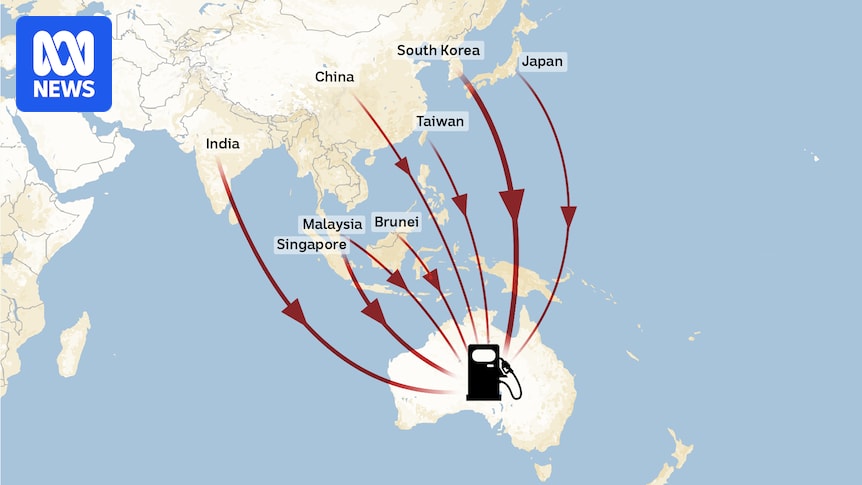
Australia has so far yet to directly feel the impact of oil supply shortages caused by the US-Israel war on Iran.
Fuel prices locally have increased with the global benchmarks for crude, but stockpiled reserves and lag in the supply chain mean that physical supply shortages still have not worked their way to our part of the world.
But that’s set to change in the coming weeks with the country’s fuel suppliers in Asia now being affected.
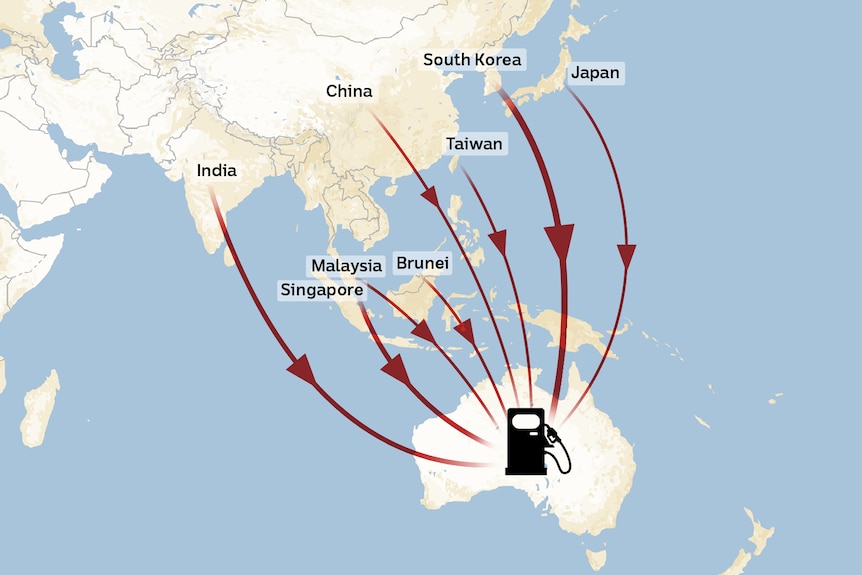
Almost all of Australia’s refined petroleum products such as petrol, diesel and jet fuel come from Asia. (ABC News: Cordelia Brown)
With only two domestic refineries still operating, Australia gets more than 80 per cent of its petrol, diesel and jet fuel from overseas.
Iran war live updates: For all the latest news on the war in the Middle East, read our blog.
Almost all of this is supplied by refineries in Asia, particularly South Korea, Singapore, Malaysia and China.
Asia’s refining countries in turn get on average about 60 to 70 per cent of their crude oil from the Middle East mostly via the now mostly impassable Strait of Hormuz.
MST Financial senior energy analyst Saul Kavonic said the region was “approaching crunch time” in the coming weeks and Australia’s position at the end of the fuel supply chain made it vulnerable.
“Now you can see what the problem is there: if you’re South Korea, you’re going to prioritise your own citizens first before you think about what you’ll do with the leftover refined product that you have.”

The Eagle Vellore was the last South Korea-bound tanker to make it through the Strait of Hormuz before it was effectively closed. (Supplied: AET Tankers)
Supply chain lag
Part of the reason for the delayed impact is that it takes a long time for oil to move around the world’s oceans.

The tanker Eagle Vellore has only just arrived after leaving Iraq on February 26. (ABC News: Cordelia Brown)
The last South Korea-bound oil tanker to make it through the Strait of Hormuz before it was effectively closed only just arrived yesterday.
The Eagle Vellore departed Iraq’s Al Basrah Port in the Persian Gulf on February 26 carrying about 2 million barrels of crude oil.
When the the vessel approached the strait on February 28 — the day the US and Israel launched their first strikes — it reportedly received warnings from the Islamic Revolutionary Guard Corps (IRGC) that the waterway was closed.
Instead of turning back, the captain decided to make a run for it.

The Eagle Vellore reportedly received a warning from the Islamic Revolutionary Guard Corps that the Strait of Hormuz was closed. (ABC News: Cordelia Brown)
Vessel tracking data shows the ship paused briefly before accelerating into the strait, braking for the sharp turn around the Musandam Peninsula and then speeding to safety into the Gulf of Oman.
When the Eagle Vellore began its journey, its cargo was worth around $US130 million ($185 million). It’s now worth more than $US220 million.
What’s happening in Asia
Refiners in South Korea and the rest of Asia have already begun scouring the world for alternative supplies.
However, as the old advertising slogan goes, “oils ain’t oils”.
Crude oils from different parts of the world have different characteristics that refineries are optimised for.
Oil from the Middle East is typically “heavy” or “medium” in density and thickness and “sour” (high in sulphur). While more complex to refine, operations in Asia have been calibrated to handle this specific grade.
The terminology comes from the 19th century when oil workers would taste and smell the oil to determine its quality.

Asia’s refineries are optimised for a particular grade of oil. (Reuters: Edgar Su)
Pauline Tang, a Singapore-based analyst at S&P Global Ratings, said Asia’s refiners typically retained around 30 to 45 days of inventory needed for refining activities but were now trying to source suitable alternative crude feedstocks.
Ms Tang said US, West African and Russian oils were viable options.
“However, sourcing alternative crudes will inevitably incur additional costs for refiners, given much higher logistics costs; it will also take longer shipping times, given the distance,” she said.
“As a result, even if Asian refiners were able to continue operating on a business-as-usual basis, their customers, including those in Australia, are likely to have to pay a lot more.
“If the Strait of Hormuz remains closed for a prolonged period, increasingly scarce and more expensive crude could prompt refiners to slow their rate of production, adding to the fuel shortage.
“We think refiners would be reluctant to shut down completely because of the significant shutdown and restart costs.
“That said, some Asian countries could curtail exports to protect their own markets.”
Iran war hits hard on the streets of Asia
The price of airline fuel — which has more than doubled — has been affected more than diesel while petroleum has been least affected.
Neil Crosby, a vice president of oil analytics at Sparta, said this was because kerosene — the feedstock for jet fuel — was more difficult to store.
“There’s hardly any strategic reserves and commercial reserves are also quite small,” he said.
“It’s also difficult from a technical perspective to blend it from other fuels.”
Singapore-based energy markets expert Vandana Hari said the blockade continuing would mean an “escalating crunch” as countries gradually exhausted their buffers and options.
“These include running down their existing commercial crude and refined product inventories, as well as strategic reserves if they exist, banning crude and product exports if they are exporters [some countries have already done it], looking for refined product imports and finally fuel supply being rationed and pumps running dry,” she said.
What Asian governments are doing
The responses from governments in Asia — who have reserves of fuel ranging from several weeks up to many months — have so far varied.
Some such as India have had success in negotiating with Iran to have their ships allowed through the Strait of Hormuz.
China — which normally supplies about a third of Australia’s jet fuel — Vietnam and Thailand have banned exports of refined products.
Cambodia has reportedly negotiated with Singapore and Malaysia to provide more fuel to make up for supply shortfalls.
Independent service stations hit hard by fuel crisis
Importantly South Korea, Australia’s single biggest source of refined petroleum products, this week imposed a cap on exports at 2025 levels.
Mr Crosby said that cap was “relatively optimistic”.
“I think that’s not the worst outcome,” he said.
“It can still change very quickly and also refiners are being asked to make sure they supply normal domestic levels to their domestic market.
“So if they end up cutting runs — operating at much lower rates — then the exports will probably fall below the export cap.
“So it’s still a bit in flux.”
Alternative sources of fuel
Mr Crosby highlighted that the liquid energy market was global and so Asian refineries having problems was only half the story.
He said analysts were seeing “some very unusual trade flows” made economically feasible by the “outrageous” prices in Asia.
What could happen to Australian fuel supplies after mid-April, according to experts
Reuters reported earlier this month that Exxon Mobil had booked the vessels Largo Eagle and Nord Ventura to bring a combined 600,000 barrels of mostly petroleum from the Gulf of Mexico to Australia via the Panama Canal.
It’s reportedly the first delivery of fuel from the US Gulf Coast to Australia since 2023.
“The problem is a large part of the market is expecting the US to enact an export ban because it suits [US President Donald] Trump politically and keeps US prices down,” Mr Crosby said.
“And that would be a very large problem [as the US is] a huge exporter of refined fuels.
“If that happens, it makes life even more difficult for large importing nations like Australia, unfortunately.”
What happens next?
It takes about 10 to 20 days for an oil tanker from an Asian refiner to reach Australia — depending on where it’s coming from and heading to.
The federal government says Australia’s fuel deliveries are assured until mid-April.
Beyond that, there is debate and uncertainty among experts about what the global oil supply shock will mean for Australia — whether we could suffer physical shortages or just much higher prices.
Energy Minister Chris Bowen today said that six fuel tankers out of about 81 ships expected from mid-April to mid-May had been cancelled or deferred.
“Some of those have already been replaced by the importers and refiners with other sources,” Mr Bowen told ABC Insiders.
Mr Kavonic said if the global situation did not get worse the main refiners should still have product to export beyond their domestic markets but “far less” than previously.
“So there will not be enough fuel to go around for all their usual customers, as there was prior to the war,” he said.
“So someone — or some nations — are going to have to go without.
“Prices are going to go up and that’s going to, in part, sort out who gets fuel and who doesn’t.
“And Australia as a country and the Australian government has the ability to pay more than, say, developing economies in South Asia.”
Expert analysis on the Middle East:
However, he said the less developed countries would still continue buying some amount of fuel for their critical services and the refiners in Asia would prioritise their own markets.
“That’s where we face a real risk of not being able to get fuel at any price because we do not have control over the supply chain,” he said.
“I think it’s not the case that Australia can simply say it’s just a matter of price and as long as we’re willing to pay, everything’s going to be alright mate.
“There are definitely scenarios where even with us willing to pay a premium price, we could still be left physically short.”
Loading…
Mr Crosby said Australia could likely backstop imports financially if necessary but the problem was so big there could be no guarantees there wouldn’t be pump shortages in Australia.
He pointed out that Europe was also a rich bloc of countries that needed to import diesel.
“They’re also likely to bid very hard for all the spare stuff that’s going around,” he said.
“And remember, the size of this problem is huge.
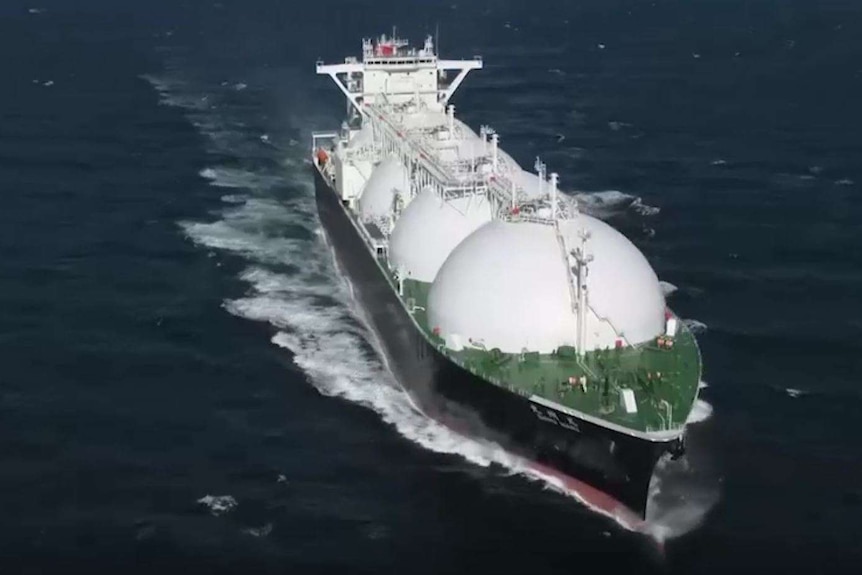
Australia could potentially use the country’s natural gas resources as leverage to secure fuel imports. (Supplied: GRACosway)
Should Australia use LNG as leverage?
Mr Kavonic said the Australian government should go through diplomatic channels to ensure Australia was a priority for the exports of refined fuels from our Asian trading partners.
“What they should be doing is reminding our trading partners that they rely on Australian LNG [liquid natural gas] for their energy security, and in turn we expect to be able to rely on them for our fuel energy security.”
He said Australia was in a strong position as a big LNG exporter to help protect our place in the priority list for imported fuel.
“While there’s a shortage of fuels, there’s also an even bigger shortage of LNG in the world right now because of the war,” he said.
A Department of Foreign Affairs and Trade spokesperson said the government was “engaging intensively and cooperatively with key energy trade partners”.
Loading…