
This is the first story in a series on “climate gentrification” in Black neighborhoods. Support for this series was provided by The Neal Peirce Foundation, a nonprofit organization dedicated to supporting journalism on ways to make cities and their larger regions work better for all people.
ATLANTA — By the time Atlanta hosts a World Cup semifinal at Mercedes‑Benz Stadium this summer, city officials will have spent years pouring billions into a new entertainment district and transit upgrades to impress the world. The question residents in nearby Black neighborhoods are asking is who, exactly, all that preparation is meant for.
On a cold January afternoon, Alfred Tucker, an 83‑year‑old lifelong Atlantan, stood at the edge of Rodney Cook Sr. Park and pointed back toward downtown, where the stadium looms over the Gulch like a steel crown.
Long before the World Cup banners and crane-topped luxury towers, the Gulch, a sunken rail yard, was a parking lot for Atlanta’s stadiums — and a massive bowl for stormwater. But as the city saw more “rain bombs” and flash flooding over Tucker’s lifetime, the water began to rush into Proctor Creek and straight through Black neighborhoods.
In English Avenue and Vine City, Cook Park was carved out of some of those repeatedly flooded blocks. Its sunken lawns and engineered wetlands can now store millions of gallons of stormwater and have reduced damage in nearby homes during recent storms. But to catch those floodwaters, the park was built on land where Black households once stood before being demolished and cleared.
By 2100, twice as many Americans are expected to be permanently forced from their homes by climate events than during the Great Migration, when 6 million Black folks left the South between the 1920s and 1970s. What is currently happening in the “Black Mecca” is a preview.
In the Black neighborhoods where water and sewage was once sent deliberately through Jim Crow policies, climate investments are now driving up land values and pushing longtime Black homeowners out. They are remaking Black neighborhoods not through protection, but through removal.
A Capital B analysis of ZIP‑code‑level data shows that in three historically Black ZIP codes, flood‑fix projects have produced a “triple burden”: a loss of Black residents, soaring living costs, and aggressive buyouts and use of eminent domain.
Since projects to address flooding have begun in these ZIP codes — which include English Avenue/Vine City, West Midtown/Westside, Proctor Creek, and the West End — each area has lost nearly 1 in 5 Black residents as home values and property taxes double and triple, while dozens of families have been bought out of their longtime homes.
As a result, residents like Tucker are advancing their own fixes and insisting the city match their ambition. They’ve launched the Stop Flooding Us coalition to force a comprehensive stormwater plan for the city, are pushing City Hall to tie every new tax break or development deal to real flood mitigation, and are fighting for community land trusts to keep people dry and in their homes.
“We’re not asking for miracles,” Tucker said. “We’re asking them to catch the water where it falls, not after it’s already washed away our living rooms.”
Tucker and his Stop Flooding Us colleagues are going door to door in Westside communities, collecting signatures, and recording flood testimonies to make it harder for officials to ignore what’s happening on their blocks.
The office of Atlanta Mayor Andre Dickens and the city’s Department of Watershed Management did not respond to multiple requests for comment.
 A car is submerged in the floodwaters in the Buckhead neighborhood of Atlanta in the aftermath of Hurricane Helene in September 2024. (Megan Varner/Getty Images)
Climate resilience meets Black removal
To keep people in their homes, experts said cities like Atlanta must make sure the ground beneath them can withstand the storm — roads, non‑residential buildings, and, most importantly, the systems that keep us alive: electric utilities, drinking water and wastewater infrastructure, and the food networks that stock our stores and pantries.
Compared to the rest of the U.S., Georgia has taken this new reality more seriously.
The most recent nationwide infrastructure report card by the American Society of Civil Engineers, which looks at preventative and responsive infrastructure improvements, had the Peach State tied for the nation’s highest grade.
The issue? That grade was a C+.
Across the South, rainfall has increased by nearly 40% since 1970. At the same time, Atlanta is building more new homes than virtually any other metro area. That means the growing number of violent downpours in Atlanta are being funneled into a stormwater system never designed for that much rain — or for this many new toilets and sinks uphill.
This spells trouble because a history of racism is linked with infrastructure, explained Darryl Haddock, an environmental scientist and former federal Environmental Protection Agency appointee.
“The way that natural resources were controlled in Atlanta was a way to set up segregation in the city,” Haddock said. “The water infrastructure went first to white business districts and surrounding white areas before going to where Black people traditionally lived in low‑lying, swampy areas.”
If the city and state attempt to improve their infrastructure without addressing the historic disparities, it threatens to reinforce inequities because some areas are better maintained than others, he added.

The Peoplestown neighborhood showed how this plays out on a single block.
The storm drains popped first in a 2012 flood. One by one along the Peoplestown block, the metal lids blew into the air “like champagne corks,” riding columns of pressure as floodwater surged up from the aging pipes beneath the street.
Cars stalled and filled, HVAC units drowned, and crawl spaces took on a sour, brown slurry that soaked insulation and family photo albums alike.
For the Black homeowners who had bought into this quiet, low‑slung slice of southeast Atlanta, it was confirmation. “Climate change is here,” Tanya Washington Hicks, who moved into the neighborhood in 2011, remembered thinking.
“They talk about it in the future tense, but it is here.”
This was what scientists call a 1-in-100 year flood event, meaning a flood of this magnitude has a 1% chance of happening in a given year based on historic averages. Atlanta has experienced at least five of these events since 2004.
When the city finally arrived with a solution for Washington Hicks and her neighbors in 2013, it came not as a fix for them, but a design rendering. On paper, the plan for Peoplestown was beautiful: a series of ponds stitched together by Japanese rock trails, a cascading waterfall, a lush stormwater park that would hold floodwaters while also doubling as an amenity for a “revitalizing” neighborhood. In the fine print, residents discovered the water would carry “a certain amount of raw sewage.”
But also something a lot worse for them. This Black block had to be sacrificed to keep Atlanta dry.The city would be taking their deeds by eminent domain, a process they’ve used repeatedly since the 1960s as a solution to stop flooding.
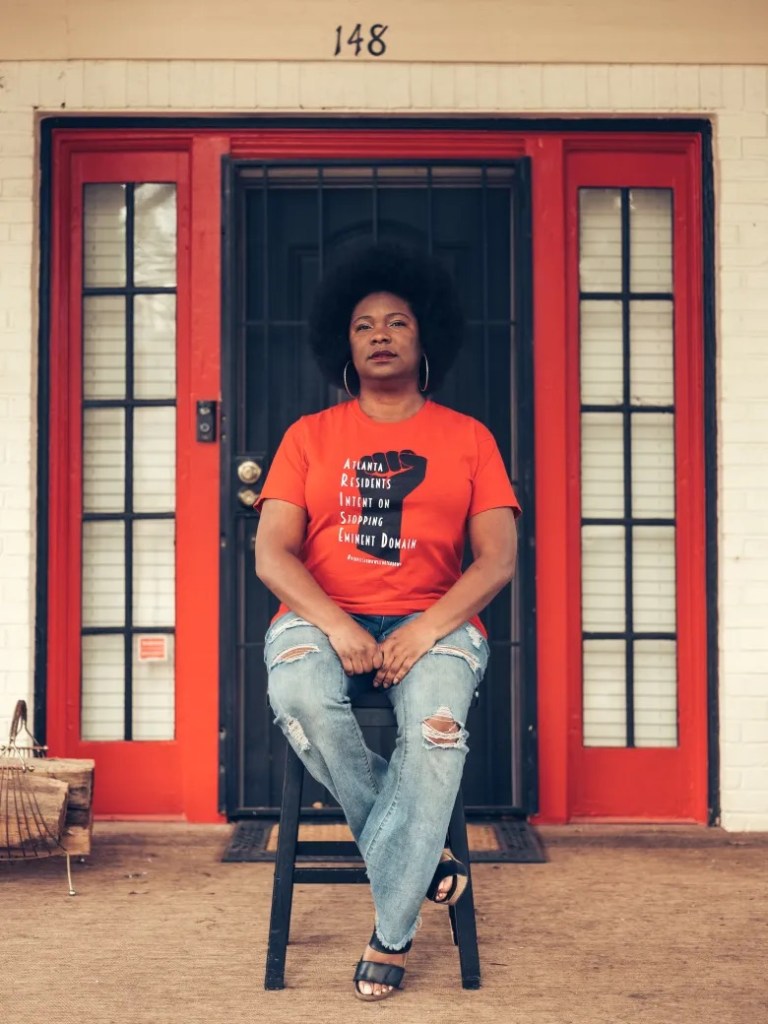 Tanya Washington Hicks sits in front of her Peoplestown home before it was demolished. (Aboubacar Kante)
“The neglect and the irresponsible development creates a problem that current residents have to deal with,” Washington Hicks said, but she also learned that it “creates a justification for displacing longtime residents for new residents.”
Years after the city seized Washington Hicks’ Peoplestown block in the name of flood protection, she keeps a splintered chunk of her former 103‑year‑old house in her new living room — a rough, heavy relic from the day neighbors held a block party and covered the walls in Sharpie memories before the excavators came.
“It had history. It was a place,” she said.
She made sure she was there when the claw bit into the siding. It felt wrong to let the city erase a century of Black homeownership without a witness. With each crunch of her home, she said, she heard “the ancestral echoes of Black folks being displaced in Atlanta,” a lineage that stretches from Jim Crow demolitions to the Olympic stadium construction to the stormwater “improvements” that finally took her street.
The cost of resisting, she believes, is visible in obituaries. “My neighbors, all three of the neighbors with whom I fought the longest, are dead,” she said as she sat at a table in a new coffee shop not too far from her old home. “I think it’s because of stress.”
For a decade, they lived in legal limbo — paying mortgages on homes the city had already retitled in its own name, barred from making repairs, and warned they could be evicted at any moment.
 Flooding seen at the construction of the new park in Peoplestown where Tanya Washington Hicks’ home once stood. (Adam Mahoney/Capital B)
For Haddock, Peoplestown is even more concerning given the context of the changing city. Atlanta has seen the nation’s fourth-most Black neighborhoods gentrified since 1980, and in 2021, the city’s Black population dropped below 50% for the first time in 50 years.
“I don’t really call those unintended consequences anymore,” Haddock said. “If we’re not doing it differently, at some point we have to admit we intend them to happen.”
Atlanta illustrates a textbook case of “climate gentrification”: Climate resilience investments meant to correct Jim Crow–era infrastructure inequities are instead redistributing climate safety to wealthier, non-Black newcomers while pushing longtime Black Atlantans into less protected, more flood-prone parts of the region, he said.
Along Proctor Creek across Atlanta, a patchwork of bioswales, retention ponds, and restored streambanks has been financed through environmental impact bonds and federal “urban waters” programs, marketed as a model for climate‑ready design. But as the creek corridor greened, investors snapped up homes and homeowners reported steep jumps in property taxes.
Nearby, the federal government is cleaning up lead‑contaminated blocks, but the soil cleanups and new trail plans are coming with rising redevelopment pressure that many Black residents read as the next phase of removal.
The city is not alone in this crisis. A national study of federal flood insurance and Federal Emergency Management Agency data found that, although flood‑adaptation projects save money overall, those savings drop off in communities that have more residents of color and more frequent heavy rain. In other words, as storms get worse, these programs work less well for the people who are most at risk.
“This is how you get community erasure,” said Na’Taki Osborne Jelks, an environmental scientist and assistant professor of environmental and health sciences at Spelman College.
 Na’Taki Osborne Jelks and Darryl Haddock are working to bring Black voices into environmental and community planning. (Adam Mahoney/Capital B)
A new Rice University study tracking 70,000 households after federal flood buyouts found that the racial makeup of a neighborhood shaped both buyout participation and outcomes. In majority-white areas, residents tended to hold out until flood risk became extreme, then moved to similarly white neighborhoods with higher property values and stronger protections. In Black neighborhoods, depressed home values — driven by racist policies and appraisals — meant buyouts rarely offered enough to relocate safely.
“The money isn’t following the risk; it’s following race and property values,” said Jim Elliott, a professor at Rice University and the lead author of the study. “In white neighborhoods, buyouts help people move into safer, higher‑value places. In Black and brown neighborhoods, people look at buyouts and say, ‘This is displacement — and we have nowhere to go.’”
That pattern plays out nationally, compounded by a fragmented federal system in which FEMA, the EPA, and the Army Corps of Engineers handle separate pieces of flood response with little coordination.
The result, residents and researchers say, is that Atlanta has imported the logic of managed retreat without the safeguards: Homes are replaced by infrastructure instead of protected by them, parks and vaults fill the footprint of demolished Black neighborhoods, and the people who spent decades living with sewage and stormwater are left to fight, largely on their own, to avoid becoming the next wave of climate migrants.
Atlanta has launched an Anti-Displacement Tax Relief Fund to help “legacy” homeowners remain in the city by covering property tax increases for up to 20 years, but it’s capped at $10 million for the entire city and only applicable for residents who have lived in the city since 2015, are at least 60 years old, earn no more than 60% of area median income, hold clear title, and recertify every year.
In a city where tens of thousands of Black homeowners live in rapidly appreciating, flood‑prone neighborhoods, that narrow program reaches only a fraction of those at risk.
Stadiums, the 2026 World Cup, and who gets saved
For Tucker and his neighbors, as hundreds of thousands of tourists flood into Atlanta this summer for the World Cup, the city will have answered a pressing question: not just whether the pitches stay dry, but which living rooms do. The stakes for them are measured in flooded basements and disappearing Black blocks, not ticket sales or TV audiences.
To keep the neighborhood below the stadium dry, Atlanta would need to hold back roughly 36 million gallons of stormwater at the Gulch itself. Cook Park catches about 14 million gallons. The park that displaced Black families now “helps a little, but it doesn’t solve the whole problem,” Tucker said.
As Atlanta rushed through a $1.9 billion tax incentive package to transform the Gulch into Centennial Yards — an 8-acre live–work–play district marketed around the 2026 World Cup — none of that money was earmarked to capture the stormwater that still barrels toward West Atlanta basements.
“Atlanta has proven it will build new housing, stadiums, and buildings, but that is happening in low‑lying communities without really addressing flooding or cumulative environmental impacts,” said Osborne Jelks, who is the director of the West Atlanta Watershed Alliance, a nonprofit group working to bring Black voices to environmental policy decision-making tables.


LEFT: A new apartment complex rises near a new park developed to combat soil contamination. RIGHT: In Vine City, neighborhood establishments are trying to hold on as the community changes around them. (Adam Mahoney/Capital B)
Tucker and his neighbors have decided to make themselves harder to ignore. Tucker co-chairs the Stop Flooding Us coalition, a loose but growing alliance of residents, church leaders, and environmental justice groups like Eco-Action and the West Atlanta Watershed Alliance. They started by chasing big crowds: petition clipboards outside Atlanta Falcons football games, music festivals, and World Cup-themed events, where they’ve gathered about 1,500 signatures calling on the mayor and City Council to adopt a real stormwater plan.
This spring, they’re shifting strategies, going block by block through the 38 neighborhoods strung along Proctor Creek, knocking on doors where flooded yards and moldy basements need no introduction.
 Leslie Jordan points to a white line where floodwater settled in the last big storm. (Courtesy of Leslie Jordan)
On his phone, Tucker pulled up a photo from Lincoln Homes, a neighborhood further down the creek: a telephone pole marked with a ghostly white line, shoulder-high, where floodwater settled in the last big storm. For him, the petition is only one tool. The coalition is also pushing for a comprehensive stormwater management plan that treats the Gulch as infrastructure, not just an entertainment backdrop: underground tanks, restored streams, and on-site green systems built into the very project that helped create the problem.
Residents have also begun talking about a different kind of climate infrastructure: Black-controlled land. In Pittsburgh, on the city’s southside, the Atlanta Land Trust and its partners bought up 53 homes after the foreclosure crisis, long before the Beltline, a green infrastructure project, led to a new business hub that sent prices skyrocketing. The land is held permanently by the trust, and homes are sold or rented to families at restricted, below-market prices, keeping them reachable even as surrounding houses now sell for half a million dollars.
Community leaders are now sketching out what it would mean to expand that model into a network tied explicitly to climate resilience. City and philanthropic dollars would help residents purchase land and homes in flood-prone neighborhoods before the next wave of “resilience” projects breaks. This would allow the community to maintain agreed upon affordability instead of letting the market decide who gets to live on high ground — or near the park that finally keeps their street from flooding. Public agencies would still build stormwater vaults, but only alongside binding commitments that the people who weathered decades of sewage backups and neglected drains are the ones who benefit when the water finally retreats.
Tucker knows that Atlanta often decides whose future is worth building for, from Buttermilk Bottom, a Black neighborhood razed in the 1960s, to the blocks now disappearing under Centennial Yards.
“If they were taking it seriously, they’d do something about it,” Tucker said. “We’ll show them they have to.”
 To Alfred Tucker, who has watched the city remake itself more than once, the message is clear: The entertainment hub and new hotels will “sit high and dry.” The water, as always, “will run downhill.” (Adam Mahoney/Capital B)
Read More: