The Europe cloud services market was valued at USD 219.10 million in 2025, is estimated to reach USD 253.31 million in 2026, and is projected to reach USD 808.55 million by 2034, growing at a CAGR of 15.61% during the forecast period from 2026 to 2034. The growth of the Europe cloud services market is driven by increasing enterprise digital transformation, rising adoption of scalable IT infrastructure, and growing demand for cost efficient cloud based solutions. The expansion of hybrid and multi cloud environments, surge in data driven decision making, and strong demand from BFSI and enterprise sectors are further accelerating market growth across the region. Additionally, advancements in cloud security, AI integration, and edge computing are supporting wider adoption among organizations of all sizes.
Key Market Trends
Rapid adoption of public cloud platforms driven by flexibility, scalability, and lower infrastructure costs among enterprises.
Growing dominance of software as a service solutions due to ease of deployment, subscription based models, and remote accessibility.
Increasing demand from BFSI sector supported by digital banking, fintech expansion, and secure data management requirements.
Rising integration of AI, machine learning, and big data analytics within cloud ecosystems to enhance operational efficiency.
Expansion of hybrid and multi cloud strategies among enterprises to optimize performance, security, and vendor diversification.
Segmental Insights
Based on deployment type, the public cloud segment was the largest and held a significant share of the Europe cloud services market in 2025. The dominance of this segment is attributed to its cost effectiveness, scalability, and ability to support dynamic workloads across industries.
Based on service, the software as a service segment accounted for the dominant share of the Europe cloud services market in 2025. The segment growth is driven by increasing demand for cloud based applications, collaboration tools, and enterprise software solutions.
Based on verticals, the BFSI segment held the major share of the Europe cloud services market in 2025. This dominance is driven by the growing need for secure, scalable, and compliant cloud solutions in banking, financial services, and insurance operations.
Regional Insights
The Europe cloud services market is witnessing strong growth across key economies due to rapid digitalization and increasing enterprise cloud adoption.
Germany was the largest contributor, accounting for 23.2% of the Europe cloud services market share in 2025, driven by strong industrial base, high adoption of cloud technologies, and increasing investments in digital infrastructure.
Competitive Landscape
The Europe cloud services market is highly competitive, with leading technology providers focusing on expanding their cloud portfolios, enhancing data security, and strengthening regional data center presence. Companies are investing in AI driven cloud solutions, strategic partnerships, and industry specific offerings to gain a competitive edge. Prominent players in the Europe cloud services market include Amazon Web Services AWS, Microsoft Azure, Google Cloud Platform, IBM Cloud, Oracle Cloud Infrastructure, SAP SE, OVHcloud, Deutsche Telekom Cloud, Alibaba Cloud, and Tencent Cloud.
Europe Cloud Services Market Size
The Europe cloud services market size was valued at USD 219.10 million in 2025 and is projected to reach USD 808.55 million by 2034 from USD 253.31 million in 2026, growing at a CAGR of 15.61%.

Cloud services represent the comprehensive ecosystem of on demand computing resources delivered over the internet encompassing infrastructure platforms software and managed services tailored to the unique regulatory and operational landscape of the European continent. This domain extends beyond mere data storage to include sophisticated artificial intelligence capabilities serverless computing architectures and integrated collaboration suites that empower organizations to innovate without heavy capital expenditure. The region distinguishes itself through a rigorous adherence to data sovereignty principles where the General Data Protection Regulation dictates strict protocols for information handling and cross border transfers. As per Eurostat, enterprises in the European Union are increasingly utilizing cloud computing, which indicates a shift away from traditional on-premise IT models toward agile digital environments. The market is characterized by a growing preference for hybrid and multi cloud strategies that allow businesses to balance performance with compliance requirements specific to member states. According to the European Commission, the digital decade targets aim for all key public services to be available online by 2030, which further accelerates the adoption of cloud-based solutions across government sectors. This evolving landscape functions as the critical backbone for the Digital Single Market, which is enabling seamless cross border trade and fostering a culture of technological resilience amidst global geopolitical uncertainties.
MARKET DRIVERS Surge in Artificial Intelligence and Machine Learning Adoption
The explosive integration of artificial intelligence and machine learning into core business processes is primarily driving the growth of the European cloud services market. Organizations across various sectors are increasingly reliant on cloud platforms to access the immense computational power and specialized hardware required to train complex algorithms and deploy generative AI models. According to the European Artificial Intelligence Alliance, many large European enterprises have initiated pilot projects or full-scale deployments of AI solutions hosted on cloud infrastructure. This demand is driven by the need to analyse vast datasets for predictive maintenance in manufacturing, personalized marketing in retail, and fraud detection in financial services. The cloud provides the elastic scalability necessary to handle the fluctuating processing loads associated with AI workloads which would be prohibitively expensive to maintain on premise. As per IDC, spending on cloud-based AI services in Western Europe is growing faster than traditional IT investments as companies race to gain competitive advantages through automation. Furthermore, the availability of pre-built AI models and APIs from major cloud providers lowers the barrier to entry, allowing even smaller firms to leverage advanced cognitive capabilities. This widespread democratization of intelligent technologies ensures sustained growth in cloud consumption as AI becomes integral to operational efficiency and innovation strategies throughout the region.
Mandatory Digitalization of Public Sector Services
Government mandated digital transformation initiatives across European nations is further boosting the European cloud services market expansion. National governments are increasingly legislating the migration of administrative systems to cloud environments to improve citizen services, enhance transparency, and reduce bureaucratic inefficiencies. As per the European eGovernment Benchmark report, a significant portion of key public services in the European Union are now fully available online, necessitating robust cloud backends to support these digital interfaces. The push for interoperable cross border services under the Digital Single Market strategy requires member states to adopt compatible cloud architectures that facilitate secure data exchange between different national administrations. Countries like Estonia and Denmark lead this charge by operating almost entirely cloud based government infrastructures, setting a precedent for others to follow. The European Commission has allocated billions of euros through recovery funds specifically earmarked for digital upgrades which often stipulate the use of scalable cloud solutions to ensure long term viability. This top-down approach creates a massive baseline demand for compliant and secure cloud services as public entities modernize legacy systems to meet stringent performance and accessibility standards. Consequently, the public sector has evolved from a laggard in technology adoption to a major consumer driving significant volume in the European cloud services landscape.
MARKET RESTRAINTS Persistent Concerns Over Data Sovereignty and Foreign Surveillance
Deep seated anxieties regarding data sovereignty and potential exposure to foreign surveillance laws significantly hinder the unrestricted growth of the Europe cloud services market. Many European organizations remain hesitant to migrate sensitive data to clouds operated by non-European hyperscalers due to fears that foreign legislation could compel disclosure of confidential information. According to the International Association of Privacy Professionals, many European data leaders cite fear of extraterritorial legal reach as a major obstacle to full cloud migration. The invalidation of previous data transfer frameworks like the Privacy Shield has created a complex legal environment where transferring data outside the European Economic Area requires intricate contractual safeguards that many find burdensome. This uncertainty forces companies to maintain fragmented IT landscapes where critical data stays on premise or in local private clouds while less sensitive workloads move to public platforms. The European Data Protection Board frequently issues guidance that tightens restrictions on international data flows, further complicating the operational models of global cloud providers. Such regulatory ambiguity increases compliance costs and delays deployment timelines as organizations must conduct thorough impact assessments before engaging with certain vendors. This climate of legal caution stifles the potential for a unified pan European cloud market and slows the pace at which businesses can fully leverage the benefits of global cloud ecosystems.
Acute Shortage of Advanced Cloud Security Expertise
A critical deficit in professionals possessing advanced skills in cloud security architecture and management is further hindering the European cloud services market growth. The rapid evolution of cloud technologies has outstripped the ability of educational institutions and corporate training programs to produce a workforce capable of securing complex multi cloud environments. As per the Centre for European Policy Studies, the European Union faces a significant gap in cybersecurity experts with a notable portion of this shortage specifically related to cloud native security practices. Organizations often delay or scale back their cloud migration plans because they lack internal teams confident enough to manage identity access controls, encryption strategies, and threat detection in distributed systems. This talent scarcity drives up the cost of hiring qualified personnel, making cloud adoption financially prohibitive for many small and medium sized enterprises. Reports from ENISA, the European Union Agency for Cybersecurity, highlight that misconfiguration due to human error remains the leading cause of cloud breaches, underscoring the risks associated with insufficient expertise. The competition for skilled talent is fierce, with global tech giants often poaching the limited pool of experts from local firms, exacerbating the problem. Without a substantial increase in trained professionals, the market cannot achieve its full potential as security concerns continue to deter risk averse organizations from embracing comprehensive cloud solutions.
MARKET OPPORTUNITIES Expansion of Industry Specific Vertical Cloud Solutions
The development and deployment of industry specific vertical cloud solutions offers a promising opportunity in the European cloud services market. Unlike generic horizontal platforms, these tailored offerings come pre-configured with compliance tools, data models, and workflows designed explicitly for industries such as healthcare, automotive, finance, and manufacturing. According to Forrester Research, many European enterprises in regulated industries express a strong preference for vertical clouds that address their unique operational and legal requirements. This trend allows providers to differentiate themselves by offering deeper functionality such as integrated electronic health records for hospitals or supply chain traceability modules for automotive manufacturers. As per the European Manufacturing Federation, sector specific clouds can accelerate digital transformation timelines by eliminating the need for extensive custom development. Providers who invest in building these niche ecosystems can command higher margins and foster stronger customer loyalty due to the high switching costs associated with specialized workflows. Furthermore, vertical clouds facilitate better adherence to industry specific regulations like the Medical Device Regulation in healthcare or Basel III in banking. As European industries seek to modernize while maintaining strict compliance, the demand for these specialized cloud environments is poised to surge, creating a lucrative avenue for market growth and innovation.
Integration of Quantum Computing Capabilities via Cloud
The nascent but rapidly advancing field of quantum computing offers a groundbreaking opportunity for the Europe cloud services market to lead global innovation in next generation computational power. European cloud providers are uniquely positioned to offer quantum computing as a service, allowing researchers and enterprises to experiment with quantum algorithms without owning expensive and fragile hardware. As per the European Quantum Flagship initiative, the European Union has committed significant funding to advance quantum technologies with cloud access being a central pillar of this strategy. This approach democratizes access to quantum resources, enabling pharmaceutical companies to simulate molecular interactions for drug discovery and financial institutions to optimize complex portfolios with unprecedented speed. According to the German Aerospace Center, early adopters utilizing cloud-based quantum simulators have reported reductions in research and development cycles compared to classical computing methods. By integrating quantum processors into their existing cloud portfolios, providers can attract high value research contracts and position themselves at the forefront of scientific advancement. The ability to offer hybrid classical quantum workflows will become a key differentiator as practical applications emerge in materials science, cryptography, and logistics. This frontier technology represents a massive growth vector that could redefine the competitive landscape and establish Europe as a global hub for quantum enabled cloud services.
MARKET CHALLENGES Escalating Complexity of Multi Cloud Management
The increasing adoption of multi cloud strategies introduces formidable management complexities, which is a significant challenge to the European cloud services market growth. As businesses engage multiple cloud providers to avoid vendor lock in and optimize services, they face significant difficulties in orchestrating workloads, monitoring performance, and enforcing consistent security policies across disparate environments. According to Flexera, many European enterprises now operate in multi cloud settings, yet a considerable portion struggle with unexpected cost overruns due to a lack of unified visibility and governance tools. The fragmentation of management interfaces and application programming interfaces requires specialized skills and sophisticated third-party tools that add layers of overhead and potential points of failure. This complexity often leads to shadow IT where departments provision resources independently, resulting in redundant services and security gaps that are difficult to detect. The European Telecommunications Standards Institute warns that without standardized interoperability protocols, the inefficiencies of multi cloud management could erode the anticipated benefits of cloud adoption. Organizations must invest heavily in cloud management platforms and training to navigate this intricate landscape, which can strain budgets and slow down innovation cycles. As the number of connected services grows, the challenge of maintaining a cohesive and secure multi cloud architecture becomes a critical hurdle that threatens to impede the smooth progression of the market.
Rising Energy Consumption and Environmental Sustainability Pressures
The surging energy demands of expanding cloud data centers is further challenging the expansion of the European cloud services market. Cloud services rely on massive arrays of servers that consume vast amounts of electricity for operation and cooling, raising concerns about their contribution to carbon emissions and resource depletion. According to the European Environment Agency, the information and communication technology sector already accounts for a notable portion of total electricity usage in the Union, with projections indicating further increases as data traffic continues to grow. Governments and consumers are increasingly demanding verifiable proof of sustainability, forcing providers to invest heavily in renewable energy sources and innovative cooling technologies which can be capital intensive. The European Green Deal sets ambitious targets for climate neutrality that require data center operators to drastically improve their power usage effectiveness and transition away from fossil fuels. Failure to meet these standards could result in stricter regulations, fines, and reputational damage that deter potential customers. Balancing the exponential growth in data processing needs with the imperative to minimize ecological impact requires continuous technological breakthroughs and strategic planning. This tension between expansion and sustainability remains a persistent challenge that providers must navigate carefully to maintain social license to operate and comply with evolving environmental mandates.
REPORT COVERAGE
REPORT METRIC
DETAILS
Market Size Available
2025 to 2034
Base Year
2025
Forecast Period
2026 to 2034
CAGR
15.61%
Segments Covered
By Deployment Type, Service, Organization Size, Verticals, and Region
Various Analyses Covered
Global, Regional, & Country Level Analysis; Segment-Level Analysis; DROC, PESTLE Analysis; Porter’s Five Forces Analysis; Competitive Landscape; Analyst Overview of Investment Opportunities
Regions Covered
UK, France, Spain, Germany, Italy, Russia, Sweden, Denmark, Switzerland, Netherlands, Turkey, and the Czech Republic
Market Leaders Profiled
Amazon Web Services AWS, Microsoft Azure, Google Cloud Platform, IBM Cloud, Oracle Cloud Infrastructure, SAP SE, OVHcloud, Deutsche Telekom Cloud, Alibaba Cloud, and Tencent Cloud
SEGMENTAL ANALYSIS By Deployment Type Insights
The public cloud segment dominated the market by holding the largest share of the European cloud services market in 2025 due to its inherent cost efficiency and unparalleled scalability for diverse workloads and the ability of organizations to access enterprise grade infrastructure without significant capital expenditure on physical hardware. Economic efficiency and operational agility remain the primary drivers for Public Cloud supremacy, as businesses shift from capital expenditure to operational expenditure, aligning IT costs directly with usage patterns. Organizations can scale resources up or down instantly to meet fluctuating demands without the burden of maintaining underutilized servers. According to the European Cloud Partnership, companies migrating to Public Cloud environments report reductions in total IT ownership costs within the first years of adoption. This financial model is particularly attractive for small and medium sized enterprises that lack the budget for extensive on-premise data centers. The agility provided by Public Cloud enables rapid deployment of new applications and services, which is crucial in a competitive digital landscape where speed to market determines success. As per IDC, many European startups launch their operations exclusively on Public Cloud platforms to leverage this flexibility. The pay per use pricing structure eliminates the risk of over provisioning and ensures that organizations only pay for the compute power and storage they actually consume. This economic advantage combined with the ability to innovate rapidly solidifies the Public Cloud as the foundational deployment model for the majority of European businesses seeking digital transformation.
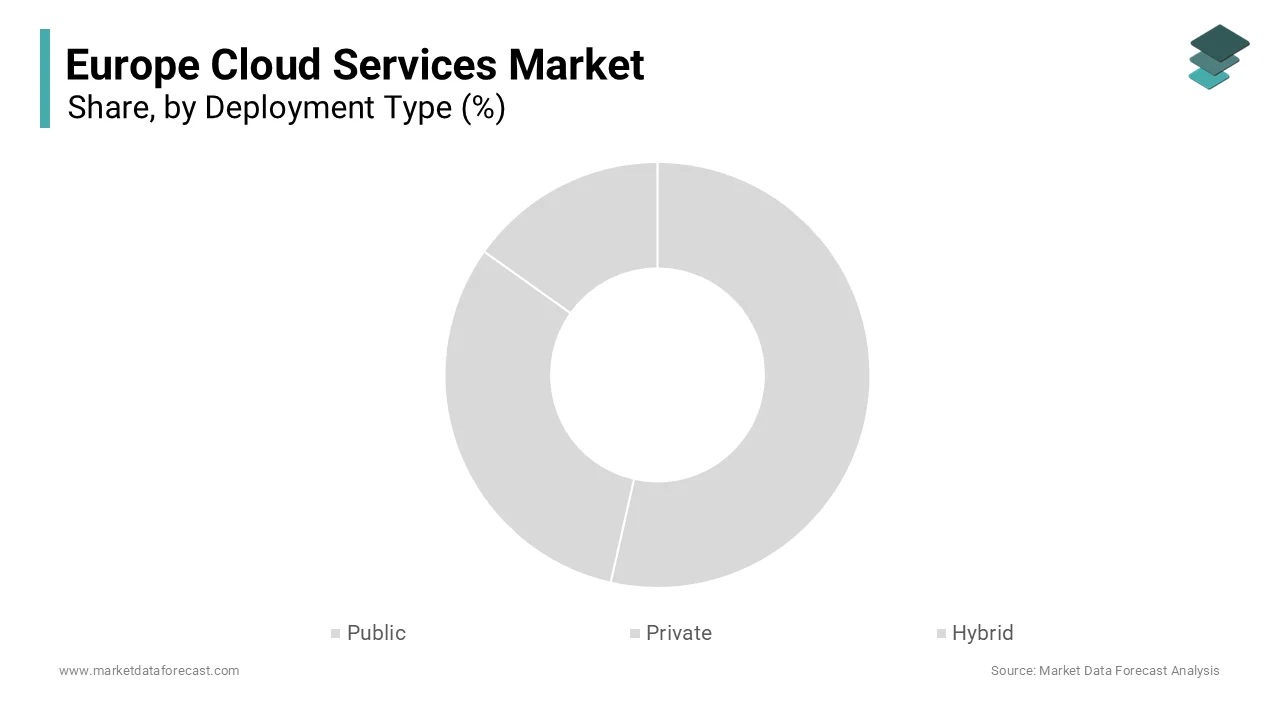
On the other hand, the hybrid cloud segment is a promising segment and is anticipated to witness a CAGR of 22.9% over the forecast period owing to the unique ability of Hybrid architectures to balance the security of private environments with the scalability of public clouds while addressing strict regulatory requirements. Regulatory compliance and data sovereignty mandates are the core reasons behind hybrid cloud adoption. According to IDC, many European enterprises are adopting Hybrid Cloud strategies specifically to comply with General Data Protection Regulation and sector specific mandates regarding data localization. The European Banking Authority has issued guidelines encouraging financial institutions to adopt Hybrid approaches to maintain control over critical data assets while benefiting from cloud innovation. According to the reports from the Cloud Security Alliance, sovereignty concerns are the top reason for CIOs to choose Hybrid deployments over purely public options. The ability to segregate workloads based on sensitivity and regulatory requirements makes Hybrid Cloud the only viable path for many organizations navigating the complex legal landscape of the European Union. As compliance requirements evolve and become more rigorous, the demand for Hybrid solutions that offer seamless governance across environments will continue to surge, driving its status as the highest growth segment.
By Service Insights
The software as a service segment led the market by capturing the dominant share of the European cloud services market in 2025 due to the widespread adoption of ready to use applications that eliminate the need for complex installation and maintenance. This segment encompasses critical business functions including Customer Relationship Management, Enterprise Resource Management, and Collaboration Suites. Rapid deployment and ease of use remain the primary drivers for SaaS dominance. According to the European Software Association, a significant portion of new software acquisitions in Europe are now SaaS based due to the reduced time to value compared to traditional on-premise software. This ease of deployment is particularly beneficial for small and medium sized enterprises that lack large IT teams to manage complex installations and updates. The subscription-based model also ensures that users always have access to the latest features and security patches without manual intervention, reducing the burden on internal resources. As per IDC, SaaS adoption has increased productivity among European knowledge workers by streamlining workflows and enhancing collaboration. The intuitive user interfaces and mobile accessibility of modern SaaS applications further drive their popularity as they support flexible work arrangements and remote collaboration. This combination of speed, simplicity, and continuous improvement makes SaaS the preferred choice for organizations seeking to digitize their operations quickly and effectively.
However, the platform as a service segment is emerging as the fastest growing category in the Europe cloud services market and is expected to expand at a CAGR of 25.1% over the forecast period owing to the increasing demand for streamlined development environments that accelerate software creation and deployment cycles. The surge in PaaS adoption is largely driven by the widespread implementation of DevOps methodologies and agile development practices across European enterprises. According to Forrester Research, companies utilizing PaaS solutions reduce their application development lifecycle significantly compared to traditional methods, enabling faster time to market for new products. Data from the European Software Industry Association indicates that many new software projects in Europe now leverage PaaS tools to enhance collaboration between development and operations teams. The ability to automate repetitive tasks reduces human error and operational overhead, allowing teams to release updates more frequently and reliably. As more organizations transition to cloud native architectures, the demand for these streamlined development platforms continues to accelerate, making PaaS the highest growth area in the service landscape.
By Verticals Insights
The BFSI segment dominated the market by holding the major share of the European cloud services market in 2025 due to the urgent need for digital transformation, enhanced customer experiences, and robust security frameworks to handle sensitive financial data. This sector relies heavily on cloud services for fraud detection, risk management, and personalized banking solutions. The primary driver for BFSI dominance is the aggressive pursuit of digital transformation initiatives aimed at delivering seamless and personalized customer experiences across multiple channels. According to the European Banking Federation, many major European banks have prioritized cloud migration as a strategic imperative to remain competitive against fintech disruptors. As per Accenture, banks utilizing cloud-based analytics have improved customer satisfaction scores through targeted product recommendations and proactive service interventions. The ability to rapidly deploy new digital services such as instant loans or robo-advisory platforms allows traditional banks to meet evolving consumer expectations for speed and convenience. Furthermore, the cloud enables the integration of open banking APIs which facilitate secure data sharing with third party providers to create innovative financial ecosystems. This relentless drive to modernize legacy systems and enhance customer engagement ensures that the BFSI sector remains the largest consumer of cloud services in Europe.
On the other side, the healthcare and life sciences segment is projected to be the fastest growing segment in the Europe cloud services market and is estimated to witness a CAGR of 26.2% over the forecast period owing to the explosion of medical data, the need for collaborative research, the push for personalized medicine and the massive volume of data generated by electronic health records, medical imaging, and genomic sequencing which requires scalable and secure cloud storage and processing capabilities. According to the European Molecular Biology Laboratory, genomic data produced in Europe is expanding at a rapid pace, which is requiring cloud infrastructures that can expand elastically to accommodate this growth. As per the European Commission, cloud based genomic initiatives have accelerated research timelines, enabling faster identification of genetic markers for diseases. The ability to store and share large medical images such as MRI and CT scans securely across different healthcare facilities improves diagnostic accuracy and facilitates remote consultations. As the cost of sequencing continues to drop and data volumes soar, the reliance on cloud services to manage and analyse this information will continue to surge, driving the exceptional growth of the healthcare vertical.
REGIONAL ANALYSIS Germany Cloud Services Market Analysis
Germany led the cloud services market in Europe in 2025 with 23.2% of the regional market share. The country serves as the economic powerhouse of the continent and its robust industrial base drives immense demand for cloud solutions to support manufacturing, automotive, and chemical sectors. The German market is characterized by a strong emphasis on data sovereignty and security which has led to the proliferation of sovereign cloud offerings tailored to local regulatory needs. According to the German Federal Office for Information Security, the number of certified cloud providers in Germany has increased in recent years to meet strict compliance requirements of local industries. The manufacturing sector known as Industry 4.0 relies heavily on cloud services to connect smart factories and enable real time data analytics for predictive maintenance and supply chain optimization. As per Bitkom, German companies have made significant investments in cloud technologies reflecting their commitment to digital leadership and operational excellence. The presence of major hyperscalers establishing dedicated regions in Frankfurt and Munich further solidifies the country’s dominant position by offering low latency and high availability services. Additionally, the government’s push for digital administration acts as a catalyst for public sector cloud adoption.
United Kingdom Cloud Services Market Analysis
The United Kingdom had the second largest share of the European cloud services market in 2025 Despite post Brexit complexities, the UK remains a global fintech hub and a center for digital innovation which fuels continuous demand for advanced cloud capabilities across financial, media, and professional services sectors. The UK market is defined by a highly mature cloud ecosystem with widespread adoption among both large enterprises and agile startups. According to Tech UK, the cloud computing sector contributes significantly to the British economy and supports a large number of jobs in technology and related fields. London’s status as a financial capital drives consumption of secure and compliant cloud services for trading platforms, banking operations, and insurance analytics. As per the Office for National Statistics, many large UK enterprises utilize cloud services for critical business functions indicating deep market penetration. The government’s Cloud First policy mandates that public sector bodies consider cloud solutions for all new IT projects, accelerating adoption in healthcare, education, and local government. Furthermore, the UK is a leader in artificial intelligence research which requires substantial cloud computing power for model training and deployment. The presence of numerous data centers in London, Cardiff, and Manchester ensures low latency and high availability for domestic and international clients.
France Cloud Services Market Analysis
France is predicted to account for a promising share of the European cloud services market over the forecast period owing to the strong government intervention aimed at fostering digital sovereignty and reducing dependence on non-European technology providers through national strategic initiatives. The status of the cloud sector in France is heavily influenced by the France 2030 investment plan which allocates significant funds to develop independent cloud capabilities and support local innovation ecosystems. According to the French Ministry of Economy and Finance, the government has partnered with major tech firms to build trusted cloud infrastructures that guarantee data residency within national borders. This focus on sovereignty creates demand for hybrid and sovereign cloud solutions that balance innovation with regulatory compliance and national security. As per Syntec Numérique, French enterprises are increasingly adopting cloud services to modernize their IT landscapes and improve competitiveness in global markets. Paris has emerged as a key data center hub in Southern Europe attracting investments from global providers who want to serve the Francophone market and surrounding regions.
Netherlands Cloud Services Market Analysis
The Netherlands is expected to witness a healthy CAGR in the European cloud services market over the forecast period. The country serves as the primary digital gateway to Europe due to its strategic location, advanced network infrastructure, and favorable business environment which attracts multinational corporations and cloud providers alike. The market status in the Netherlands is defined by its role as a major interconnection hub where a significant portion of European internet traffic is exchanged facilitating efficient cloud connectivity for the entire region. According to the Dutch Internet Exchange, data traffic volumes in the country have reached record highs supporting the dense concentration of data centers in Amsterdam and surrounding areas. As per the Holland Data Center Association, the country hosts facilities for all major global cloud providers ensuring redundancy and low latency access for customers across the continent. The Dutch government promotes a progressive digital agenda that encourages cloud adoption among startups and multinational corporations through supportive policies and incentives. Furthermore, the nation’s commitment to sustainability has led to the development of green data centers powered by renewable energy sources aligning with the environmental goals of many European enterprises.
Sweden Cloud Services Market Analysis
Sweden is estimated to grow at a notable CAGR in the European cloud services market over the forecast period. The Swedish market is renowned for its advanced digital maturity, high internet penetration, and leadership in sustainable cloud computing practices which attract environmentally conscious organizations. The status of the cloud sector in Sweden is characterized by early and widespread adoption across all sectors driven by a tech savvy population, supportive government policies, and a strong tradition of innovation. According to Statistics Sweden, a large majority of the population uses the internet regularly creating fertile ground for cloud-based consumer and enterprise services. As per the Swedish Post and Telecom Authority, Sweden leads Europe in fiber optic coverage which provides the high-speed connectivity necessary for effective cloud utilization and low latency applications. Stockholm has become a prominent hub for cloud innovation particularly in sectors that require high performance computing and real time data processing. The Swedish government’s ambitious climate goals have spurred the development of carbon neutral data centers that utilize excess heat for district heating systems setting a benchmark for sustainability in the industry.
COMPETITIVE LANDSCAPE
The competition in the Europe cloud services market is intensely fierce characterized by a dynamic struggle between global hyperscalers and emerging regional providers vying for dominance amidst strict regulatory scrutiny and evolving customer demands. Global giants leverage their vast resource pools and extensive service catalogs to capture large enterprise contracts while local players compete on agility specialized compliance knowledge and personalized support services. The battleground has shifted from mere price competition to value added services including artificial intelligence integration sustainability credentials and sovereign data handling capabilities that address specific European concerns. Regulatory frameworks like the General Data Protection Regulation act as both a barrier and a catalyst forcing all participants to innovate rapidly to meet localization demands and maintain trust. New entrants specializing in niche verticals or green computing are challenging established norms by offering tailored solutions that resonate with specific European cultural and legal expectations. The rise of multi cloud strategies among customers further intensifies rivalry as providers must ensure seamless interoperability to prevent churn and maintain relevance. Strategic acquisitions and partnerships have become commonplace as companies seek to fill capability gaps quickly and expand their geographical reach without the delay of organic growth. This complex ecosystem ensures that no single entity can rest on its laurels as technological advancements and shifting political tides constantly reshape the competitive hierarchy and define future success.
KEY MARKET PLAYERS
Some of the notable key players in the Europe cloud services market are
Amazon Web Services AWS Microsoft Azure Google Cloud Platform IBM Cloud Oracle Cloud Infrastructure SAP SE OVHcloud Deutsche Telekom Cloud Alibaba Cloud Tencent Cloud Top Players in the Market Amazon Web Services maintains a commanding presence across Europe by operating extensive infrastructure regions that cater to diverse regulatory and latency requirements. The company contributes significantly to the global market by pioneering serverless computing and advanced machine learning tools that set industry standards. Recent actions include the launch of new data center zones in Spain and Italy to enhance local service delivery and reduce carbon footprints through renewable energy initiatives. Amazon Web Services actively partners with European automotive and manufacturing giants to drive Industry 4.0 transformations using its robust IoT and analytics platforms. These strategic expansions and deep industry integrations reinforce its position as a critical enabler of digital innovation while ensuring strict adherence to European data sovereignty laws without compromising on performance or scalability for its vast customer base. Microsoft Azure leverages its deep integration with enterprise software to drive widespread adoption among European corporations and public sector entities seeking seamless hybrid cloud solutions. Globally the company leads in providing sovereign cloud capabilities that address specific national security and data privacy concerns within the European Union. Recent efforts involve establishing new cloud regions in Poland and Greece to support local digital economies and collaborating with governments to modernize public administration systems securely. Microsoft actively invests in artificial intelligence tailored for European languages and business practices while committing to carbon negative operations by 2030. These initiatives strengthen its market position by offering unique compliance features and hybrid architectures that allow organizations to modernize at their own pace while maintaining full control over sensitive workloads and meeting strict regulatory mandates. Google Cloud Platform distinguishes itself in Europe through superior capabilities in data analytics artificial intelligence and sustainable computing practices that appeal to innovation driven enterprises. The company contributes globally by advancing open-source technologies and multi cloud strategies that prevent vendor lock in scenarios for customers. Recent expansions include opening new cloud regions in Finland and the Netherlands to serve diverse needs with low latency and high efficiency. Google Cloud partners extensively with European telecommunications providers to integrate edge computing for fifth generation networks and supports research institutions with massive computational resources for scientific breakthroughs. Its commitment to operating carbon free data centers aligns perfectly with European environmental goals. By offering advanced tools for data visualization and machine learning Google Cloud empowers organizations to derive actionable insights driving innovation in sectors ranging from healthcare to retail while reinforcing its reputation as a leader in responsible and cutting-edge cloud technology. Top Strategies Used by the Key Market Participants
Key players in the Europe cloud services market primarily employ strategies centred on localized infrastructure expansion and strategic partnerships to navigate complex regulatory landscapes effectively. Companies are heavily investing in building new data centers within specific European nations to ensure data sovereignty and comply with General Data Protection Regulation mandates regarding data residency. Another prevalent strategy involves developing sovereign cloud offerings that guarantee data remains within national borders to attract government and financial sector clients who prioritize security. Major providers are also forming alliances with local telecommunications firms to enhance edge computing capabilities and reduce latency for real time applications across the continent. Sustainability initiatives serve as a critical differentiator as vendors commit to powering operations entirely with renewable energy to meet European Green Deal objectives and appeal to eco conscious enterprises. Furthermore, organizations are focusing on industry specific cloud solutions tailored for manufacturing finance and healthcare to address unique sectoral requirements and deliver greater value. Acquisitions of specialized security and analytics firms allow these giants to broaden their service portfolios and offer integrated ecosystems that retain customer loyalty and drive long term growth effectively.
MARKET SEGMENTATION
This research report on the European cloud services market has been segmented and sub-segmented based on categories.
By Deployment Type
By Service
Infrastructure as a Service (IaaS) Primary Storage Disaster Recovery and Backup Archiving Compute Platform as a Service (PaaS) Application Development and Platforms Application Testing and Quality Analytics and Reporting Integration and Orchestration Data Management Software as a Service (SaaS) Customer Relationship Management (CRM) Enterprise Resource Management (ERM) Human Capital Management (HCM) Content Management Collaboration and Productive Suites Supply Chain Management (SCM) Others
By Organization Size
Small and Medium-sized Enterprises (SMEs) Large Enterprises
By Verticals
BFSI Telecommunications IT and ITeS Government and Public Sector Retail and Consumer Goods Manufacturing Energy and Utilities Media and Entertainment Healthcare and Life Sciences Others (Education, Travel and Hospitality, and Transportation and Logistics)
By Country
UK France Spain Germany Italy Russia Sweden Denmark Switzerland Netherlands Turkey Czech Republic Rest of Europe