
The fifteen points of the US plan for Iran
JD Vance, potential chief negotiator in the Islamabad talks
The internal power struggle within the Iranian regime and the role of Ghalibaf
Lebanon expels Iran’s ambassador and the Lebanese stand up to Hezbollah
Deployment of the 82nd Airborne Division and the scenario for the capture of Kharg Island
The UAE denounces Iranian “international economic terrorism”
Brief Introduction
The events of 25 March 2026 constitute, possibly, one of the most intense and revealing days since the start of Operation Epic Fury on 28 February. The convergence of a fifteen-point US peace proposal conveyed to the Iranian jihadist oligarchy via Pakistan, the diplomatic mobilisation of Vice-President JD Vance as a potential lead negotiator in Islamabad, the deployment of the 82nd Airborne Division to the Middle East with Kharg Island as a possible target, the expulsion of the Iranian ambassador to Lebanon by a Lebanese government that has had enough of Tehran’s tutelage, the internal power struggle within a leaderless Iranian regime, and the strong warning from the United Arab Emirates (UAE) against Iranian “international economic terrorism” paint a picture of extreme complexity with potentially transformative consequences for the regional and global order.
The war is entering its fourth week with no immediate ceasefire in sight, but with mixed diplomatic signals which — for the first time since the start of hostilities — suggest that Tehran’s jihadist oligarchy is beginning to realise that the cost of all-out resistance could simply prove unsustainable.
The fifteen points of the US plan for Iran
Facts
The United States has conveyed to the Iranian jihadist oligarchy — via Pakistani mediation and, in particular, through Field Marshal Asim Munir, Chief of the Pakistani Army — a fifteen-point plan aimed at ending the war in the Middle East. The existence of the plan was confirmed by Bloomberg, The New York Times, Reuters, Axios, The Jerusalem Post and France 24, among others. President Trump stated in the Oval Office that the United States “is in negotiations right now” with Iran and that Tehran “desperately wants a deal”. Iran, for its part, denies that direct negotiations are taking place, although Iranian Foreign Minister Abbas Araqchi secretly informed US Special Envoy Steve Witkoff that the new Supreme Leader, Moytabá Jamenei—son of the late Ayatollah Ali Jamenei, who was killed in the opening attack of Operation Epic Fury—had given his consent to negotiate, as revealed by the Israeli newspaper Yedioth Ahronoth and reported by Al Arabiya.
The plan includes, among its main points: the complete dismantling of Iran’s nuclear programme; the closure of the Natanz, Fordow and Isfahan facilities; the end of all uranium enrichment on Iranian soil; the handover of all enriched uranium reserves to the International Atomic Energy Agency (IAEA); full, immediate and verifiable access for the IAEA to all facilities; the severe curtailment or abolition of the ballistic missile programme; a total cessation of support for all satellite terrorist organisations —Hezbollah, Hamas, the Houthis, pro-Iranian terrorist organisations in Iraq and Syria—; the reopening of the Strait of Hormuz as a zone of free maritime navigation; and, in return, a gradual easing of sanctions conditional upon verifiable and sustained compliance with all the above points.
It is mind-boggling —if I may use the expression— that certain international media outlets and some Spanish analysts have gone so far as to deny the existence of this plan and have even compared Trump to ‘a naughty child caught in a lie’. The fifteen points are there, confirmed by multiple highly reliable sources. That the proposal is maximalist and that Tehran may reject it outright is one thing; that it does not exist is a claim that lacks any foundation and reveals more about the mediocrity of the person making it than about diplomatic reality.
Implications
The proposal constitutes a deliberately ambitious starting position — a full-fledged negotiating opening, not a final ultimatum — which seeks to establish the most demanding framework possible before the inevitable concessions are made. Washington knows it will not secure all fifteen points in full, but aims to set the bar high enough so that, even after concessions, the final outcome represents a qualitative shift in the regional balance of power. Israel, which has been briefed on the plan, remains understandably sceptical about Tehran’s actual willingness to accept such severe conditions. Prime Minister Netanyahu has expressed concern that Trump might strike a deal that falls far short of Israeli objectives.
Outlook and scenarios
The most likely scenario in the short term is a phase of indirect negotiations — with Pakistan, Turkey and Egypt acting as intermediaries — which could lead to a face-to-face meeting in Islamabad as early as this week. However, both US and Israeli officials are planning for the war to continue for at least another two or three weeks, regardless of whether talks take place. The combination of sustained military pressure and diplomatic overtures follows the classic doctrine of ‘negotiating under fire’: maintaining pressure to maximise one’s negotiating position. If Tehran rejects the plan, Washington will have the political cover to escalate; if it accepts it partially, an unprecedented window for negotiations will open since the 1979 Islamic Revolution.

Donald Trump, President of the United States, sets out a 15-point plan to end the war in Iran – PHOTO/REUTERS/EVAN VUCCI
JD Vance, potential chief negotiator in the Islamabad talks
Facts
According to The Guardian, Axios, The Daily Beast, TRT World and multiple Pakistani and Israeli sources, US Vice-President JD Vance has been proposed as the chief negotiator for the US side in the potential Islamabad talks. Iran has categorically refused to sit down with Steve Witkoff and Jared Kushner — the envoys who led the nuclear negotiations prior to the war — whom it holds responsible for deceiving Tehran whilst the attacks of 28 February were being prepared. The Vance option addresses the need to raise the level of representation and to offer Iran a counterpart who is not tainted by the previous breach of trust.
Pakistani Prime Minister Shehbaz Sharif has confirmed that Pakistan “is ready and honoured to host meaningful and conclusive talks”. Field Marshal Asim Munir spoke directly with Trump on Sunday. The two possible meeting formats under consideration are: either Araqchi with Witkoff and Kushner, or Vance with the Speaker of the Iranian Parliament, Mohammad Bagher Ghalibaf. It is this second option, which carries greater political and symbolic weight, that is the focus of expectations.
Implications
The choice of Vance is hugely significant. Throughout his political career, the vice-president has maintained a sceptical stance regarding US military intervention in the Middle East and is known as an advocate of resolving this crisis as soon as possible. The fact that it is Vance — and not the negotiating hawks who preceded the conflict — who is sitting down with the Iranians sends a clear signal: Washington is seeking a way out, not an indefinite escalation. For Iran, Vance’s presence offers an implicit guarantee that the US delegation has real authority to reach an agreement, not merely to explore positions.
Outlook and scenarios
The main stumbling block remains Iranian mistrust, which is deep-seated and understandable following the outbreak of hostilities during ongoing nuclear negotiations. Ghalibaf, for his part, has publicly denied that any contacts exist—a stance that can be interpreted both as a genuine rejection and as a tactical cover-up vis-à-vis his internal rivals. Pakistan is gaining an international profile it has not enjoyed since facilitating Nixon’s secret opening to China in 1971. If the talks materialise, Islamabad will establish itself as a key mediator in the new diplomatic architecture of the Middle East.

JD Vance at the Palm Beach County Convention Centre – REUTERS/ BRIAN SNYDER
The internal power struggle within the Iranian regime and the role of Ghalibaf
Facts
The internal situation of the Iranian jihadist oligarchy is extremely complex. Following the elimination of Ayatollah Ali Khamenei and Ali Larijani — considered the de facto civilian leader following the death of the Supreme Leader — the regime finds itself in a savage power struggle between rival factions. According to an exhaustive analysis by Critical Threats (Institute for the Study of War, linked to the American Enterprise Institute), the inner circle of the new Supreme Leader, Mojtaba Khamenei, is dominated by veteran commanders of the Islamic Revolutionary Guard Corps (Pasdaran/IRGC): the former IRGC intelligence chief Hosein Taeb, Brigadier General Ahmad Vahidi (de facto commander of the IRGC), former commander-in-chief Mohammad Ali Jafari, and Ghalibaf himself.
Mohammad Bagher Ghalibaf is a prime example of the ‘decapitation paradox’ we have been analysing in these reports. He is a veteran of the IRGC — having served as commander of the Pasdaran Air Force, chief of police and mayor of Tehran for twelve years —, cosmically corrupt according to investigations pointing to the embezzlement of millions to a foundation run by his wife, a four-time failed presidential candidate and, yet, a born survivor of all the regime’s internal purges. Analyst Michael Rubin has described him accurately: “Many Iranians despise Ghalibaf; diplomats see him as a pragmatist. Those diplomats confuse pragmatism with opportunism. Ghalibaf is a survivor. He sees in Trump someone who can help him achieve what the late Khamenei always denied him: the presidency or an equivalent leadership role”.
The semi-official Iranian news agency Tasnim, close to the Pasdaran, described reports of Ghalibaf’s contacts with Washington as a “political bombshell” intended to create internal divisions: “Ghalibaf’s name was deliberately introduced to present a contradictory and disunited image of Iran and provoke conflicts between political forces.”
Implications
Iran’s internal struggle has a dimension that Western observers often underestimate. It is not a debate between “reformists” and “conservatives” —that distinction has always been largely fictitious within a regime in which all relevant actors share the same jihadist ideological framework—but rather a brutal struggle between factions of the military-security apparatus for control of the levers of power and, in particular, the immense economic resources managed by the Pasdaran. Outright corruption is the glue that binds these factions together and, at the same time, pits them against one another.
Outlook and scenarios
Ghalibaf’s actual ability to negotiate across the board with all factions of the regime is doubtful. He has solid military credentials, close ties to Mojtaba Khamenei and a proven ability to survive politically. But he lacks the religious authority of the Supreme Leader and faces mistrust from hardline sectors of the IRGC who view any negotiation with Washington as treason. The most likely scenario is that Ghalibaf will attempt to use the negotiations to strengthen his internal position — presenting himself as the man who saved the regime — without actually committing to the substantial concessions demanded by Washington.
Iranian Majles Speaker Mohammad-Baqer Qalibaf: The Strait of Hormuz Cannot Return to Its Pre-War Status; Iran Will Not Surrender to U.S. and the Zionist Regime pic.twitter.com/vUgGWDj9ou
— MEMRI (@MEMRIReports) March 18, 2026
Lebanon expels Iran’s ambassador and the Lebanese stand up to Hezbollah
Facts
The Lebanese government — led by Sunni Prime Minister Nawaf Salam and backed by the President of the Republic, the Maronite Christian Joseph Aoun, former head of the Lebanese Army and the leading advocate of Hezbollah’s total disarmament — has declared Iran’s designated ambassador to Beirut, Mohammad Reza Shibani, persona non grata, and has given him until Sunday 29 March to leave Lebanese territory. The Lebanese Ministry of Foreign Affairs, headed by Minister Youssef Raggi, has also withdrawn the ambassador’s accreditation and recalled the Lebanese ambassador to Tehran for consultations. The decision comes after weeks of escalation in which Hezbollah — acting as an instrument of the Iranian jihadist oligarchy — dragged Lebanon into war by launching missiles and drones against Israel on 2 March, in retaliation for the elimination of Khamenei, violating the November 2024 ceasefire and defying the explicit orders of the Lebanese government.
Hezbollah condemned the expulsion as “reckless and reprehensible”, whilst the IRGC threatened further attacks. Israeli Foreign Minister Gideon Saar described the decision as “a justified and necessary step against the state responsible for violating Lebanon’s sovereignty and dragging it into war”. A January 2026 poll by the Council for a Secure America revealed that 73% of Lebanese support President Aoun’s efforts to disarm Hezbollah, compared with just 9% who oppose them.
And here comes what exposes — once again — the European and Spanish armchair analysts who rushed to predict that the Israeli bombings would provoke a wave of popular solidarity with Hezbollah among the Lebanese. The day after such “sagacious” observations, the Lebanese government expelled the Iranian ambassador. The Christian and Sunni neighbourhoods of Beirut and southern Lebanon are rounding up and expelling Hezbollah members attempting to hide amongst the civilian population to avoid being eliminated by Israel or to provoke civilian casualties that would fuel popular outrage. The communities of Marjayoun and Alma al-Shaab are refusing to evacuate precisely to prevent Hezbollah infiltration. A certain ‘geopolitical expert’ — as his television credits state — went so far as to claim that the Shia possess ‘the conviction of martyrdom’. It does not seem that these cowards hiding amongst Christians and Sunnis are exactly ‘Captain Thunder’.
Implications
The expulsion of the Iranian ambassador represents the most significant diplomatic rift between Lebanon and Tehran since the founding of Hezbollah in 1982. Combined with the government’s ban on Hezbollah’s military activities (2 March), the arrest warrant against IRGC operatives in Lebanon (5 March), and the massive popular support for the disarmament of the terrorist group, this constitutes a structural transformation of Lebanese politics that directly contradicts the narrative of those who portrayed Hezbollah as an actor with deep and unyielding social roots.
Outlook and scenarios
Israel has announced, through Defence Minister Israel Katz, its intention to occupy southern Lebanon up to the Litani River to create a permanent security zone. France has urged Israel to refrain from ground operations, with remarkable hypocrisy: Paris did not lift a finger for years to enforce UN Security Council Resolution 1701 or to prevent Hezbollah from turning southern Lebanon into an arsenal. President Aoun has proposed direct talks with Israel — an offer that Washington has welcomed. If the current momentum takes hold, Lebanon could see its first real opportunity to break free from Iranian tutelage since the 1989 Taif Accords.
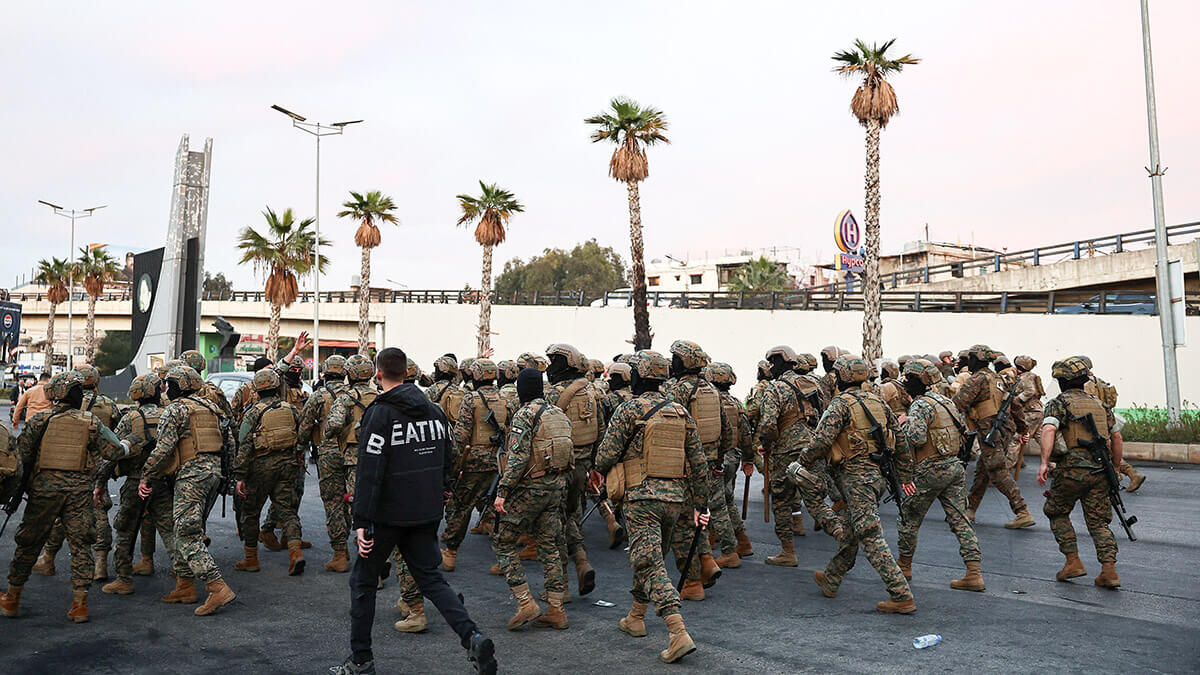
Members of the Lebanese Army walk past as Hezbollah supporters attend a protest organised by the group – REUTERS/EMILIE MADI
Deployment of the 82nd Airborne Division and the scenario for the capture of Kharg Island
Facts
The Pentagon has ordered the deployment of approximately 3,000 paratroopers from the 82nd Airborne Division — based at Fort Bragg, North Carolina — to the Middle East, as confirmed by The Washington Post, The Wall Street Journal, Bloomberg, Axios and Stars and Stripes. Major General Brandon Tegtmeier and his command staff have already received orders to deploy to establish a forward command post to enable the immediate execution of combat operations if ordered. This contingent joins the more than 50,000 US troops already deployed in the region as part of Operation Epic Fury, and joins the expeditionary force comprising two Marine Expeditionary Units (MEUs)—approximately 5,000 marines—which are already sailing towards the Persian Gulf.
According to The New York Times and Axios, one of the possible targets for these forces is the capture of Kharg Island, a small islet barely eight kilometres long situated twenty-five kilometres off the Iranian coast, which houses the terminals through which 90% of the regime’s oil exports pass. Trump has described Kharg as Iran’s “crown jewel”. Retired Admiral James Stavridis, former Supreme Allied Commander Europe (SACEUR), has analysed the operational options in Bloomberg: the Marines would carry out the initial amphibious-air assault using helicopters and MV-22 Osprey tiltrotor aircraft; Marine Corps combat engineers would repair the runway—damaged by previous bombing; and the 82nd Airborne Division would reinforce the position once the beachhead had been secured.
Implications
The capture of Jarg Island would be the riskiest and most strategically significant operation of the entire Operation Epic Fury. From a military perspective, the island’s proximity to the Iranian coast exposes it to a massive counterattack involving missiles, drones and boats laden with explosives. From an economic perspective, the occupation of the central hub of Iranian oil exports would have an immediate and devastating effect on the regime’s revenues, but would also trigger an instant rise in global crude oil prices—with direct consequences for American and European consumers. Senator Lindsey Graham has expressed support for the operation; Gulf allies, who have restricted the use of their airbases for strikes against Iran for fear of retaliation, view the scenario with understandable unease.
Outlook and scenarios
The deployment of the 82nd Airborne Division does not necessarily mean that the operation on Kharg is imminent; its main function is to provide an immediate response capability that gives Washington additional leverage in the negotiations. If the talks in Islamabad fail, the threat of occupying the island becomes a card to play in a controlled escalation. If they proceed, the deployment can be scaled back as a demonstration of deterrent force. In any case, the decision to send ground troops to a theatre of operations against Iran marks a turning point in a conflict that the Trump administration has sought to keep confined to the air and sea.

Members of the US 82nd Airborne Division deployed on the ground – REUTERS/Leonhard Foeger
The UAE denounces Iranian “international economic terrorism”
Facts
Sultan Ahmed Al Jaber, CEO of the Abu Dhabi National Oil Company (ADNOC) and UAE Minister of Industry and Advanced Technology, delivered a forceful speech at S&P Global’s CERAWeek conference in Houston: “Let me be absolutely clear: weaponising the Strait of Hormuz is not an act of aggression against a single nation. It is economic terrorism against all nations, and no country should be allowed to hold Hormuz hostage, either now or ever.” The statement comes against a backdrop of sustained Iranian attacks on the UAE — 357 ballistic missiles, 1,806 drones and 15 cruise missiles launched against Emirati territory since 28 February, according to the UAE Ministry of Defence, which have caused 8 deaths and 157 injuries.
The President of the UAE, Mohamed bin Zayed Al Nahyan (MBZ), warned in a rare public appearance that “the UAE has thick skin and tough flesh; we are not easy prey” and that its “enemies must not be deceived by the UAE’s appearance”. Foreign Minister Abdullah bin Zayed Al Nahyan described the Iranian attacks as “terrorist attacks” and stated that the UAE “will not be blackmailed by terrorists”. Presidential adviser Anwar Gargash stressed that the war must end with a long-term security solution for the Persian Gulf and advised against a ceasefire that fails to achieve this. MBZ also held a telephone conversation with NATO Secretary General Mark Rutte, who condemned the Iranian attacks as violations of sovereignty, international law and the United Nations Charter.
Implications
The UAE’s use of the concept of “international economic terrorism” has significant legal and political implications. This is not a rhetorical device, but a classification that seeks to frame Iran’s actions within the framework of international law as acts of systematic aggression against the global economy, comparable in severity to a conventional armed attack. United Nations Security Council Resolution 2817, co-sponsored by 136 member states, demands that Iran immediately and unconditionally cease its attacks against the Gulf states and Jordan and establishes Iran’s full liability for the damage caused.
Outlook and scenarios
The UAE and Saudi Arabia — which also expelled the Iranian military attaché and four diplomats last week — are converging towards a position of maximum firmness that could result in closer military cooperation with the United States and Israel. The discovery of Hezbollah terrorist cells in Kuwait and within the UAE itself has reinforced the conviction that Iran’s network of proxies constitutes an existential threat to the security of the Gulf states. If Iran persists in its attacks on civilian and energy infrastructure of high geo-economic value, the pressure for a coordinated military response from the Gulf States — going beyond mere missile defence — will intensify exponentially.

Saudi Arabia’s Minister of Foreign Affairs, Faisal bin Farhan – REUTERS/MOHAMMED BENMANSOUR
Bloomberg: Confirms the fifteen-point plan and the Trump administration’s urgency to find a negotiated solution to the conflict with Iran.
The New York Times: Revealed the existence of the plan relayed via Pakistan and the possible deployment of the 82nd Airborne Division to capture the island of Jarg.
The Washington Post: Confirms the order to deploy paratroopers and analyses the operational implications.
Reuters: Provided the first independent confirmation of the fifteen-point plan and Pakistan’s mediating role.
Axios: Detailed the two possible negotiation formats in Islamabad and Israeli scepticism regarding the alleged Iranian concessions. It analysed in depth the role of the 82nd Airborne Division.
CNBC: Extensively covered Trump’s statements and Al Jaber’s speech at CERAWeek on “economic terrorism”.
The Guardian: First to report that Iran is demanding that Vance — and not Witkoff or Kushner — be the US negotiator.
The Jerusalem Post / Times of Israel: Comprehensive coverage of the expulsion of the Iranian ambassador from Lebanon and the Israeli reaction.
Al Arabiya: Reported on Yedioth Ahronoth’s story regarding Araqchi’s secret communication with Witkoff, with the consent of Mojtaba Khamenei.
Al Jazeera: Detailed coverage of the Pakistani mediation proposals and Ghalibaf’s profile.
Al-Monitor: In-depth analysis of the expulsion of the Iranian ambassador in Beirut and its regional ramifications.
France 24: Balanced coverage of the fifteen-point proposal and the opening of the Strait of Hormuz to “non-hostile vessels”.
Critical Threats (AEI): Key analysis of Mojtaba Khamenei’s inner circle and the IRGC’s power structure.
Yedioth Ahronoth: Original source of the revelation regarding the secret Araqchi-Witkoff communication.
Stars and Stripes / Military Times: Operational information on the deployment of the 82nd Airborne Division and options regarding the island of Jarg.
UAE MOFA (official source): Statements on Abdullah bin Zayed’s talks with multiple foreign ministers — including Spain’s José Manuel Albares — and the condemnation of the Iranian attacks.
The Daily Beast: Analysis of the Iranian ultimatum regarding Vance as the sole acceptable interlocutor.
The events of 25 March 2026 illustrate, with a clarity that should put more than one self-proclaimed expert to shame, the gulf between rigorous geopolitical analysis and armchair speculation. Those who denied the existence of the fifteen-point plan—citing, with a mixture of ignorance and arrogance, their anonymous ‘sources’—have been discredited by Bloomberg, The New York Times, Reuters, Axios and half a dozen other world-renowned media outlets. Those who predicted that the Lebanese would show solidarity with Hezbollah in the face of Israeli bombings have watched, seemingly unmoved, as the Iranian ambassador was expelled by a Lebanese government comprising a Sunni prime minister and a Maronite Christian president, with the backing of 73% of the population. What sharp analysts they are.
Reality—that old, stubborn friend—prevails: Hezbollah is not the Lebanese people, but their jailer. The members of the terrorist organisation who hide in Christian and Sunni neighbourhoods to evade Israeli action are not martyrs — as one illustrious commentator has sought to portray them — but cowards who use the civilian population as human shields, exactly as Hamas has done in Gaza. The ‘conviction of martyrdom’ fades remarkably quickly when martyrdom is a real possibility rather than a rhetorical abstraction.
Washington’s fifteen-point plan is, like any opening negotiating position, maximalist by design. But its very existence and formal communication refute the narrative — carefully cultivated by Iranian propaganda and enthusiastically amplified by certain sectors of the Western media — that Trump is “winging it” without a plan. One may debate the viability of each point, the sequence of concessions, and the credibility of the guarantees, but there is no denying that a coherent negotiating framework exists and has been formally communicated to Tehran.
The choice of JD Vance as a potential lead negotiator is a move of considerable political acumen. Vance embodies the strand of the Republican Party that believes the US military presence in the Middle East must have a defined objective, a timetable for implementation and an exit strategy. His presence in Islamabad would send the Iranian regime—and the world—the message that Washington seeks a resolution, not a permanent conflict. It is the right signal at the right time.
That said, it would be unwise to succumb to optimism. Tehran’s jihadist oligarchy has demonstrated over the course of forty-seven years an almost supernatural capacity to survive, mutate and resist. The internal power struggle — with Ghalibaf, the IRGC commanders, Mojtaba Khamenei in the shadows and Araqchi manoeuvring on the diplomatic front — could produce any outcome, from a genuine opening for negotiation to a suicidal entrenchment. And herein lies the greatest flaw in the US and Israeli strategy: the absence of a credible plan for ‘the day after’. If the regime collapses, who will govern? If it implodes, who will control the arsenal? If it fragments, how many internal civil wars will it trigger? These questions remain without a convincing answer.
Meanwhile, the United Arab Emirates—with a moral and terminological clarity that Europe should take as an example—have named what Iran is doing: international economic terrorism. When a regime blocks the flow of 20% of the world’s oil as a weapon of blackmail, launches missile attacks on its neighbours’ energy terminals and sends drones to strike civilian hotels in Dubai, we are not facing a “regional escalation” or a “diplomatic dispute”, but an act of state terrorism on a global scale. Let this be noted in Brussels, in Madrid and in the foreign ministries that still insist on talking about “dialogue with Tehran” as if it were a neighbourhood dispute.
Europe, once again, is proving irrelevant. France is urging Israel not to send troops to southern Lebanon — the very same southern Lebanon that Paris allowed Hezbollah to turn into a missile launch base during two decades of UNIFIL inaction. Brussels issues statements and “expresses concern”. Spain remains entangled in its own internal crises. And in the meantime, it is Pakistan, the UAE, Saudi Arabia and Turkey that are moving the pieces on the diplomatic chessboard. Twenty-first-century Europe has sealed its strategic irrelevance with a passivity that is no longer even elegant.