
Every day, the Ukraine Battlefield update newsletter offers a clear look at how the war is unfolding on the ground, highlighting key developments along the frontline and the shifting dynamics of the conflict. This offers readers regular and detailed information to better understand the implications of the war for the country and the whole continent.
Do not make up excuses, the drones that hit St Petersburg did not attack from Nato territory – Russian bloggers surprisingly debunk the hoax.
The seas are blocked for Russian tankers.
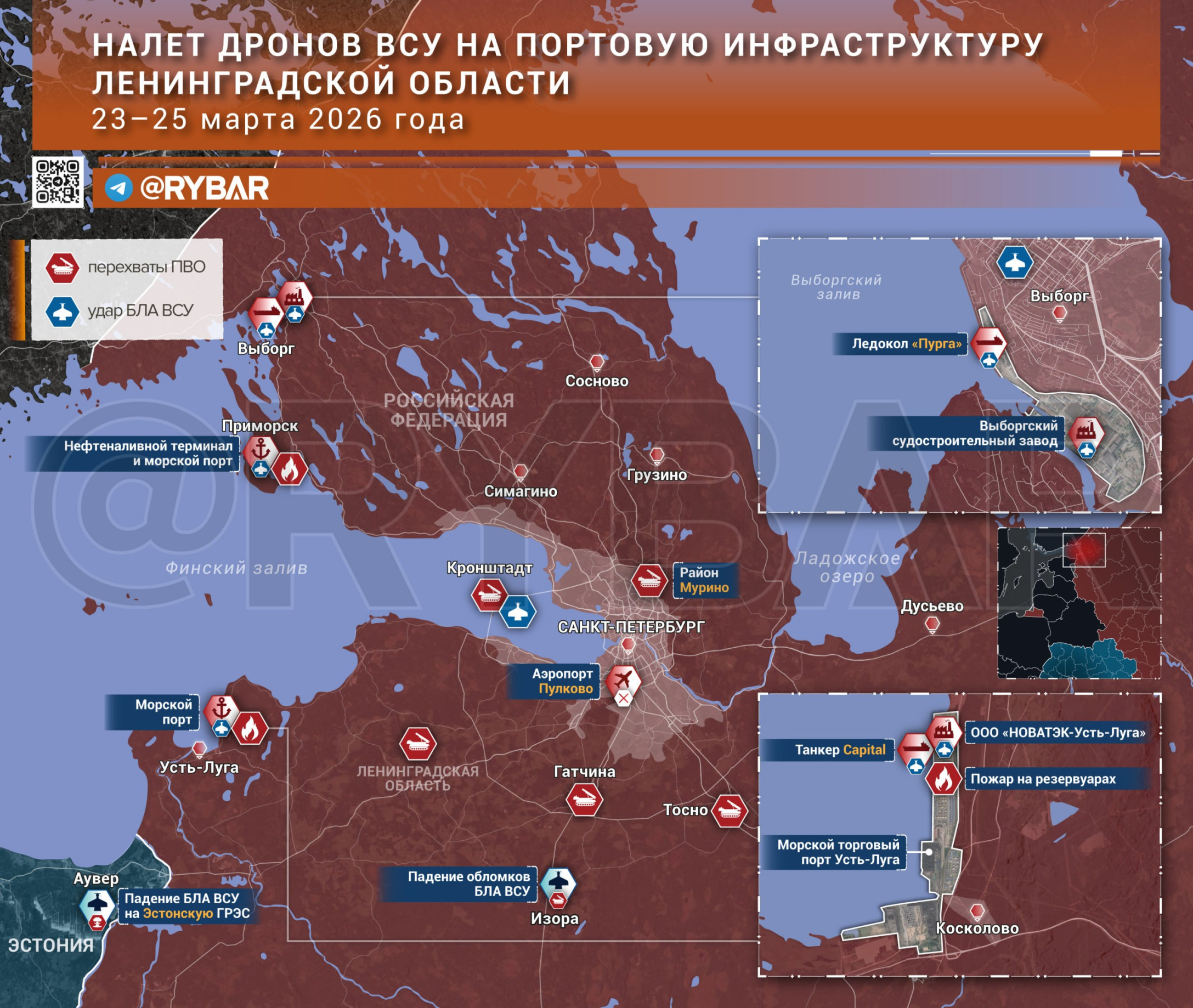
Drones have again set Ust-Luga near Saint Petersburg on fire.
Russians are preparing the Sloviansk axis for an offensive – they blew up a dam on the Siverskyi Donets.
Russian units are slowly advancing towards Rai-Oleksandrivka near Sloviansk.
Maps of the day – Sloviansk axis
Videos of the day – Russian Rubikon claims it destroyed a Patriot; the impact of the war in Ukraine on the Middle East; what a bomb dropped by an aircraft can do to an underground bunker.
Do not make up excuses, the drones that hit St Petersburg did not attack from Nato territory. The successful attacks on oil terminals near St Petersburg have caused a major stir in Russia. Large pro-war Telegram accounts have reacted to the spreading theory in an unexpectedly rational and self-critical way, arguing that the latest Ukrainian raids were successful because the drones either took off directly from the Baltic states and Finland, or at least flew through their territory.
This conspiracy was strongly fuelled by a map whose author drew the route of the incoming drones as if they had taken off in western Ukraine near Lviv, then flown over Poland, Lithuania, Latvia, and Estonia, only to suddenly appear over the Gulf of Finland and from there head directly from the west towards St Petersburg.
If this version were true, the attacking unmanned aircraft would have flown the entire time over friendly territory and would not have been threatened by Russian air defence. But it would also have meant the direct involvement of Nato states in the attack, because the drones could not have flown over them unhindered without the knowledge and consent of their governments and armed forces. Such an explanation might have helped the Russian army to mitigate the embarrassment it suffered, but accepting it would at the same time have entailed the risk of serious escalation.
It is unclear whether this is out of fear of such escalation or unwillingness to spread a new falsehood, but one large and influential Telegram channel after another convincingly debunked the theory.
The largest and most influential aviation channel Fighterbomber published a map of what an attack from Nato territory would supposedly look like (red line) and how, in his view, it actually took place (blue line). He added the following comment to the map:
According to him, several facts contradict the version of an attack via the Baltic region. First, the airspace along the border with Poland and the Baltic states has long been closed. “Accusations from ‘beauty’ bloggers that drones are being launched from the territory of these countries have been voiced for several years. No evidence other than arrows on maps, supposedly ‘from verified and reliable sources’, has ever been presented,” he wrote.

Fighterbomber went on to point out that he did not recall any official protest by the Russian foreign ministry that would have been lodged if the Kremlin had information about the airspace of other countries being used for attacks on Russia. “Such steps by the foreign ministry could lead to a mandatory nuclear strike on these countries, as well as a declaration of war,” Fighterbomber said, rolling out the old threat of a nuclear attack.
He also added that, in reality, everything was exactly the opposite: “I remind you that the territory and airspace of the Republic of Belarus were allowed by the Belarusians to be used by us for military purposes against Ukraine, but this has so far not resulted in attacks by Ukraine.”
“Given the repeated nature of the raids, it is particularly amusing to watch claims that the airspace of the Baltic states is being used for the attacks,” wrote Archanjel Specnaza, who has 1m followers on Telegram. He did claim that the drones did not fly over Russian territory, which contradicts Fighterbomber’s map, but he too unequivocally rejected Nato’s involvement.
Even a simple measurement of the distance with a ruler shows that this route is longer than via the border with Belarus. And given how air defence operates, it is also clear that the drones are flying along this route and not via Estonia, Latvia, and Lithuania. “Reckless claims only distract our units, which repel raids every day. We need more mobile launch teams, more firepower, more radars. Then there will be fewer attacks,” Speznasa added.
One of the most influential Russian channels, Rybar, also unequivocally rejected the idea of an attack from Estonia, even though one of the drones crashed into a power-plant chimney there. “But that does not mean that the attacks are coming from Baltic territory. During the raids on the Leningrad region, there were reports of many drones being intercepted in the Bryansk, Smolensk, Pskov, Novgorod, and Tver regions as well,” Rybar noted, listing the Russian regions over which the attacking drone swarms flew.
The Telegram channel Dvaja majori did not even deal with the theory of Nato’s involvement, but instead analysed the question of who was responsible for the repeated damage to strategic facilities. In this context, an initiative has emerged in Russia that the protection of such sites could be provided by private companies.
The channel pointed out that this was an unrealistic idea, because protecting airspace is highly complex and multi-layered, and private companies would be unable to provide some of its layers, which would inevitably lead to chaos and inefficiency.
The seas are blocked for Russian tankers. “The Mediterranean has become a ‘dead zone’ for Russian gas carriers, while Baltic trade routes are under constant threat. In the Black Sea, Ukrainian unmanned boats and drones are attacking tankers. There are no longer any safe routes for ships connected with Russia,” wrote Russian commentator Oleg Tsarev, who has more than 400,000 followers.
He was reacting to an attack on the tanker Altura, which took place near the Turkish coast in the Black Sea. The ship sails under the flag of Sierra Leone and is part of Russia’s shadow fleet, which Moscow uses to try to circumvent sanctions. According to Tsarev, it was carrying 140,000 tonnes of Russian crude, loaded in the port of Novorossiysk. Ukraine has not officially claimed responsibility for the attack, but is of course the most likely attacker.
“Since the beginning of the year, the EU and Ukraine have been systematically restricting Russian oil exports, destroying shadow tankers and Russian port infrastructure,” Tsarev complained.
“I agree with Oleg. In the case of the enemy, a carefully thought-out strategy is clearly visible in its attacks on our rear lines. And the serious consequences are also visible. Unfortunately, we are not yet managing to do the same,” the largest Russian pro-war channel, of Yuriy Podolyaka, commented on Tsarev’s post.
Drones have again set Ust-Luga near St Petersburg on fire. The strategic drone offensive on both sides continued the previous night. While Russia has for several days been attacking targets around Odesa on a larger scale – the city serving as Ukraine’s main maritime link to the world – the Ukrainian army, once again, struck the heavily targeted oil infrastructure near St Petersburg.
Given the nature of the targets, Ukrainian actions look far more visually striking. The terminal in Ust-Luga was once again engulfed in flames and smoke.
The consequences of the latest raid are not yet known, but since Thursday satellite images have been available showing the Ust-Luga terminal before and after the previous strike.
Russians are preparing the Sloviansk axis for an offensive – they blew up a dam on the Siverskyi Donets. More precisely, it might be said that the offensive has already begun and this is just one of the episodes accompanying it. On a map by French analyst Clément Molin, the site of the attack is marked with a red circle. It lies north of Sloviansk and in the centre of the area where Russian attacks on this axis are converging.
As always, in this case too the destruction of the dam serves to flood roads and other routes in the Ukrainian rear, complicating the logistics of units defending directly on the frontline.
Ukrainian soldier Kyrylo Sazonov also explained further consequences. According to him, the entire Kramatorsk–Sloviansk agglomeration would face problems with drinking water, because water from the damaged dam was diverted into a canal that supplied the towns and their surroundings.
Russian units are slowly advancing towards Rai-Oleksandrivka. This claim can be regarded as fact, but as usual there are important differences between Russian and Ukrainian interpretations.
Russian commentator Yuriy Kotenok, in the description of his current map of the area, said that Russian units were approaching the outskirts of Rai-Oleksandrivka. He also stated that the Russians had managed to seize the forest west of Riznykivka. This village is not on the map, but you would find it further east, beyond the village of Kalenyky, which appears in the upper right corner marked as occupied, as does Nykyforivka in the lower right.

Ukrainians from DeepStateUA see the situation in Kalenyky and Riznykivka very differently. They do report Russian advances near Riznykivka, but they do not consider either it or Kalenyky to be lost. They do not even shade them fully in grey.

The Finnish OSINT group Black Bird Group sees the situation in a very similar way – and around Kalenyky even more favourably for Ukraine than DeepStateUA.

The reason why these locations need to be monitored is that they currently form the most likely direction of a Russian attack on Sloviansk and Kramatorsk. The expected Russian offensive in spring and summer will almost certainly unfold in this area.
Videos of the day