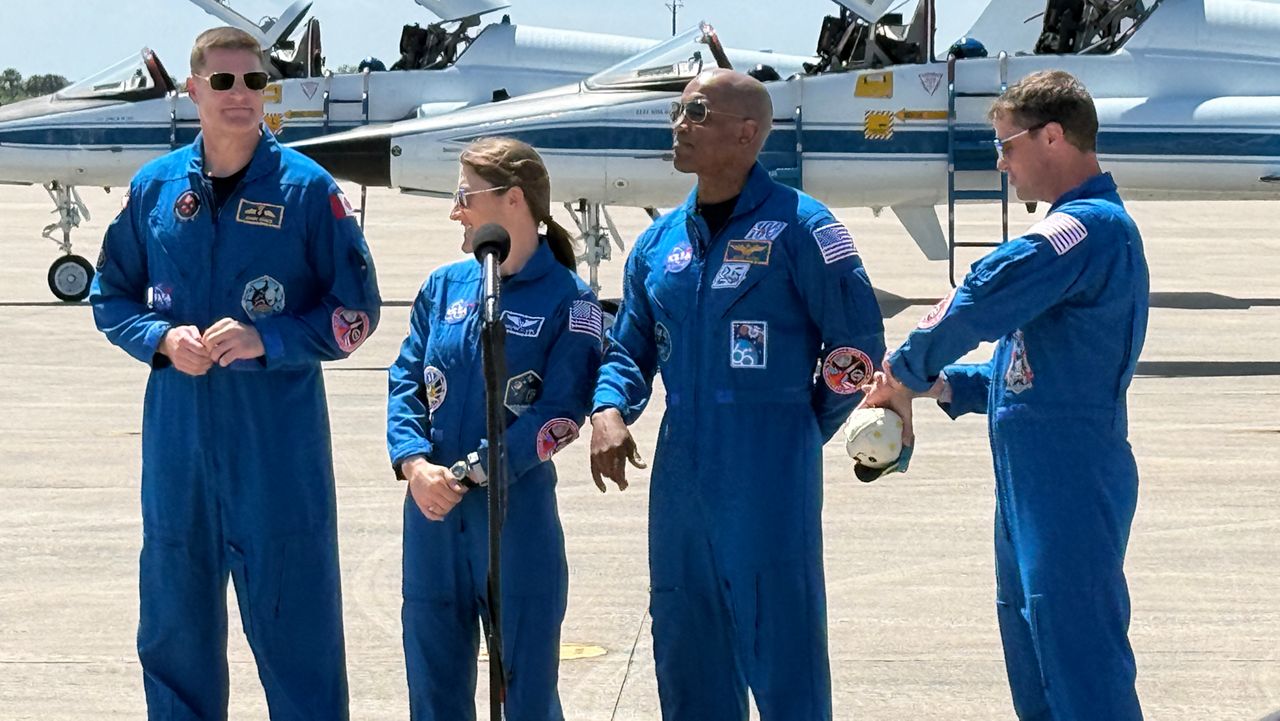
CAPE CANAVERAL, Fla. — NASA’s Artemis II crew flew to the Space Coast Friday afternoon to begin their historic journey to the moon.
What You Need To Know
The Artemis II crew has arrived at Kennedy Space Center for their moon mission
The mission aims for a launch in early April with a 10-day journey around the moon
Previous delays were caused by a helium leak; now resolved
Their rocket awaits them at Kennedy Space Center Pad 39B as their journey around the moon gets underway soon.
NASA is aiming for liftoff as soon as Wednesday. The space agency has the first six days of April to launch the Space Launch System rocket before standing down for nearly a month.
The crew flew in on their T-38 training jets from Houston and landed at Kennedy Space Center around 2 p.m.
They include NASA astronauts Reid Wiseman, Victor Glover and Christina Koch, and Canadian Space Agency astronaut Jeremy Hansen.
The crew initially came to Kennedy Space Center back in mid-January for the first planned launch attempt, but went home disappointed after the wet dress rehearsal revealed a helium leak, prompting NASA to roll back the giant rocket to the Vehicle Assembly Building for repairs.
They returned for last week’s rollout back to the pad but returned to Texas to begin the quarantine period.
NASA is confident enough in this launch attempt that another practice launch will not be required.
So, the crew will continue training in Florida until they suit up for launch.
“The way I think about it in my head, it’s the first time we are loading the crew on with fuel on the pad, so we’re ready, the rocket is ready, NASA is ready, this vehicle is ready to go,” said Commander Reid Wiseman.
Wiseman stressed there’s no guarantee they will launch in early April as planned, and that it could slip to May or even June. The Space Launch System rocket has soared only once before; the crew-less test flight to the moon was back in 2022.
“That’s this business,” Glover said of all the delays. “It will go when the engines light at T-zero, and we totally understand that.”
The crew also revealed their plush “Zero G indicator” named Rise — created by a California student competing in NASA’s Artemis II ZGI Design Challenge.
It is a re-creation of the famous Earthrise photo taken during the Apollo 8 mission, which Artemis II is in many ways mirroring.
The Orion capsule atop the rocket will carry the four on NASA’s first astronaut moonshot since Apollo 17 in 1972. The 10-day flight will end with a Pacific splashdown.
Earlier this week, Isaacman outlined a fresh plan for the moon base that NASA intends to build under the Artemis program. The upcoming moonshot will be followed in 2027 by a lunar lander demo in orbit around Earth and in 2028 by one and possibly two lunar landings by astronauts.
Koch said the changes are motivating and inspiring. “We’re in a relay race … and if nothing else this just fired us up for that all the more.”
The Associated Press contributed to this report.