
Nigel Lindsay-Smith has been in the job for a few weeks. He’s already opened a new Sydney headquarters, he’s still hiring, and he wants to talk about why Australian enterprises should rethink their AI contact centre tools.
The new Managing Director of NiCE Australia and New Zealand sat down with iTWire to walk through what’s happening on the ground as NiCE (NASDAQ: NiCE), the 40-year-old customer experience giant, pushes its agentic AI strategy hard into the ANZ market.
His message is direct: the old IVR “press 1 for sales, press 2 for service” model is dying. And the company that just spent US$955 million acquiring Cognigy thinks it has the replacement.
Below is my video interview with Nigel, upon which this article is based, and which continues thereafter, so please watch, and read on!
A new office, a new chapter
NiCE has grown significantly in ANZ over the past 5 to 6 years. The new Sydney office (the old one was simply outgrown) signals real commitment. The company is also expanding operations into Melbourne.
“We’re still hiring. We’re still growing,” Lindsay-Smith told iTWire. “And we’re bringing really the best of people in the space to work with NiCE Australia.”
Here is a photo from the office launch event:

NiCE’s CEO Scott Russell standing next to Nigel Lindsay-Smith, both in the middle.
That growth sits against a broader financial picture that’s hard to argue with. NiCE posted $2.95 billion in revenue for full-year 2025, with cloud revenue climbing 13% year-on-year.
AI annual recurring revenue hit US$328 million in Q4 2025 alone, a 66% jump. AI was included in 100% of the company’s new seven-figure CXone deals.
Fast Company named NiCE the 11th most innovative company in Applied AI for 2026, alongside Google, Nvidia, and Walmart. The company also took home Best Innovation for Customer Experience at Enterprise Connect 2026.
This is a company on a run.
The article continues below this second photo from the NiCE Sydney HQ launch event:

NiCE’s CEO Scott Russell in the middle cutting the ribbon in the first shot, and standing next to Nigel Lindsay-Smith on the right.
The Cognigy play
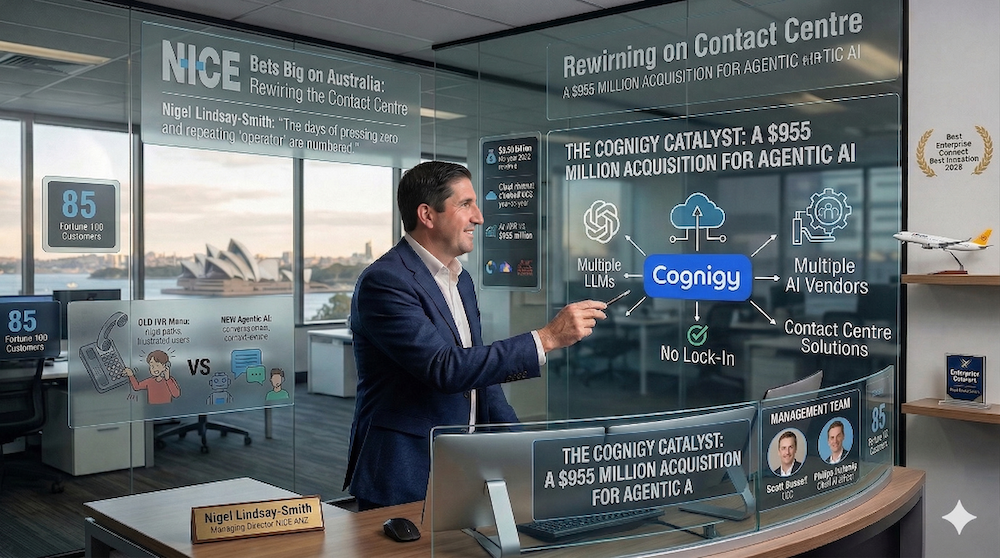
The centrepiece of NiCE’s current strategy is Cognigy, the German-born agentic AI platform it acquired in September 2025 for US$955 million. Lindsay-Smith describes it as an orchestration layer that sits across multiple LLMs, multiple AI vendors, and (critically) multiple contact centre solutions. You’re not locked in.
“What could have taken weeks before can actually be developed and deployed in days. And that’s the really exciting thing for organisations.” – Nigel Lindsay-Smith, Managing Director, NiCE ANZ.
That speed matters. Lindsay-Smith says the traditional approach to AI automation in contact centres involved complex development sprints, long UAT cycles, and months before production. Cognigy compresses that timeline dramatically.
And the platform’s credentials aren’t theoretical. Lufthansa Group handles around 16 million AI-powered conversations annually through Cognigy, with peak days hitting 375,000 interactions. Lindsay-Smith mentioned the airline can process roughly 40,000 simultaneous conversations during major disruptions like flight cancellations.
Allianz, Generali, and BT’s Openreach are also on the client roster.
At NiCE’s Nexus 2026 Global CX AI Summit, the company announced 5 new Cognigy capabilities: Automation Opportunity Discovery (which turns interaction data into deployable AI agents), embedded multivariate testing, multimodal hybrid journeys, advanced conversation analytics, and expanded MCP integration.
Philipp Heltewig, Cognigy’s co-founder and now NiCE’s Chief AI Officer, put it bluntly: “Agentic AI is becoming the operating layer of the enterprise.”
This image was playfully created by Gemini Nano Banana 2 based on this article, which continues below, please read on! Please excuse Gemini’s occasional spelling errors, AI isn’t perfect yet no matter how many times you tell it “no spelling errors!”
What Australian enterprises are actually doing
Lindsay-Smith paints a picture of a market that’s enthusiastic but cautious. Australian organisations are spending real money on AI experimentation, budgeting for generative and agentic AI pilots, and doing serious road-mapping. The appetite is there.
The sticking point? Moving from pilot to production.
“We have visibility, a lot of visibility, when there are errors made,” Lindsay-Smith said, referencing recent high-profile AI missteps in the Australian market. “There have been a couple in the press recently where AI has taken a slight turn and operated slightly differently than was originally expected.”
The answer, he argues, is guardrails. NiCE has built its technology so customers control precisely what the AI can and can’t do, what topics it can address, what actions it can take.
“Organisations are the ones in complete control of how they want that AI tech to be deployed across their business.” – Nigel Lindsay-Smith.
Some Australian customers are already live with public-facing AI agents on limited use cases. The trajectory is clear: experiment, validate, tighten the guardrails, then go to production.
NiCE’s own Agentic AI CX Frontline Report (published February 2026) backs this up with hard numbers: enterprises using agentic AI are seeing deployment cycles up to 3x faster, double-digit reductions in cost per contact, containment rates above 80% for tier-one inquiries, and CSAT improvements of up to 20%.
The ROI question (answered with maths, not marketing)
Lindsay-Smith is specific about where the money shows up. The biggest immediate win is containment: handling simple enquiries (billing questions, statement requests, payment extensions, address changes) through AI agents instead of human ones.
“If you look at the cost to handle one of those calls, sometimes they’ll range from $10 a call up to $20 or $30 a call depending on the efficiency of the contact centre,” he said. “All of those calls can immediately be deflected and handled through an AI agent.”
The second win is harder to quantify but commercially powerful: reduced dropouts. Customers who hang up before reaching an agent represent lost revenue, especially for contact centres that drive sales. Faster routing, smarter containment, and AI copilots feeding real-time data to human agents all chip away at that problem.
“Your time is valuable. You don’t get it back when you’re sitting on hold.” – Nigel Lindsay-Smith.
This image was created by Gemini Nano Banana 2 based on this article, which continues below. Please read on!

Why build when you can buy?
Some CIOs are eyeing the hyperscaler platforms and thinking they can assemble their own AI contact centre stack. Lindsay-Smith has heard this before.
His counter-argument has 3 prongs. First, NiCE is shipping constant updates; a homegrown solution built over a few months can be outdated before it launches, given the pace of AI.
Second, internal builds carry ongoing support costs and technical debt that organisations routinely underestimate. Third, there’s vendor lock-in on the build side too: you’ve just chosen your cloud provider’s AI stack, and you’re stuck with it.
“Most organisations that do go down that path do find they face significant tech debt and then significant vendor lock-in, because they’ve made a choice with the vendor, as well as significant cost to support,” Lindsay-Smith said.
NiCE, by contrast, employs dedicated value realisation teams that help customers plan adoption and a continuously updated roadmap. The company processes around 30 billion interactions a year across its platform. That’s a data advantage no internal build can replicate.
The death of “press zero”
Anyone who’s ever frantically mashed the zero button on their phone to bypass a maddening IVR menu will appreciate what Lindsay-Smith describes next.
IVR trees were designed to route callers to the right specialist. But when frustrated customers bypassed them, they’d land with a generalist who couldn’t help, and get shunted into a new queue anyway. A perfectly rational customer response that lengthened your time in the queue, not shortened it.
NiCE’s approach strips those rigid menus out entirely and drops in a voice AI agent you can actually talk to. Call a telco, explain you have two issues (an incorrect bill and a plan upgrade), and the AI agent parses both, handles what it can, and intelligently routes the rest.
“The AI agent would be able to take that, understand that there are two inquiries, deal with the first one… and then address the upgrade of the contract.” – Nigel Lindsay-Smith.
If the AI senses trouble (a customer in financial hardship, a vulnerable individual, or just a conversation going sideways), it escalates to a human agent with full context: everything discussed so far, plus a prediction of what the customer likely needs to close the issue.
That handover, with context intact, solves one of the most infuriating parts of calling any contact centre: having to re-explain your problem to every new person.
Drinking their own champagne
NiCE uses its own AI internally (Lindsay-Smith prefers the phrase “drinking our own champagne”, a more elegant alternative to the more common “eating our own dogfood”). The results are telling.
A recent internal incident that would normally take 4 to 6 hours to diagnose was identified by AI within minutes. The human engineers then spent 50 minutes verifying the AI’s findings. Total resolution time: under an hour, down from half a day.
The company is also using AI across sales (prospecting and customer targeting), development (accelerating code releases), and support operations.
The generational shift already underway
Lindsay-Smith offers a personal data point that says as much as any market research. His son, about to turn 21, has never contacted a call centre. He does everything through digital channels, chat, and doesn’t care if the entity solving his problem is human or AI, as long as it works.
“He’s happy to chat to an agent or a bot. He doesn’t even care if it’s human or if it’s AI, as long as it solves his problem,” Lindsay-Smith said.
That generation is becoming the dominant customer base. Brands that can’t meet them on digital channels with instant, competent service will lose them.
What’s next for NiCE in ANZ
Lindsay-Smith outlined 3 growth priorities for the region.
1) Large enterprise targeting. NiCE sees significant opportunity to transform CX technology stacks at Australia’s biggest companies.
2) Cognigy as a standalone product. Because Cognigy works across competitive contact centre platforms (not just NiCE’s CXone), it opens doors with organisations that aren’t ready to switch their entire CCaaS provider. “Naturally, it’s better if you use CXone,” Lindsay-Smith conceded with a grin, “but that’s an area we’re very heavily focused on.”
3) Compliance and vulnerability management. Financial hardship identification, vulnerable customer detection, and regulatory compliance are becoming urgent priorities for Australian banks and telcos. Recent public missteps in these areas have created demand for technology that handles sensitive situations correctly, every time.
The bottom line
NiCE has spent 40 years in the contact centre space. It acquired the best agentic AI orchestration platform it could find for nearly a billion dollars. It’s opening offices, hiring staff, and landing awards while posting 66% AI revenue growth.
The pitch to Australian enterprises is blunt: stop experimenting in isolation, stop building internally, and start deploying AI that’s already proven at scale with companies like Lufthansa, Allianz, and 25,000 others across 150 countries.
Whether the local market moves fast enough to match the technology’s capability is the real question. But if Lindsay-Smith’s calendar is any indication (a few weeks in, new office already open, already on camera doing interviews) NiCE isn’t planning to wait around for the answer.
Here is the video interview again, if you didn’t already get a chance to watch it above. Below is the detailed infographic for this article:
This detailed infographic created by Gemini Nano Banana 2 based on this article – please excuse Gemini’s very occasional spelling mistakes, you can ask AI to fix it but it doesn’t always do what you want:

+++
Nigel Lindsay-Smith is the Managing Director of NiCE Australia and New Zealand. Connect with him on LinkedIn.
NiCE (NASDAQ: NiCE) is headquartered in Hoboken, New Jersey, and operates in more than 150 countries. CEO Scott Russell leads the company. Over 85 Fortune 100 companies are NiCE customers.
Cognigy was founded by Philipp Heltewig and acquired by NiCE in September 2025 for US$955 million. Heltewig now serves as NiCE’s Chief AI Officer and General Manager of NiCE Cognigy.