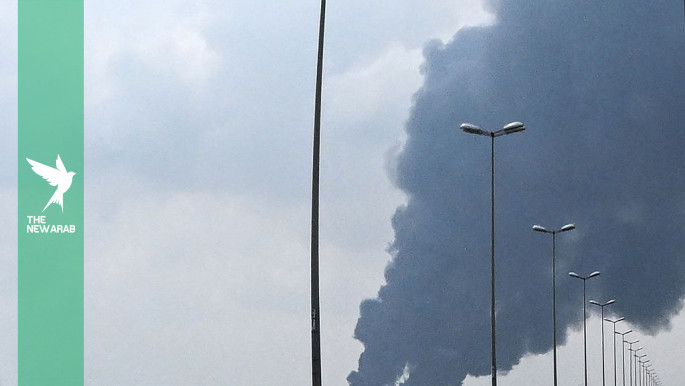
Kuwait was the latest Gulf country to have their key infrastructure targeted [Getty]
Iran launched fresh strikes across the Gulf and Israel on Monday, escalating regional tensions as US President Donald Trump said he was considering a potential ground operation to seize Iranian oil infrastructure.
Kuwait said one of its power and desalination plants was hit early Monday, killing an Indian worker and causing extensive damage.
Kuwait’s Ministry of Electricity described the attack as “part of the Iranian aggression against the State of Kuwait”, while GCC states, including Qatar, condemned the strike.
Kuwait’s military reported shooting down five Iranian drones over its territory, while Saudi Arabia’s defence ministry also said its forces intercepted five other drones during the past hours.
Air raid sirens were also heard in Jordan and Bahrain throughout Monday morning.
In parallel, Iran continued launching missiles towards Israel late Sunday and into Monday morning, prompting disruptions in the Negev and southern Dead Sea areas.
Israel’s health ministry said 6,008 people have been treated in hospitals since the start of the war on 28 February, with 121 still hospitalised. In the past 24 hours alone, 232 new injuries were reported.
US-Israel strikes inside Iran
On Monday, Iran’s Islamic Revolutionary Guard Corps (IRGC) confirmed the death of its Navy Commander, Alireza Tangsiri, following an Israeli strike.
Explosions were reported overnight across Tehran and the nearby city of Rey, resulting in widespread power cuts in the Iranian capital. An Iranian official reported that Israeli airstrikes had damaged power grids, but said that electricity had now been restored.
Israel confirmed it had carried out strikes on about 40 targets in the Iranian capital over the past two days, including alleged weapons production sites.
In Tabriz, a petrochemical complex was hit, igniting a fire that remained out of control Monday morning.
In Zanjan, a drone strike destroyed a residential building, killing three people and injuring seven others, according to the provincial governor. Search and rescue operations are continuing.
The International Atomic Energy Agency (IAEA) said Iran’s Khondab heavy water complex had ceased operations after Israeli strikes last week, noting the facility contained no declared nuclear material.
Trump mulls ‘taking the oil’
As Washington deploys roughly 10,000 additional troops to the Middle East, Trump said he was weighing options to “take the oil in Iran” potentially via the seizure of Kharg Island, the hub of Iran’s crude exports.
In an interview with The Financial Times on Sunday, he compared the strategy to US actions in Venezuela, saying his “preference would be to take the oil” indefinitely, similar to Washington’s intentions following the January kidnapping of Nicolás Maduro.
“Maybe we take Kharg Island, maybe we don’t. We have a lot of options,” Trump said. “It would also mean we had to be there for a while.”
The Wall Street Journal reported that Trump was considering a mission to extract Iran’s stockpile of roughly 1,000 pounds of uranium, though officials cautioned that no decision had been made, given the risks to US personnel that a ground invasion of this scale would entail.
Separately, Trump told Israel’s Channel 14 that he believed the US could control the Strait of Hormuz, adding that steps in that direction were already underway.
Diplomatic efforts falter
Meanwhile, efforts to de-escalate the conflict showed little progress.
An informed Iranian source told The New Arab that Tehran would not participate in ongoing talks in Islamabad, which include officials from Saudi Arabia, Turkey, and Egypt.
The source said Iran was maintaining contact with some participating states but had no intention of negotiating directly with the United States.
Officials from the three regional countries left Pakistan on Monday after concluding a four-way discussion aimed at preventing further regional escalation.