
In March 2026, President Emmanuel Macron formally named France’s next-generation aircraft carrier “France Libre” as the long-running PANG aircraft carrier program inches closer to becoming a reality.
The ship, expected to displace close to 80,000 tons, costs around €10 billion and will enter service by 2038, replacing the aging Charles de Gaulle aircraft carrier that has been in service since 2001.
In a statement issued in March, Macron stressed that for France to remain free, it “must be feared” — and that to be feared, it must also be “powerful.”
The statement echoed his comments to French troops in the United Arab Emirates earlier this year, in which he said that France “must be strong in order to be feared” in an “age of predators.”
Macron is clearly on the warpath to strengthen France’s military capabilities, ensure his country’s long-term place as a global power, and, indeed, bolster its strategic independence. But a single aircraft carrier may not be enough to achieve it.

PANG France Nuclear Aircraft Carrier. Image Credit: French Government.
France is investing heavily in one of the most advanced carriers ever built outside of the United States, but it is still only one carrier. And one carrier, no matter how capable, cannot be everywhere at once.
Why France Is Building PANG
The PANG program is not simply about replacing an aging warship. It is a central component of France’s long-standing effort to maintain an independent military capability — particularly in a European context where few countries can operate at a global scale.
France is currently the only European Union country with nuclear weapons and a nuclear-powered aircraft carrier, giving it a unique role within NATO and European defense planning. That status is crucial as Paris pushes for strategic autonomy — a reduced reliance on the United States for high-end military operations. Aircraft carriers must be a primary part of that strategy.
Charles de Gaulle has served France and NATO well. It has conducted combat operations in Afghanistan against ISIS and, in March 2026, was again deployed to the Mediterranean.
The PANG program will build on these successes and is being developed alongside other defense investments, including nuclear modernization and expanded expeditionary capabilities. In July 2025, President Macron announced €6.5 billion in additional defense spending over two years. In January 2026, Macron reaffirmed his commitment to continued defense budget growth, aiming for roughly €64bn by 2027.
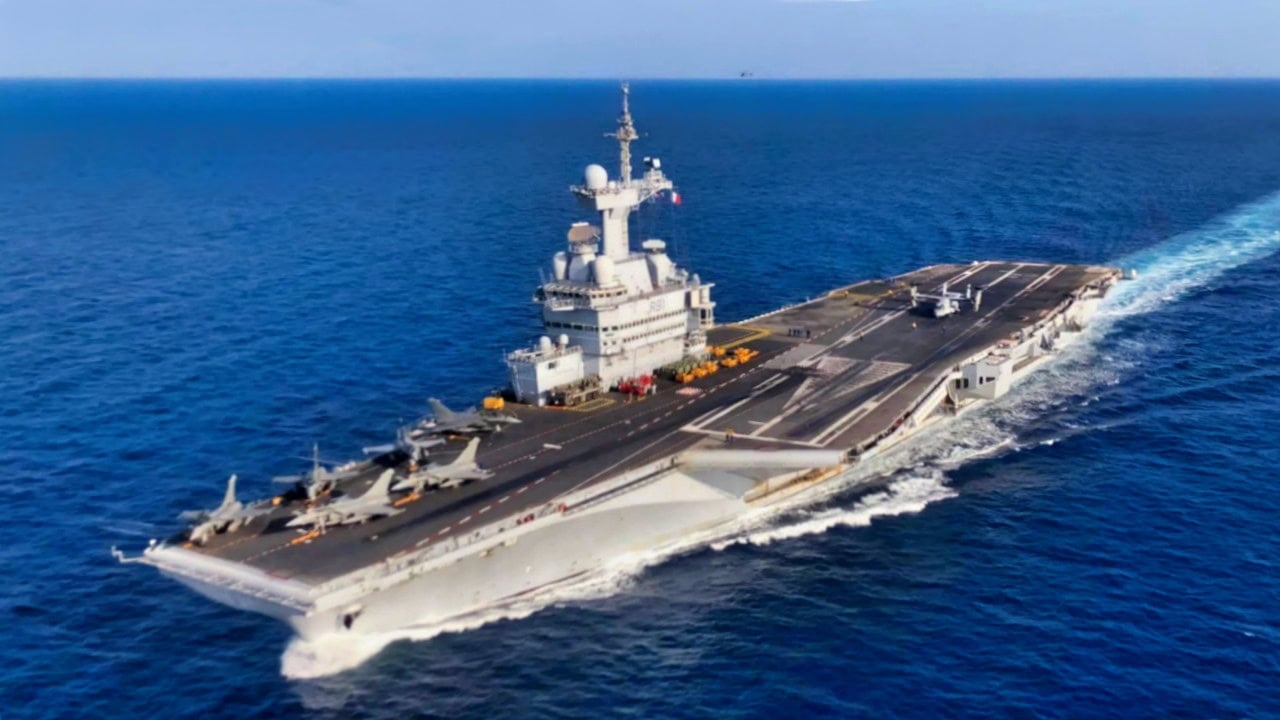
U.S. 5TH FLEET AREA OF OPERATIONS (April 24, 2019) A U.S. Marine MV-22 Osprey assigned to the 22nd Marine Expeditionary Unit sits on the flight deck of France’s Marine Nationale aircraft carrier FS Charles De Gaulle (R 91). This was the second time that Ospreys have landed aboard the French vessel. Marines and Sailors assigned to the 22nd MEU and Kearsarge Amphibious Ready Group are currently deployed to the U.S. 5th Fleet area of operations in support of naval operations to ensure maritime stability and security in the Central region, connecting the Mediterranean and the Pacific through the western Indian Ocean and three strategic choke points. (U.S. Marine Corps photo by Maj. Joshua Smith/Released)
There’s a geographic dimension to the decisions the French government has recently made, too. France maintains overseas territories across the Indian and Pacific Oceans, giving it a permanent global footprint that requires credible naval reach.
A nuclear-powered carrier provides that reach in a way that land-based airpower cannot. In that sense, a new nuclear-powered aircraft is a strategic necessity — even at huge expense. PANG is not really about matching what great powers like the United States are doing, but ensuring that France can act independently when it chooses to do so — and, indeed, to defend its own interests.
PANG’s Great Leap
Technically, PANG represents a major leap in capability over the Charles de Gaulle and places France close to the lower end of U.S.-style “supercarrier” design. The ship is expected to displace between 75,000 and 80,000 tons, roughly double the size of its predecessor, and measure around 310 meters in length. It will be powered by two K22 nuclear reactors, allowing effectively unlimited range and sustained high-speed operations without refueling.
One of the most significant upgrades is the adoption of the Electromagnetic Aircraft Launch System (EMALS) — the same system used on the U.S. Navy’s Gerald R. Ford-class aircraft carriers. The system will replace the steam catapults on Charles de Gaulle, enabling smoother launches and higher sortie rates. EMALS will also ensure compatibility with heavier aircraft and future unmanned systems.
PANG is expected to carry around 30 combat aircraft, including naval variants of France’s next-generation fighter and airborne early warning platforms like the E-2D Hawkeye. With EMALS and a larger flight deck, sortie generation could increase significantly, with some estimates suggesting up to 60 sorties per day under the right conditions.
And, in keeping with global military trends, the ship will also be designed to accommodate drones and advanced networked warfare systems, ensuring it is compatible with next-generation systems that heavily rely on AI-powered “loyal wingman”-style aircraft. PANG, then, is far more than an upgraded Charles de Gaulle – it is France attempting to field an advanced carrier that can operate at the very highest level of modern naval warfare. It will be their silver bullet.
Is One PANG Aircraft Carrier Enough?

PANG Aircraft Carrier. Image Credit: Creative Commons.
Despite its size and capabilities, PANG will inherit a limitation that no technological improvement can solve: France will still operate only one aircraft carrier.
Remember: carrier operations are governed by maintenance cycles. Even under ideal conditions, a carrier is typically available for deployment only part of the time, with extended periods spent in maintenance, refit, and training.
Nuclear-powered carriers, in particular, require complex overhaul periods that can last months or years. France has already experienced this limitation repeatedly. When the Charles de Gaulle enters refit, France effectively loses its fixed-wing carrier capability entirely. There have been multiple periods over the past two decades when France had no operational carrier available.
When France deployed the Charles de Gaulle to the Mediterranean in March 2026, it proved the carrier’s value – but it also showed the risk. Had the ship been in maintenance at that time, for example, France would have had no capability to deploy.
The United States, meanwhile, operates 11 carriers, enabling continuous global presence. The United Kingdom also operates two HMS Queen Elizabeth-class carriers specifically to ensure that at least one is available at any given time. France’s model, therefore, is flawed.
Why Not Build Supercarrier Two?
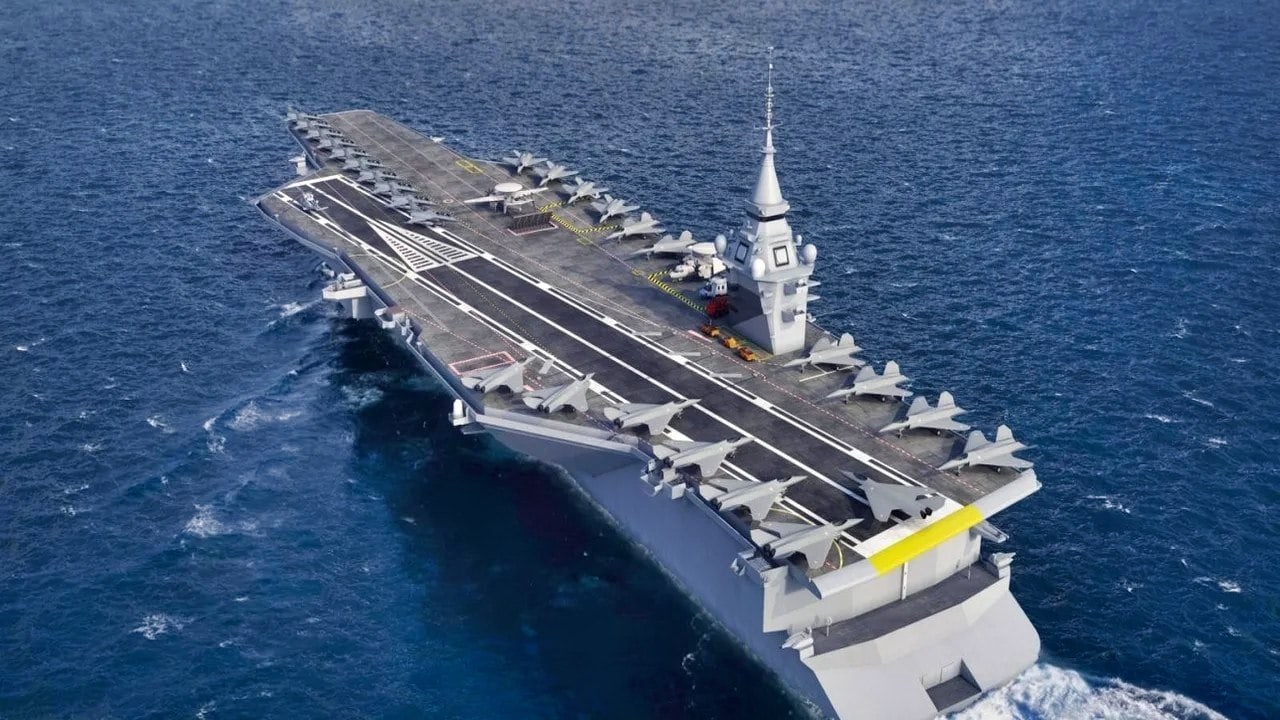
PANG Aircraft Carrier from France. Image Credit: French Navy.
The obvious solution for France, then, is to build a second carrier. Paris has explored this idea before, but earlier programs were ultimately canceled due to cost and political constraints — the PA2 carrier project, canceled in 2013, being a good example.
Committing to spending such large sums on a second carrier is politically difficult for a country of France’s size.
The primary obstacle here is financial, which, in turn, becomes political.
The PANG program is expected to cost around €10-10.25 billion per ship, before accounting for its air wing, escorts, and long-term operating costs. Doubling the fleet would require not just another carrier but also additional aircraft, crews, and support vessels, significantly increasing the overall cost of the force. And, there are industrial constraints.

PANG Aircraft Carrier from France. Image Credit: Industry Handout.
France’s shipbuilding capacity is not optimized for serial production of large nuclear carriers. Each vessel is effectively a bespoke project with long timelines, meaning a second carrier could take decades to deliver.
And the trade-offs are equally significant. France must balance carrier investment with other priorities, such as its land forces and nuclear deterrent. It also continues its efforts to modernize its airpower. So, Macron’s defense strategy is balancing all of those priorities while ensuring a nuclear carrier capability – even if it is flawed.
Is PANG worth it, then? Probably. While a single carrier poses a risk, it is undoubtedly better than none. For a country with overseas territories and ambitions to maintain strategic independence, it’s hard to envision giving up on a serious blue-water navy as a good idea.
About the Author: Jack Buckby
Jack Buckby is a British researcher and analyst specializing in defense and national security, based in New York. His work focuses on military capability, procurement, and strategic competition, producing and editing analysis for policy and defense audiences. He brings extensive editorial experience, with a career output spanning over 1,000 articles at 19FortyFive and National Security Journal, and has previously authored books and papers on extremism and deradicalization.