
Israel said on Friday it was being attacked by a new barrage of missiles from Iran, as President Donald Trump warned the United States had yet to begin “destroying what’s left” of the Islamic republic’s infrastructure.
Israel’s military reported a new missile salvo from Iran on Friday, with its air defences operating to down them, but there were no immediate reports of casualties.
Israeli emergency services reported some damage to houses and cars from a cluster missile that wasn’t intercepted, while Israeli military radio said a train station in Tel Aviv was damaged by shrapnel.
The Iranian fire came as Trump said the US military “hasn’t even started destroying what’s left in Iran. Bridges next, then Electric Power Plants!” on his Truth Social platform, several hours after saying Iran’s tallest bridge had been destroyed.
Iranian Foreign Minister Abbas Araghchi posted online that “striking civilian structures, including unfinished bridges, will not compel Iranians to surrender.”

A screenshot of US President Donald Trump’s Truth Social account, 3 April, 2026 – @realDonaldTrump
Strikes from both sides have increasingly targeted economic and industrial sites, raising fears of wider disruption to global energy supplies and deepening the conflict’s impact beyond the battlefield.
The war started more than a month ago with US-Israeli strikes on Iran, triggering retaliation that has spread the conflict throughout the Middle East, convulsing the global economy and impacting millions of people worldwide.
The Strait of Hormuz, a conduit for one-fifth of the world’s oil and liquefied natural gas, has come into sharp focus after Iran effectively closed it, with Gulf nations pushing for a force to protect shipping there, but a UN vote set for Friday was delayed.
Trump has threatened to bomb Iran “back to the Stone Ages” and warned US attacks would intensify if Tehran did not reach a negotiated settlement, while Iran has vowed in response to carry out “crushing” attacks against the US and Israel.
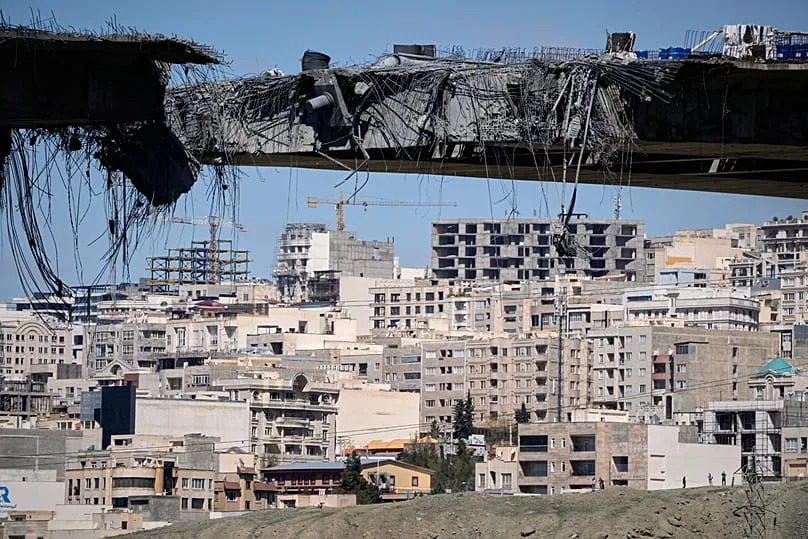
A bridge struck by US airstrikes seen in the town of Karaj, 3 April, 2026 – AP Photo
New Gulf attacks
Gulf states once seen as safe havens have become direct threats, accused by Iran of serving as launchpads for US strikes.
A drone attack on a refinery owned by Kuwait’s national oil company on Friday sparked fires at several of its units, state media said, while the oil-rich emirate’s air defences responded to new missile and drone attacks.
Iran said one of its latest attacks a day earlier had struck targets in the United Arab Emirates, Bahrain and Israel.
They included “American steel industries in Abu Dhabi, American aluminium industries in Bahrain, and the Rafael arms factories”, it said.

Smoke rises from Kuwait international airport after a drone strike on fuel storage in Kuwait City, 25 March, 2026 – AP Photo
Despite the ongoing bombardment in Iran, families gathered in Tehran’s Melat Park, with men smoking water pipes and children playing to mark the 13th day after Nowruz, the Persian New Year, when people traditionally picnic outdoors.
A resident said checkpoints manned by the country’s Revolutionary Guards had increased across the city.
“They gather in the streets in order to show people that they are still in power and nothing is gonna change,” said the 30-year-old man, who requested his name not be used.
In Israel, Passover celebrations also continued, though some marked the holiday underground.
“This is not my first choice,” said a writer named Jeffrey at a meal in a Tel Aviv bunker.
Related
Global impact
The war’s economic impact is rippling far beyond the Middle East.
Oil prices surged to around $110 (€95) a barrel on Thursday after Trump warned of further strikes on Iran. Oil markets were closed on Friday.
Analysts said that Trump’s prime-time address to the nation failed to provide clarity on an exit strategy from the war, with Deutsche Bank’s Jim Reid noting there was “no signal of the US seeking an imminent off-ramp.”
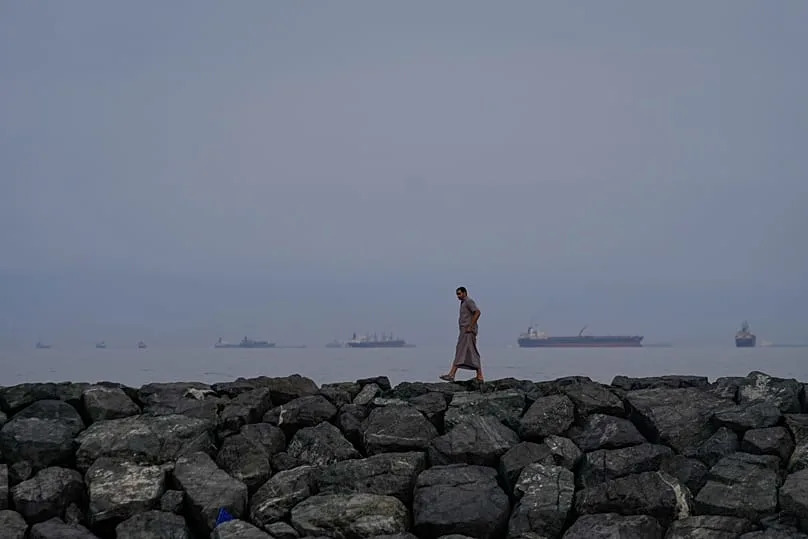
A man walks along the shore as oil tankers and cargo ships line up in the Strait of Hormuz, 11 March, 2026 – AP Photo
The World Bank warned of mounting risks to inflation, jobs and food security worldwide.
Trump, whose administration has been accused of giving mixed messages about the war’s end game, has suggested that Tehran’s new leadership could prove “more reasonable” in potential peace talks.
Iran has dismissed US overtures as “maximalist and irrational.”