
Recently published satellite imagery shows the first in-production unit of the People’s Liberation Army Navy (PLAN) Type 095 Sui-class nuclear-powered attack submarine being outfitted for a shakedown cruise.
Those preparations are taking place at the Bohai Shipbuilding Heavy Industry Company (BSHIC) shipyard at Huludao, in Liaoning Province.
BSHIC is one of Beijing’s largest shipyards and was established in the mid-1950s. It is China’s first and still only shipyard for the construction of nuclear-powered submarines.

SSBN China Submarine. Image Credit: Creative Commons.
The Type 095, also known as the Type 09V, is a significant step in the expansion of Chinese undersea forces.
Like most of the PLAN’s construction, the tempo of shipbuilding continues to outpace that of U.S. submarine production.
Naval strategists and analysts of the PLAN say the Type 095’s entry into service will affect the overall balance of power in the Pacific.
Among other concerns, the expanding PLAN submarine fleet allows an increase in the density and frequency of Beijing’s undersea patrols in the western Pacific.
This has considerable implications for Taiwan’s security.
Chinese President Xi Jinping has stated his intentions to invade the island democracy, and many Western observers believe a takeover could be attempted as early as 2027.
New Design Techniques
There are notable design changes in the Type 095, which is officially a third-generation submarine of the PLAN class.
These alterations may result from lessons learned from the operations of previous-generation designs.

The nation’s newest and most advanced attack submarine Seawolf (SSN 21) puts to sea in the Narragansett Bay operating area for her first at-sea trial operations on July 3, 1996. Sea trials include various tests of the Seawolf propulsion systems and the first underway submergence of the submarine. The Seawolf represents the Navy’s most advanced quieting technology, weaponry, tactical capability and communications. Seawolf is scheduled to be delivered to the Navy and commissioned this fall. U.S. Navy photo courtesy of General Dynamics.
One of the more visible changes is the Type 095’s X-tail rudder.
Submarine design specialists say this is likely accompanied by a pump-jet propulsor. It could reduce propeller noise, thereby minimizing cavitation.
The sub also has a wider hull than its predecessor model, the Type 093 Shang-class.
Design specialists believe this is another sign of a significant improvement in quietness.
The Type 095 is often compared to the U.S. Seawolf-class, largely due to its size.
The Type 095 appears to be slightly shorter than the Type 093 but is almost one meter wider.
As naval analyst H.I. Sutton has pointed out, there is “a hydrodynamic logic in Seawolf’s specifications.”

The first of a revolutionary new class of fast attack submarine, the Seawolf (SSN-21). Shown during construction at the Electric Boat Division of General Dynamics Corporation in Groton, Conn. She was christened by Margaret Dalton, wife of Secretary of the Navy John H. Dalton, on June 24, 1995.
“Like a whale or other marine creature, there is an optimum length-to-beam ratio which optimizes drag and allows the creature to go faster or use less energy. Counter-intuitively, the shorter-fatter Seawolf has a much more efficient hull design than the later, more compromised, Virginia-class,” Sutton writes.
The Type 095 appears to be designed for that sweet spot, or what submarine design analysts call a “golden ratio.”
Mission Profile
The Type 095 is designed to include vertical launch missile cells for enhanced anti-ship and land-attack capabilities.
One of the central mission functions, aside from hitting targets in preparation for larger military operations, is protecting aircraft carrier task forces
Between 2021 and 2025, the PLAN launched 10 nuclear-powered submarines collectively totaling 79,000 tons.
This is markedly greater output than the U.S. shipyard output during the same timeframe, of 7 boats for a total of 55,000 tons.
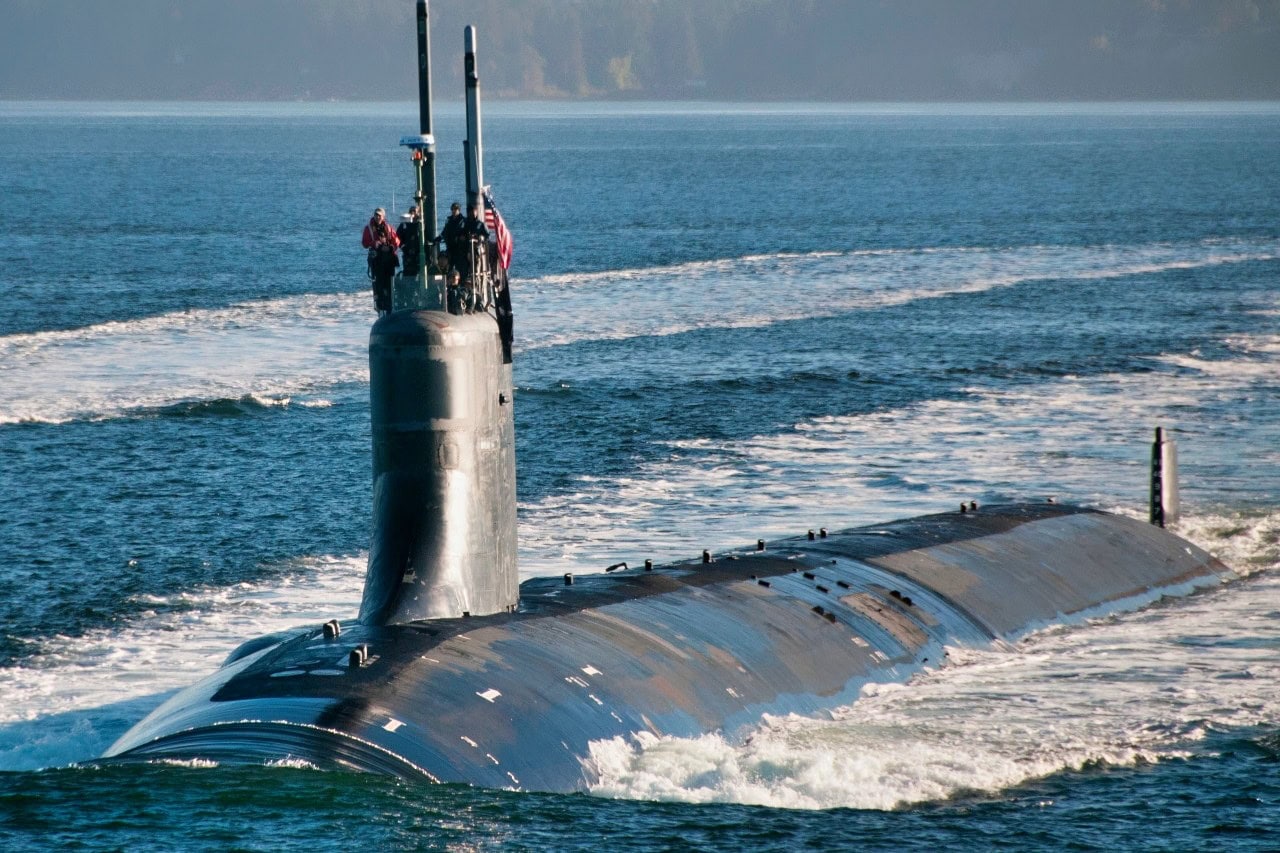
PUGET SOUND, Wash. (Sept. 11, 2017) The Seawolf-class fast-attack submarine USS Jimmy Carter (SSN 23) transits the Hood Canal as the boat returns home to Naval Base Kitsap-Bangor. Jimmy Carter is the last and most advanced of the Seawolf-class attack submarines, which are all homeported at Naval Base Kitsap. (U.S. Navy photo by Lt. Cmdr. Michael Smith/Released)
The launch of the Type 09V/Type 095 will be a watershed moment, with China reaching a 1+2 tempo of annual nuclear submarine production in the 2024–25 period. This is an industrial output equal to the U.S. Navy’s target for 2028.
The Type 095’s introduction would mark the PLAN’s dual milestone: the launch of a new class of submarine and the continuation of an accelerated industrial tempo that the United States is currently unable to match.
About the Author: Reuben F. Johnson
Reuben F. Johnson has thirty-six years of experience analyzing and reporting on foreign weapons systems, defense technologies, and international arms export policy. Johnson is the Director of Research at the Casimir Pulaski Foundation. He is also a survivor of the Russian invasion of Ukraine in February 2022. He worked for years in the American defense industry as a foreign technology analyst and later as a consultant for the U.S. Department of Defense, the Departments of the Navy and Air Force, and the governments of the United Kingdom and Australia. In 2022-2023, he won two consecutive awards for his defense reporting. He holds a bachelor’s degree from DePauw University and a master’s degree from Miami University in Ohio, specializing in Soviet and Russian studies. He lives in Warsaw.