Next week, Venezuelans will mark 100 days since U.S. forces launched a raid in Caracas, capturing President Nicolas Maduro and his wife, Cilia Flores, and taking them to the U.S. to face trial on drug-trafficking and other charges.
The operation sparked a debate about whether Maduro’s removal from power constituted another U.S. attempt at “regime change”—a politically loaded term after the experiences in Iraq and Afghanistan—this time aiming to restore democracy in Venezuela. Indeed, some Venezuelans both at home and among the diaspora thought they would see a quick break with Caracas’ 27-year history of increasingly illiberal and deeply anti-American policies, first launched by Hugo Chavez after he was elected president in 1998.
Those policies were continued by Maduro, Chavez’s hand-picked successor who took over after he died in 2013. Since then, Maduro accelerated the dismantling of Venezuela’s democracy, tightening the increasingly dictatorial regime’s apparatus of repression while also driving the economy into a ditch.
But it took just a few hours after Maduro’s rendition for most observers to realize that U.S. President Donald Trump was not following the old regime change playbook, and above all that he was not aiming to carry out a swift transition back to democracy in Venezuela. Trump promptly dismissed the notion that he might help the leaders of the country’s democratic opposition take power—even though there is little doubt the opposition candidate won the most recent presidential election last July, only to see the regime resort to fraud and brute force to hold onto power.
To get more in-depth news and expert analysis on global affairs from WPR, sign up for our free Daily Review newsletter.
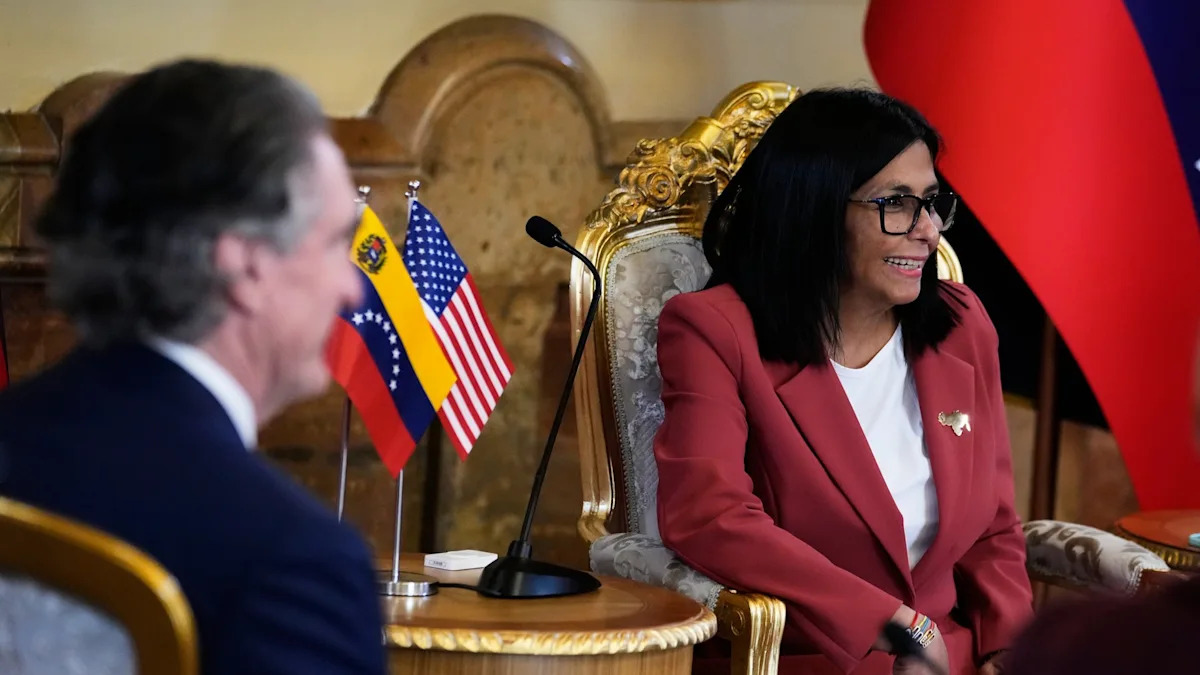
Instead of empowering the opposition, Trump turned to another Chavista—as members of the regime’s broader movement are known—as his interlocutor in Caracas. Then-Vice President Delcy Rodriguez was named acting president by Venezuela’s parliament and started working closely with Trump’s point man on Venezuela, Secretary of State Marco Rubio.
Now, some 15 weeks later, Venezuelans are still optimistic that positive change is on the way, even though so far they’ve found it in short supply.
Trump’s new model of intervention is illegal under international law and possibly under U.S. constitutional law as well, given that he didn’t consult Congress for what was obviously a military raid, though the administration characterized it as a law enforcement action. As for how it will work out for Venezuelans, the jury is still out.
An independent fact-finding mission established by the United Nations reported last month that “Venezuela’s repressive State machinery … remains operational,” with politically motivated arrests continuing alongside other widespread human rights abuses. In short, the report’s authors found, “the structures that have sustained persecution for years have not been dismantled.”
Even so, the fact that Maduro is in jail and on trial in New York, that several hundred political prisoners in Venezuela have been released and that Rodriguez is working hand-in-glove with the Trump administration has led to a dramatic shift in sentiment. In a recent survey, 58 percent of respondents said conditions have not improved, but a hefty 85 percent said they expect them to be better in a year.
Clearly, Venezuelans have experienced what today would be called a “vibe shift.” But much of the reality on the ground is remarkably unchanged.
Clearly, Venezuelans have experienced what today would be called a “vibe shift.” But much of the reality on the ground is remarkably unchanged, considering that the U.S. mounted what was essentially a successful regime-decapitation operation.
In all likelihood, however, their optimism won’t last forever if conditions don’t improve and if democracy doesn’t return. To that end, another poll found that 68 percent of Venezuelans want to see elections within a year.
If elections are held soon, opposition leader and Nobel Peace Prize winner Maria Corina Machado would almost certainly win in a landslide. But when polls will take place is anyone’s guess. Rubio has repeatedly said they will happen, without providing a date.
After more than a decade of dictatorship and a quarter-century of democratic backsliding under Chavista rule, Venezuelans are eager to choose their own leaders. But Washington is in no hurry, as for now, the current government in Venezuela is following the Trump administration’s instructions. Rodriguez and her associates—all members of the Chavista inner circle—know that Trump and Rubio hold their fate in their hands, so they have an interest in keeping the two happy. A new democratically elected government may not prove as pliable to Trump’s desire to call the shots in Caracas.
Rodriguez is keeping in close contact with Rubio as she reopens Venezuela’s oil industry to foreign investment, while trying to maneuver around Trump’s awkward claims that the U.S. is already making huge profits from Venezuelan oil. In a recent Cabinet meeting at the White House, Trump boasted, “We’ve taken billions and billions of dollars,” while claiming that “the United States has made a lot of money” from Venezuelan oil.
He then turned to his secretary of state, who is more accustomed to paying lip service to legal and ethical norms, to elaborate. Rubio said the U.S. is helping Venezuela benefit from its oil sales, handling the proceeds responsibly. The money, he emphasized, “is not being stolen.” But Trump, unable to restrain himself, promptly jumped in to add, “And we get a lot of it!”
Venezuelans are likely to tolerate the opaque handling of earnings from U.S.-controlled sales of Venezuelan oil, as long as they believe that not only economic but also political change is coming.
For her part, Machado has shown extraordinary tactical forbearance in dealing with Trump, even playing along with the spectacle of giving him her Nobel Peace Prize medal, even though the prize itself—as the committee made a point of emphasizing—cannot be transferred. And as she has noted of the current government in Caracas, “It’s the same people, with the same ideas and values, but the dynamic has changed because they’re evidently following instructions that come from the U.S.”
But Trump, who is now distracted by the war against Iran, seems happy with the situation as it stands in Venezuela. In the meantime, the regime may not be loosening its repressive grip on Venezuelan society. Last month, Rodriguez replaced long-serving Defense Minister Vladimir Padrino, who was reportedly aligned with a rival power center, with Gen. Gustavo Gonzales Lopez, a former head of Venezuela’s intelligence services who has been described as the country’s “chief torturer” and is also seen as a Rodriguez loyalist. The next day, she replaced the top rung of the military brass, securing a more loyal chain of command.
Most Venezuelans wanted to be rid of Maduro and were happy to see the dictator removed from power. For now, they are optimistic about the future. But there is no guarantee that Trump is going to follow through with Rubio’s promises of a democratic transition.
The regime’s colectivos—essentially gangs of civilian enforcers—are still roaming the streets in Caracas and other major cities, and the country is still governed by an unelected member of the Chavista clique. But Venezuelans are hoping that this is just the beginning and that the Trump administration will eventually return control over the country’s fate to its people. When that might happen, or how long the Venezuelan people’s patience will last, is the great unknown.
Frida Ghitis is WPR’s senior columnist and a contributor to CNN and The Washington Post. Her WPR column appears every Thursday. You can follow her on Twitter and Threads at @fridaghitis.
The post For Venezuelans, the Post-Maduro ‘Vibe Shift’ Is Still a Waiting Game appeared first on World Politics Review.